
How to Match New Hardwood to an Existing Floor (Even If It's Discontinued)
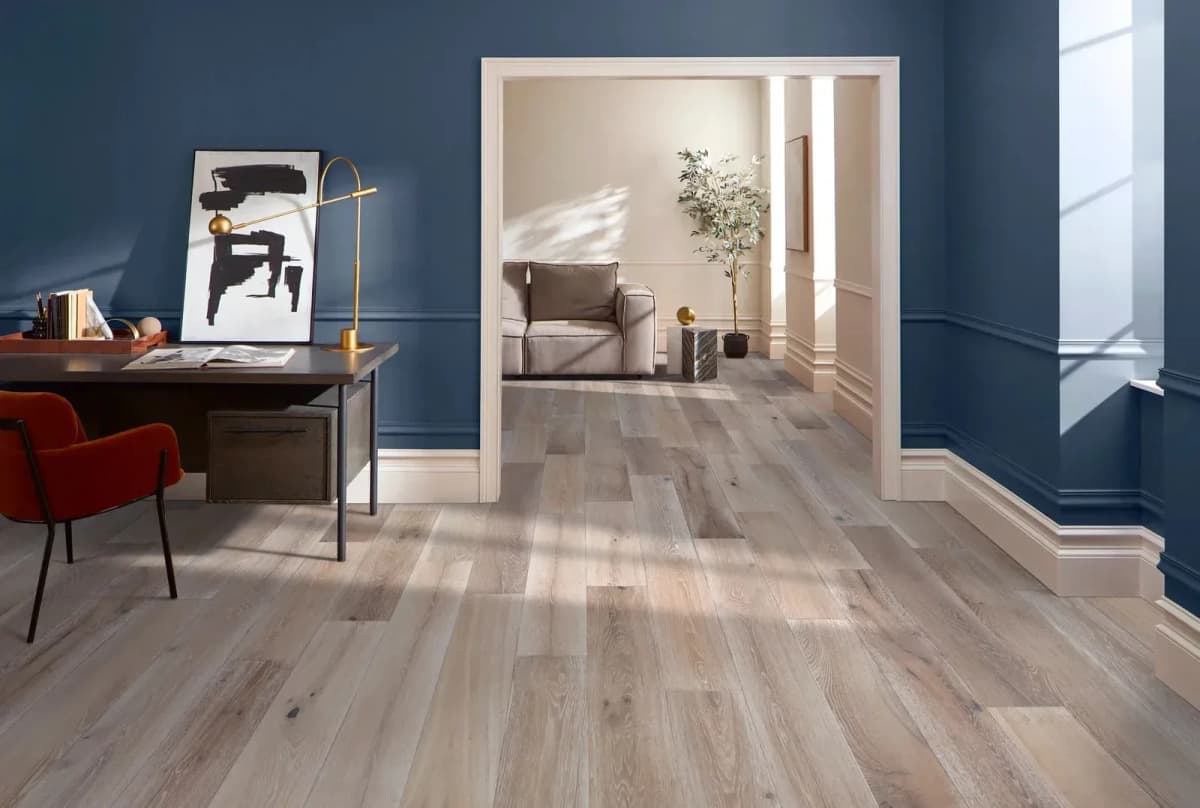
Floor names link to their product pages in a new tab.
Quick answer: Exact matches to a discontinued floor are rare, so the honest goal is "close enough that nobody's eye stops." Seven specs decide it: species, plank width, board thickness, stain color and undertone, sheen, edge profile, and board length. Where the two floors meet at a doorway, a transition strip buys enormous tolerance and a near-match is genuinely fine. Where they run continuously into one plane, tolerance collapses and almost nothing but the identical floor works. That leaves three exits: hunt a near-match and break it at a doorway, refinish everything together to unify it, or deliberately switch the new area to a complementary floor. Whichever you pick, hold physical samples against your actual boards first.
You have a floor you like and a room that needs one. An addition off the back. A hallway the water heater flooded. The office you finally finished. And somewhere around the third hour of searching, you learn the floor you're trying to match hasn't been made since 2011.
The advice you find at that point is remarkably unhelpful. Take a board to a flooring store. Find something similar. Consider refinishing. All technically true, none of it answering the question you actually have: what are my real options, and how close does close have to be?
The seven specs that decide whether two floors match
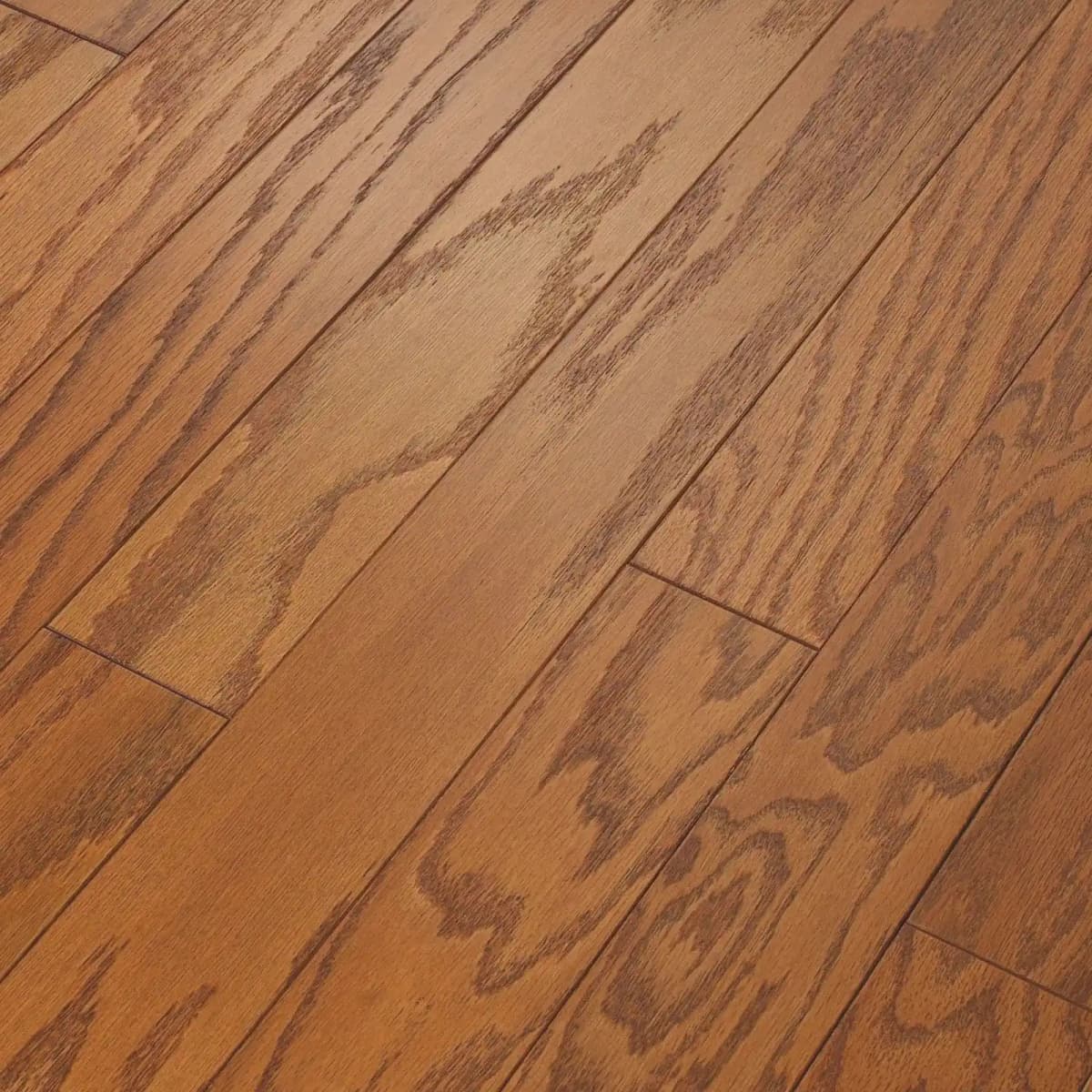
When someone says two floors "don't match," they almost never mean the color. It's usually one of the other six that gives it away.
1. Species. Red oak has an open, wavy grain with a pink cast underneath. White oak is straighter and browner. Maple is nearly grainless and takes stain unevenly. Hickory swings wildly board to board. Put stained maple next to stained red oak and no amount of color-matching makes them look related.
2. Plank width. The most visible mismatch and the most underestimated. A 3-inch board and a 5-inch board do not read as the same floor at any color. If your existing floor is narrow strip, this spec alone decides your project.
3. Board thickness and finished height. The sneaky one. If the new floor sits even a sixteenth of an inch off the old one, you feel it with a sock foot and see it in raking light. It's also where matching solid hardwood with engineered gets complicated — different builds land at different heights (solid vs. engineered covers why).
4. Stain color — and undertone. Two floors can both be "medium brown" and clash violently, because one runs red or gold underneath and the other runs gray or olive. Undertone is what fights, it's nearly impossible to judge from a screen, and it's obvious in four seconds in daylight.
5. Sheen. Mismatched gloss reads as wrong even when the color is perfect. Older floors are often satin or semi-gloss; most of what's built now is matte or low-gloss. Same stain, different sheen, and you still have two floors — one is glowing and the other isn't.
6. Edge profile. Square, micro-beveled, or fully beveled edges change the shadow line between boards: square reads as one continuous surface, bevels read as distinct planks. Easy to check — our hardwood pages publish an Edge Type spec, and most Shaw and Anderson Tuftex styles list Micro Bevel.
7. Board length and grade. How much of the floor is long boards versus short, and how much knot and mineral streak the grade allows. A clean select-grade floor next to a rustic character-grade floor is a mismatch at identical species, width, and color — one looks calm, the other busy.
How to use the list: write all seven down for your existing floor before you shop for anything — width and height with a tape and a straightedge, the rest read off a clean board in daylight. That one page of notes turns an overwhelming search into a filter. Two honest caveats while you do it. Width is printed on every one of our hardwood product pages; check it against your tape before ordering, because it's the dimension a matching project can't fudge. And gloss level isn't printed on our product pages — even a manufacturer's gloss percentage can't tell you how two sheens read side by side, so sheen is a judgment you make with a board in your hand, which is the last section of this post and the reason it exists.
Why an exact match to a discontinued floor is rare
Understanding why the search is hard stops you from spending three weekends on something that was never available.
Discontinued means gone, not renamed. When a mill retires a style, the tooling, the stain formula, and the grade spec go with it. There's usually no current product built to that spec under a new number — you're looking for something similar, not something equivalent.
Wood varies within one live style. Two cartons of the same SKU from different production runs can read noticeably different — which is why installers blend from multiple boxes as they lay a floor.
Your floor has aged. The factor almost everyone forgets. Wood ambers with UV exposure, some species dramatically — and a rug has been shielding one rectangle of it the whole time. Even a brand new carton of the identical floor wouldn't match your fifteen-year-old floor.
The whole category moved. Finishes shifted from satin and semi-gloss toward matte and wire-brushed; formats moved from 2 1/4-inch strip to 5-inch-and-wider plank. If your existing floor is narrow and glossy, you're not searching a small pool of near-matches — you're searching a market that has largely moved on from that product.
Accepting that early isn't defeatism. It's what lets you pick the right exit.
The doorway rule: what "close enough" actually tolerates
A continuous run has almost no tolerance. If the new boards extend the old floor in the same plane — butting end to end, sharing one uninterrupted field — your eye tracks straight across the seam and reads every difference as a flaw. Width, height, sheen, and undertone all have to be right, which in practice means the identical floor or a refinish.
A doorway break has enormous tolerance. A T-molding at the doorway tells your eye, quietly and instantly, that these are two rooms — and once it has that signal, it stops comparing and starts accepting. A floor in the same species and a compatible undertone reads as a deliberate choice, not a failed match. And if the new floor sits a little higher or lower, a reducer solves what would have been unfixable in a continuous run.
The corollary: a whole room in a slightly different floor reads as a design decision. Half a room reads as a repair. If you're patching damage mid-floor and can't source the original, extending the replacement to the nearest natural break is almost always the better-looking result — even though it means replacing more material than the damage required.
So before you evaluate a single sample: does my new floor meet the old one at a doorway, or in the middle of a room?
The three exits
There are only three, and every version of this problem ends at one of them.
Exit 1: Hunt a near-match, and break it at a doorway
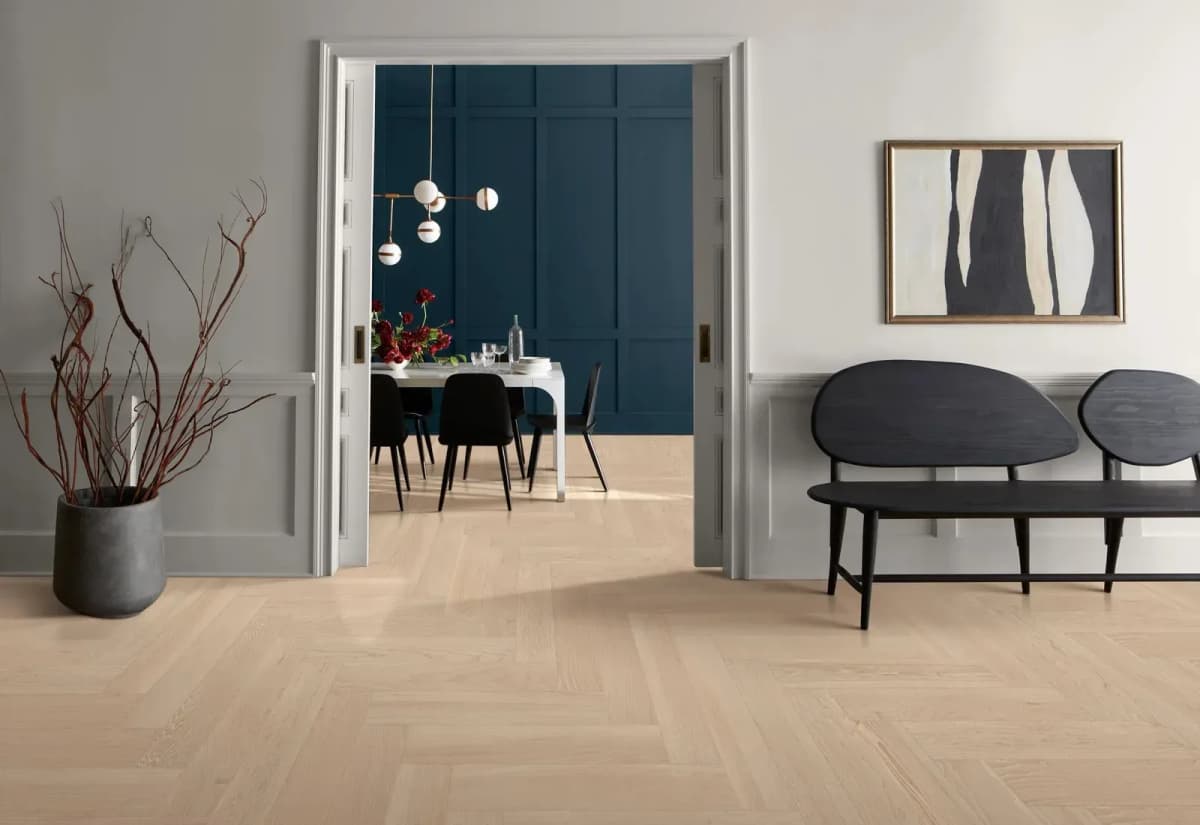
The right move when the areas are separable and you like your existing floor enough to extend its logic.
Prioritize in this order: species first, undertone second, sheen third, width fourth. Species and undertone are what your eye reads from across the room, which is where floors are seen. Width matters more the closer the two floors get — at a doorway break, much less than people fear.
Shaw's engineered hardwood covers maple, hickory, oak, white oak, red oak, and birch across 28 styles from $5.19 to $11.39/sq ft (MAP), 22 of them made in the United States. Anderson Tuftex — a Shaw brand that makes premium hardwood as well as carpetSource 1 — runs $7.79 to $21.99 across 21 styles and adds European ash, American walnut, European walnut, pecan, and Brazilian oak. Our Anderson Tuftex vs. Shaw comparison covers where the two catalogs overlap.
Species is the first filter to run, and it's more encouraging than most people expect:
- Red oak — what most older American floors actually are — is still in production. Albright Oak 5 is red oak at $5.99/sq ft on a 5-inch plank.
- Hickory runs from Arbor Place at $5.89 to Reflections Hickory at $8.99 at Shaw, and up to $10.79 in Anderson Tuftex's Bernina Hickory.
- Maple, the hardest species to stain-match because it takes color so unevenly, is Shaw's entry point — Ocala at $5.19, also 5-inch.
- White oak spans the range, from Cornerstone II at $7.59 (7.48-inch) to Grand Estate at $15.09 (10.25-inch). Walnut and ash are Anderson Tuftex only — Revival Walnut at $13.59, European Ash at $12.19.
Then the width reality check. Shaw's engineered planks run from 3.25 inches on Albright Oak 3.25 up to 7.5 on Expressions; Anderson Tuftex's straight-lay planks run from 5 inches on Bernina Hickory up to 10.25 on Grand Estate. If your existing floor is 2 1/4-inch strip oak, nothing in our engineered catalog will match its width — the closest is Albright Oak 3.25, a red oak plank at 3.25 inches. That's where the industry went, and it takes a continuous run off the table.
And buy extra. Whatever the room needs, add a carton and put it in a closet — the entire reason you're reading this is that somebody didn't. Our quantity guide covers waste factor, or the room calculator does it for you.
Exit 2: Refinish everything together to unify it
The only method that produces a truly seamless result, because you're not matching two finishes — you're erasing both and applying one.
Sand the old floor and the new one as a single surface, then stain and seal them together. Color, undertone, and sheen mismatches vanish completely — same stain, same sealer, same day. This is the answer when the two areas are continuous and a doorway break isn't available.
What it can't fix: width, thickness, and species. Sanding doesn't make a 3-inch board look like a 5-inch board, and stain lands differently on maple than on oak — refinishing two species together often amplifies the difference rather than hiding it.
The requirement people miss: the new floor has to be sandable too, and most engineered hardwood isn't. Twenty-seven of Shaw's 28 hardwood styles run a 1.2mm wear layer far too thin to put a sander over, and seven Anderson Tuftex styles run 1.2mm to 2mm. Unifying by refinish means buying a wear layer of at least 2.5mm for the new area, the National Wood Flooring Association's minimum for a factory-finished floor to count as refinishable.Source 2 In straight-lay white oak that starts at Shaw Expressions at $11.39/sq ft and Anderson Tuftex Artisan Oak at $11.69, both white oak, both 4mm, thirty cents apart. Both are textured too (Expressions wire-brushed, Artisan Oak distressed), and NWFA measures a textured floor's wear layer at the lowest point of the texture,Source 2 so have your refinisher assess a sample board before you commit. Above those, Revival Walnut at 4.5mm and Grand Estate at 6mm buy more sanding life. Our wear layer explainer covers why 1.2mm can't cross that line.
One more check first: your existing floor needs enough wood left above the tongue to sand, which a floor already refinished twice may not have. A contractor settles that in one visit — and it decides whether this exit is open at all.
Exit 3: Deliberately switch the new area to a complementary floor
The exit people resist and then, once they see it done, wonder why they fought.
If the new area is a distinct room — an addition, a finished basement, a bedroom, a laundry — you're allowed to stop matching. Choose a floor that's confidently different, coordinated by undertone rather than imitation. A warm oak in the main house and a deeper walnut-toned floor in the study reads as design; a warm oak and an almost-matching oak reads as a mistake. Go far enough that nobody wonders whether you were trying — a near-miss is the only genuinely bad outcome.
This is also the correct answer, not a fallback, in one case: when the room that flooded shouldn't have wood in it. Hardwood is not waterproof — not engineered, not solid, not at any wear layer. If the damage happened in a basement, laundry room, or full bath, replacing wood with wood rebuilds the same failure. Those rooms want a rigid-core vinyl floor; our basement flooring guide covers what belongs below grade.
If this is an insurance claim
Practical notes only — we sell flooring, we're not adjusters or attorneys, and what your policy covers on continuous-area replacement is a conversation with your carrier.
Document before anything gets demolished, and keep boards. Photograph the floor in daylight, wide and close, with something in frame for scale. Pull several undamaged pieces from the affected area and keep them dry — they're your reference for species, width, thickness, sheen, and edge, and what you'll hold samples against later. Once the damaged boards are in a dumpster, the evidence goes with them.
Get the discontinuation on record. If the original floor is no longer made, that's a fact about the claim, not an inconvenience to sort out privately. Note when you determined it and how.
Photograph the near-misses. The most useful thing you can do, and almost nobody does it. Order samples of your closest candidates and photograph them lying on your actual floor in daylight. Two samples beside your existing boards in one frame, showing the closest available product is visibly different — that's evidence. A written description of a color difference isn't.
Think in whole areas, not damaged square feet. Patching a continuous floor with a near-match produces a visible repair. Whether that's worth raising in your claim depends on your policy and your adjuster, but it's far easier to explain with photographs taken before anything was torn out.
The part that actually settles it: samples against your real boards
Everything above is analysis. This is the step that ends the anxiety.
You cannot match a floor on a screen. Undertone and sheen — the two specs most likely to sink a near-match — are exactly the two photographs render unreliably, and a warm oak can read gray on one monitor and gold on another. The only honest test is a physical board on your physical floor in your own light.
Samples at FloorFreight are $5 each with shipping included, and every dollar comes back as credit toward your floor order — with one condition we'll always state plainly: the credit applies only when you sign in at checkout with the same email you used to order the samples. Guests who check out anonymously don't get it, so sign in. The credit doesn't expire, so nothing is forcing a decision.
Order generously — four candidates, a full sample box, rather than two. You're not choosing a floor you like; you're finding one that survives contact with the floor you already own, and most won't. And once you've landed on a style in the right species and width, order two or three colorways of that same style: same construction, width, texture, and edge leaves color as the only variable. Albright Oak 5 in Hazelnut against the same style in Flax Seed Lg is that comparison at its cleanest — one red oak floor, two stains, your old floor deciding between them.
Then use them properly: flat on your existing floor, at the seam or doorway where the two will meet, in morning light and again in evening light — a candidate that matches at 8 AM and clashes at 7 PM is not a match. Our guide to comparing samples walks the full method, and how to evaluate a single sample covers reading one board well.
And whichever exit you pick, new hardwood has to acclimate before it goes down — doubly true here, since wood that moves after installation opens gaps at exactly the seam you were trying to make invisible.
Final word
Matching hardwood to an existing floor is a decision problem dressed up as a shopping problem. So answer the structural question first: doorway or continuous run. At a doorway, a near-match is genuinely good enough, and hunting one is the cheapest, cleanest path. In a continuous run, stop hunting — you're choosing between refinishing everything together and extending the new floor to the nearest natural break. And if the room shouldn't have had wood in it to begin with, switching floors isn't a compromise; it's the fix.
Browse the hardwood collection, or narrow by brand — the Shaw hardwood catalog and the Anderson Tuftex catalog. Prices are the manufacturer's advertised price (MAP); lower prices may be available — request a quote by email using the "Email for today's best price" form on any product page.
Then order $5 samples of your closest candidates and put them on the floor you're trying to match. However long the search felt, the answer usually announces itself within ten seconds of the right board landing next to the wrong one.
In this article
The floors from this guide

Shaw Hardwood
Albright Oak 5
Rustic Natural
Samples are $5 each, credited back at checkout when you sign in.

Anderson Tuftex
Revival Walnut
Rye
Samples are $5 each, credited back at checkout when you sign in.

Shaw Hardwood
Expressions
Poetry
Samples are $5 each, credited back at checkout when you sign in.

Anderson Tuftex
European Ash
Metro
Samples are $5 each, credited back at checkout when you sign in.
Common questions
Frequently Asked Questions
Can you match hardwood flooring that's been discontinued?
Rarely exactly, and you should plan around that from the start. A discontinued floor means the SKU is gone — not renamed, not reissued under a new number — so nothing currently in production was built to that spec. Even when you find a style in the same species and a nearly identical stain, three things will still be different: the finish chemistry mills use today (matte and wire-brushed have largely replaced the satin and semi-gloss of twenty years ago), the board format (the industry moved from 2 1/4-inch strip to 5-inch-and-wider plank), and your own floor, which has ambered under UV light and worn in its traffic lanes since the day it was installed. The realistic target is a floor close enough that nobody's eye stops on the seam — and where the two floors meet at a doorway rather than in one continuous plane, "close enough" is a much wider window than people expect.
Does new hardwood have to match the existing floor exactly?
It depends entirely on how the two floors meet. If the new boards run continuously into the old ones — same plane, butting end to end in a single unbroken field — tolerance is brutal and effectively nothing but the identical floor works, because your eye reads any shift in width, thickness, or sheen as a defect. If the two floors meet at a doorway with a T-molding between them, tolerance is enormous: the transition tells your eye that these are two rooms, and a near-match in the same species and undertone reads as intentional. That single structural question — continuous run or doorway break — decides more about your project than any spec on the box.
Is it better to refinish or replace hardwood to make it match?
Refinishing everything together is the only method that produces a genuinely seamless result, because the new stain and sealer go down over both floors at once and erase the color and sheen differences entirely. It cannot fix a width or thickness mismatch, it requires that the existing floor still have sandable wood left, and — the part people miss — it requires the new floor to be refinishable too. Most engineered hardwood isn't: 27 of Shaw's 28 hardwood styles run a 1.2mm wear layer that's too thin to sand, and seven Anderson Tuftex styles run 1.2mm to 2mm, also too thin. If unifying by refinish is your plan, you have to buy a wear layer of at least 2.5mm for the new area, the National Wood Flooring Association's minimum for a factory-finished floor to count as refinishable. In straight-lay white oak that starts at $11.39/sq ft (Shaw Expressions, 4mm) or $11.69 (Anderson Tuftex Artisan Oak, 4mm) at the manufacturer's advertised price. Both are textured (Expressions wire-brushed, Artisan Oak distressed), and NWFA measures a textured floor's wear layer at the lowest point of the texture, so have your refinisher assess a sample board before you commit.
How do you match hardwood after water damage or an insurance claim?
Document before you demo. Photograph the existing floor in daylight next to something for scale, save a few undamaged boards pulled from the affected area, and write down whatever identifying information you have — the original invoice, a carton label from the attic, the builder's name. Then, before any replacement material is ordered, get the mismatch itself on record: if the original floor is discontinued and no current product matches it, that fact is part of the claim, not a detail to sort out later. Order samples of the closest candidates and photograph them against your actual boards, because a photograph of two samples beside your floor is far more persuasive than a description. We're a flooring retailer, not adjusters or attorneys — for what your specific policy covers on continuous-area replacement, that's a conversation with your carrier.
Referenced in this guide
Sources
Our Company — History
Shaw Industries Group, Inc. · Accessed 2026-09-26
https://shawinc.com/Our-Company/HistoryNWFA Launches Engineered Wood Flooring Refinishable Program (Hardwood Floors magazine, Aug/Sept 2022)
National Wood Flooring Association · Accessed 2026-09-26
https://nwfa.org/wp-content/uploads/2022/09/HFM_AugSept22_final_refinishable_small.pdf
Related Posts
Keep Reading
Shaw Hardwood Buying Guide: Repel, The Gallery and Expressions (2026)
9 min read
What Is the Best Flooring for Stairs? Hardwood, LVP and the Stair Nose (2026)
13 min read
Herringbone Flooring Guide: What Makes the Pattern Premium (2026)
8 min read
Best Hardwood for High-Traffic Homes: Janka, Wear Layer, and What Lasts
9 min read
Keep browsing