
What Is the Best Flooring for Stairs? Hardwood, LVP and the Stair Nose (2026)
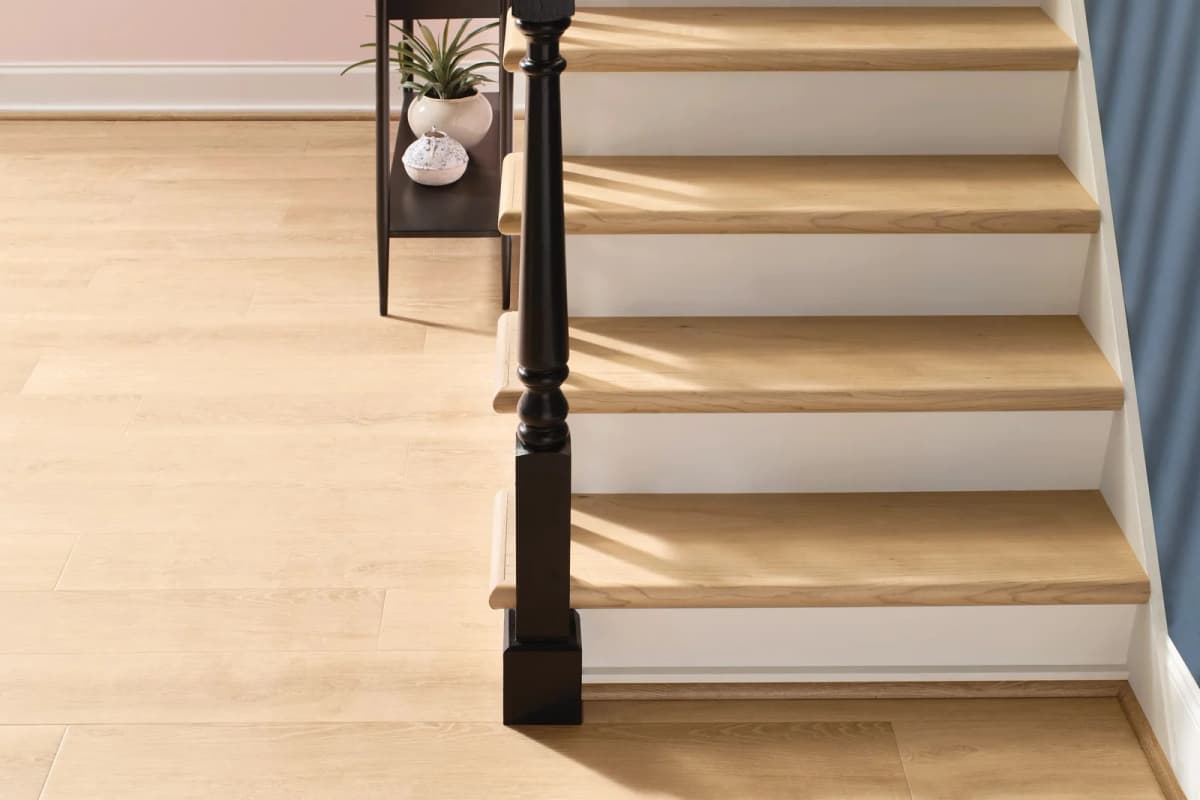
Floor names link to their product pages in a new tab.
Quick answer: The best flooring for stairs is the floor that matches the room it climbs from, fully glued to every step and finished with a stair nose made for your exact color: engineered hardwood from $5.19 per square foot, or luxury vinyl plank (LVP) from $2.99 per square foot. Shaw's step-down directions require fully adhered installations on steps, for resilient floors and wood floors alike, even for click-together floors approved to float on a flat floor.Source 1Source 2 All 102 styles we sell list at least one stair nose, but only 656 of 770 colorways (about 85%) have one declared for that specific color, so confirm yours before you order.
Every floor in your house takes wear. Stairs take it differently.
Walk across a living room and your weight spreads over the whole floor. Walk up a staircase and every step lands on the same narrow strip at the front of the tread, the part that projects past the riser. That edge is the stair nose. A loose, worn or uneven one is a trip hazard, not just a cosmetic flaw, which makes stairs the most demanding surface in the house.
This guide covers how hardwood and LVP each perform on steps, why stair flooring is glued rather than floated, how to choose between flush, overlap and square stair nose profiles, what building code and slip guidance actually say, and which of our floors have a stair nose made to match. We sell every floor named here as an authorized dealer for Shaw Floors, Anderson Tuftex and COREtec, and the stair nose numbers come straight from the product data in our catalog as of September 22, 2026.
How do hardwood and LVP compare on stairs?
Both work on stairs when they're fully adhered. The practical differences are price, the wood-or-vinyl surface underfoot, and how likely you are to find a stair nose made for your exact color: 97% of our LVP colorways have one, compared with 68% of our engineered hardwood colorways.
| Attribute | Engineered hardwood | Luxury vinyl plank |
|---|---|---|
| Price per sq ft | Shaw $5.19 to $11.39; Anderson Tuftex $7.79 to $21.99 | Shaw $2.99 to $8.19; COREtec $4.09 to $10.69 |
| Surface | Real wood top layer | Wear layer from 6 to 30 mil; 20 mil on 36 of the 53 LVP styles with stair pieces |
| Install on stairs | Fully adhered; stair nose glued and nailed or screwed | Fully adhered; the stair nose sits on a molding track, or, if it's a flush LVT nosing, glues straight to the stair edge |
| Styles with a stair nose | 49 of 49 | 53 of 53 |
| Colorways with a stair nose for that exact color | 206 of 305 (68%) | 450 of 465 (97%) |
| Line to double-check | Shaw hardwood: 111 of 184 colorways (60%) | Coverage is high across both brands (96% to 98%) |
| Choose it if | Your main floor is wood and you want real wood on the treads | Your main floor is LVP, or you want the widest color choice with a matching nose |
Can you put luxury vinyl plank on stairs?
Yes. Luxury vinyl plank works on stairs as long as every piece is glued down rather than clicked together and left floating. Shaw publishes its own step-down directions for resilient floors, separate from the wood and laminate set, and they require full adhesion on steps, for reasons of safety and structural stability. The rule applies even to click-lock floors approved to float on a flat floor, and the planks go down with Shaw's 200 TPS resilient adhesive.Source 1
Here's what that looks like in practice. The COREtec Original Premium in Wheat Oak (VV820) pictured at the top of this guide is listed for floating or glue-down installation. In the living room, you can choose. On the stairs, we'd glue. Shaw files those resilient directions under its own Shaw-Residential lines, and we found no COREtec stair-installation document to sit beside them, so on a COREtec floor that last part is our position rather than a COREtec instruction: confirm the method in the installation guide for your specific style.
If your nosing glues straight to the stair edge, it gets extra steps. Shaw's resilient step-down directions set the nose on a molding track,Source 1 but its LVT flush stair nose guidelines cover a nosing bonded directly to the stair edge with no track at all: scuff the underside of the nosing, clean it with denatured alcohol, apply a premium construction adhesive in an S pattern, and hold the piece in place with weights or sandbags and/or pre-drilled finish nails. Shaw names the adhesive by product line: its TTT (Tread, Trim & Tackstrip) adhesive for Floorté, and T-180 for rigid-core floors with an attached pad.Source 3 Two Shaw documents, two methods, so use the one the installation guide for your style points to.
A one-piece tread can simplify the job. Shaw describes its stair tread as a single-piece alternative to a separate stair nose that installs faster and includes a cap for a right- or left-side installation.Source 3 COREtec's version is a one-piece tread with pre-attached nosing, made for closed stairs and for stairs with an exposed side.Source 4
Wear layer matters more on a stair edge. Your foot rolls onto the nose on the way up and pivots on it on the way down, so that narrow strip wears first. Of the 53 LVP styles in our catalog with stair pieces, 36 have a 20 mil wear layer, 8 have 30 mil, 3 have 22 mil, 4 have 12 mil and 2 have 6 mil. Our LVP wear layer explainer covers what each of those buys you, and our LVP installation guide covers adhesive and prep basics.
Why does stair flooring have to be glued instead of floated?
Because the manufacturer requires it. Shaw publishes step-down directions for wood and laminate floors and a separate set for resilient floors. Both carry the same line: "Shaw requires fully adhering installations on steps for safety and structural stability reasons."Source 1Source 2 The sequence is the same either way. The direction you work in, the adhesive and the fasteners depend on the material:
- Work in one direction. The resilient directions start at the bottom step and work up, so each tread lands against a riser that is already glued and set. The wood and laminate directions start at the highest step and work down.
- Tread first. Full-spread glue the tread piece to the existing step. On vinyl that's Shaw's 200 TPS resilient adhesive, hand rolled for transfer and bond; on wood it's ECOMADE wood flooring adhesive, spread with a 3/16-inch V-notch trowel.
- Riser second. Glue the riser piece in so it sits flush to the tread. On a metal riser, the resilient directions have you let the adhesive flash off before setting the plank.
- Stair nose last. Both documents set the nose on a molding track. On vinyl, the track is bonded with a two-part epoxy, with trim screws added where the step itself is built of wood; on a wood floor, the nose goes on with ECOMADE adhesive plus finish nails or trim screws in pre-drilled holes, then color fill over the heads. A flush LVT nosing is the exception: Shaw's separate sheet for it skips the track and bonds the nosing straight to the stair edge.Source 3
- Wait 12 hours. Both documents keep everyone off the stairs for 12 hours so the adhesive can cure.
The gluing doesn't stop at the top step. Shaw's LVT flush stair nose guidelines say flooring on a landing should be direct glued, and if a flush stair nose sits next to a floating floor, the first row of flooring (or at least 6 inches) must be secured with a band of adhesive, with the normal perimeter spacing kept around the rest of the room.Source 3 In other words, even a floating vinyl main floor gets glued where it meets the stairs.
Can engineered hardwood go on stair treads and risers?
Yes. Engineered hardwood can cover both treads and risers, and it's the natural choice when the floor at the top or bottom of the staircase is wood. The glue-down rule still applies. Anderson Tuftex's engineered hardwood installation guidelines, a Shaw Industries document, say stair nosing is secured by gluing and then nailing or screwing it into place, with pre-drilled holes to avoid splitting.Source 5
Those same guidelines allow floating installation only for products 3 inches or wider, with 1/2 inch of expansion space at every wall and other vertical surface.Source 5 So a hardwood that's eligible to float in a room still goes down fully adhered on the steps, per Shaw's step-down directions for wood and laminate floors.Source 2 Anderson Tuftex's installation page links that guide and a separate herringbone guide but no stair-specific directions,Source 6 so for its floors, follow the guide for your specific style alongside Shaw's wood and laminate step-down directions.
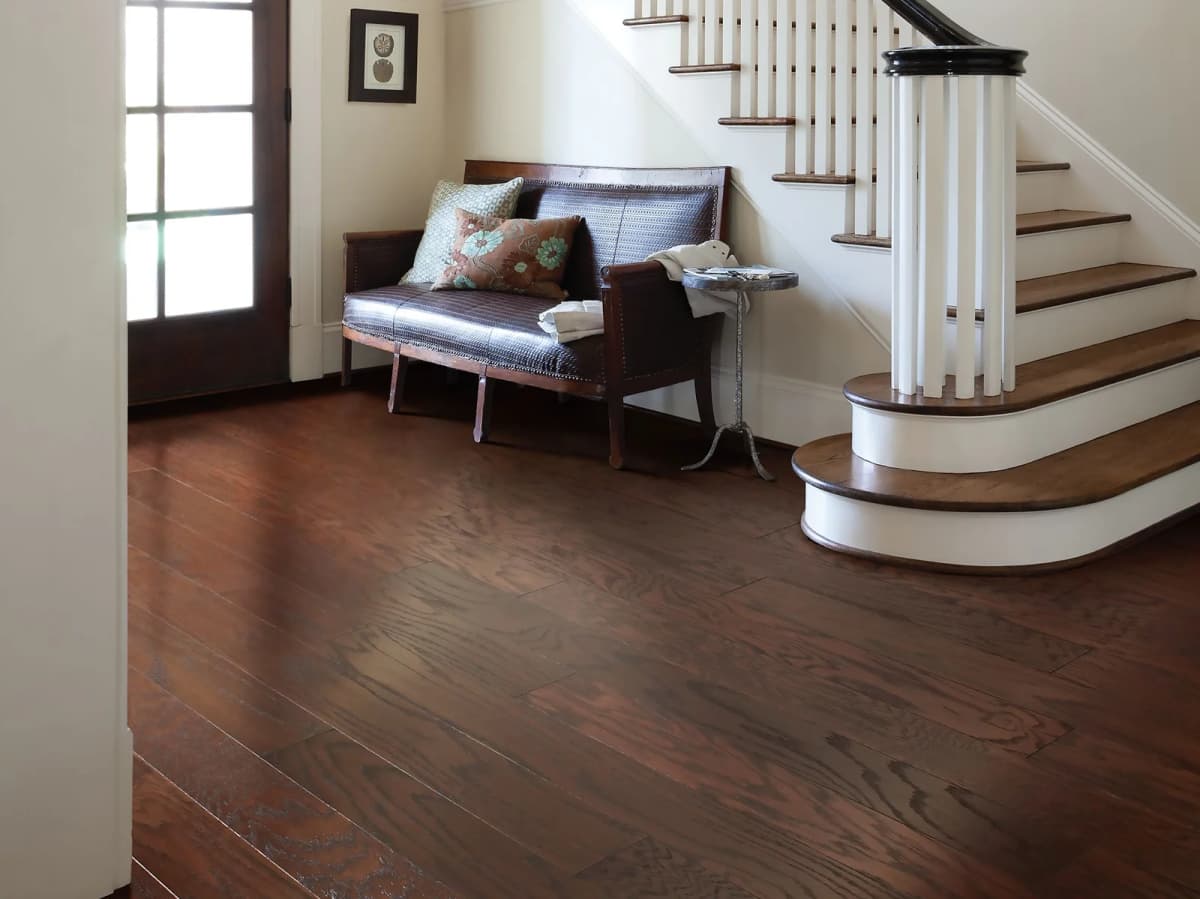
Price and color are where hardwood asks more of you. Shaw hardwood runs $5.19 to $11.39 per square foot across 184 colorways, and Anderson Tuftex runs $7.79 to $21.99 across 121. Matching stair nose coverage is 79% of colorways for Anderson Tuftex and 60% for Shaw hardwood, so 4 in 10 Shaw hardwood colors don't have a stair nose listed for that exact color. If you're set on a Shaw hardwood color, check its trim list before anything else.
Pick a surface built for traffic. A stair nose takes concentrated wear, so species hardness and the thickness of the wood layer matter here. Our guide to the best hardwood for high-traffic homes ranks species by hardness, and engineered hardwood wear layers explained covers how much real wood you're getting. For brand-level detail, see our Shaw hardwood buying guide and Anderson Tuftex hardwood buyer's guide.
Matching risers are rare. In the Shaw product data behind our catalog, a stair riser piece is listed for just 9 of the 102 styles we sell, which is one reason so many wood staircases pair wood treads with painted risers.
Flush, overlap or square stair nose: which one do you need?
Choose between a level edge and a lip, check what your floor's installation guide calls for, then confirm that profile is made for your color. A flush stair nose sits even with the floor surface, while an overlap stair nose has an extended edge that covers the seam between the flooring and the stair and hides expansion gaps.Source 7 One flooring retailer's guide describes that overlap lip lapping over a floating floor and hiding its expansion gap so the floor can still move, and notes that overlap nosing can also be glued down with construction adhesive.Source 8 We couldn't find a Shaw, COREtec or Anderson Tuftex document, or the Today's Homeowner piece above, that pairs overlap with floating floors and flush with glue-down floors as a rule, so confirm the profile against the installation guide for your floor.
| Profile | What it does | Where it fits | In our catalog |
|---|---|---|---|
| Overlap stair nose | A lip laps over the edge of the flooring | Can hide the expansion gap where a floating floor meets the stairs | Listed for fewer styles than flush, including 11 of our 30 COREtec styles |
| Flush stair nose | Sits level with the floor surface | A level edge with no lip; next to a floating floor, Shaw's LVT guidelines require gluing the first row | The most widely listed stair piece in our catalog |
| Square nose stair nose | Caps the step edge with a squared-off profile | We found no manufacturer install guidance specific to it | Listed on some styles, including two of the three Anderson Tuftex herringbone styles |
| One-piece stair tread | Tread and nose in a single piece, with a round or square edge | An alternative to a separate nose, with fewer pieces to fit | Listed for many styles |
| Stair riser | Covers the vertical face of the step | A fully matched staircase | The rarest stair piece, just 9 styles |
In our catalog data, a flush stair nose is listed for all 30 COREtec styles we sell and an overlap stair nose for 11 of them, so check the trim list before planning on an overlap nose for a COREtec floor. For a flush nose next to a floating floor, remember Shaw's rule from the section above: glue the first row of flooring, or at least 6 inches, with a band of adhesive.Source 3
Think about the lip, too. A raised stair nose lip is something home inspectors discuss as a trip concern.Source 9 If someone in your home tends to catch a toe on edges, a level flush nose is worth weighing. Our flooring trim guide shows profile drawings of flush and overlap pieces side by side.
Which FloorFreight floors have a matching stair nose?
Every one of the 102 active styles we sell lists at least one stair nose, but coverage by exact colorway ranges from 60% for Shaw hardwood to 98% for Shaw LVP. That gap exists because many stair nose listings are tied to specific colors rather than a whole style: 264 stair nose listings in our catalog data are limited to named colorways.
| Line | Active styles | Styles with a stair nose | Active colorways | Colorways with a stair nose for that color |
|---|---|---|---|---|
| Anderson Tuftex engineered hardwood | 21 | 21 | 121 | 95 (79%) |
| Shaw engineered hardwood | 28 | 28 | 184 | 111 (60%) |
| Shaw luxury vinyl plank | 23 | 23 | 215 | 210 (98%) |
| COREtec luxury vinyl plank | 30 | 30 | 250 | 240 (96%) |
| All floors | 102 | 102 | 770 | 656 (85%) |
These are floors where we've confirmed the stair pieces listed for the specific color shown:
| Floor | Type | Price per sq ft | Stair pieces listed for this color |
|---|---|---|---|
| COREtec Original Premium, Wheat Oak (VV820) | LVP, 20 mil wear layer | $8.79 | Flush and square stair nose, stair tread |
| COREtec Originals Premium 3/4", Natural Linen Oak (CR500) | LVP, 30 mil wear layer | $10.69 | Flush and square stair nose, stair tread |
| Shaw Pantheon HD+ Natural Bevel, Fresco Cream (1051V) | LVP, 20 mil wear layer | $6.49 | Flush and square stair nose, stair tread |
| Shaw Mendocino, Buckskin (200SA) | Engineered maple, 3/8 inch | $6.79 | Flush and overlap stair nose |
| Anderson Tuftex Bernina Hickory, Sella (AA791) | Engineered hickory, 1/2 inch | $10.79 | Flush and overlap stair nose |
| Anderson Tuftex Transcendence, Absolute (AA806) | Engineered hickory, 9/16 inch | $10.79 | Flush, overlap and square stair nose |
| Anderson Tuftex European Ash Herringbone (AA846), all 8 colorways | Engineered hardwood, herringbone | $12.89 | Flush, overlap and square stair nose |
| Anderson Tuftex Provincial Herringbone (AA853), all 5 colorways | Engineered hardwood, herringbone | $10.79 | Flush, overlap and square stair nose |
How to check any floor. On every product page, the coordinating trim and moldings section lists the pieces made for that color, including stair nose and stair tread pieces where they exist. Our product pages also note that trim is made to coordinate with your floor rather than match it exactly, and some color variation is expected. Trim and stair nose pieces are final sale, so confirm the profile and color before you add them to your order. Our returns policy has the details.
What do building codes and slip guidance say about stair flooring?
Adding flooring changes the height of your steps, and the model residential code allows only 3/8 inch of difference between the tallest and shortest riser in a flight. Here's what the International Residential Code's stair section says, as reproduced in the City of Boise's code handout:Source 10
| Measurement | Model code limit (IRC R311.7.5) |
|---|---|
| Riser height | No more than 7-3/4 inches; tallest riser in a flight no more than 3/8 inch taller than the shortest |
| Tread depth | At least 10 inches; the greatest tread depth in a flight may exceed the smallest by no more than 3/8 inch |
| Nosing projection | Between 3/4 inch and 1-1/4 inches; largest projection no more than 3/8 inch greater than the smallest |
| When nosing isn't required | Where tread depth is at least 11 inches |
| Nosing edge | Radius no more than 9/16 inch, or a bevel no more than 1/2 inch |
Why that matters for flooring. If you add 1/2-inch treads to every step but the floor at the bottom of the stairs doesn't rise by the same amount, the bottom riser ends up 1/2 inch taller than the rest, which is more than the 3/8-inch tolerance. The same math applies at the top landing. Stair codes are adopted and amended locally, so check with your building department or installer before you change tread thickness.
On slipperiness, be wary of borrowed numbers. The 1991 ADA Standards recommended a static coefficient of friction of 0.6 for accessible routes and 0.8 for ramps, but that was advisory guidance for public and commercial buildings, not a requirement for private homes, and the same appendix notes that friction varies considerably with water, contaminants and floor finishes.Source 11 We don't have published slip-resistance test results for the individual floors we sell, so we won't rank them on traction. What you can control:
- A stair nose that is glued and fastened the way the manufacturer specifies.
- Nose projections that stay consistent from step to step.
- No raised lip that catches a toe at the top or bottom of the flight.
- A full 12 hours off the stairs after installation, which both of Shaw's step-down documents require.Source 1Source 2
Should your stairs match the rest of your floor?
Usually, yes. The same material and colorway flowing from the floor onto the stairs reads as intentional, provided a stair nose is listed for your exact color. Confirm that before you commit, because finding the gap after the main floor is down is an expensive surprise.
Herringbone is a floor pattern, not a stair pattern. The zigzag belongs to the open floor, and the step edge is finished with a coordinating stair nose. All three Anderson Tuftex herringbone styles we carry list a stair nose for every active colorway: European Ash Herringbone (AA846) and Provincial Herringbone (AA853) in flush, overlap and square, and Revival Walnut Herringbone (AA833) in flush and overlap. In the photo below, the herringbone stays on the entry floor while the staircase is handled separately. Our herringbone flooring guide covers layout and pattern choices.

Riser options come down to style. The riser is the vertical face between treads, and it's where you get a design choice:
- Match. Use the manufacturer's riser piece in the same color as the treads for an all-wood or all-vinyl look, where one is offered.
- Contrast. Pair wood or LVP treads with a painted riser, most often white, for the classic two-tone staircase shown in the photos in this guide.
- Paint throughout. Surface only the treads and paint the existing risers.
Not sure which material fits your home? Our LVP vs. engineered hardwood comparison lays out the full decision.
Should you install stair flooring yourself?
For most homeowners, stairs are the job to hand to a pro. The stair nose is structural, Shaw's step-down directions call for adhesive on every piece plus a nose anchored down rather than floated, on a molding track set in epoxy or in adhesive with nails and screws through pre-drilled holes,Source 1Source 2 and consistent overhangs, clean miters and tidy returns across a full flight take real finish-carpentry skill.
A straight, closed staircase is within reach for a confident DIYer who is comfortable with a miter saw and adhesive. Open-sided stairs, curved runs and winders are better left to a professional. If you're hiring, our guide on how to find a flooring installer covers the questions worth asking, and it's reasonable to ask installers to price the stairs as their own line item.
Which stair floor should you choose?
Start with the floor the stairs connect to, then let the stair nose decide between colors you like equally.
- Choose engineered hardwood if your main floor is wood and you want real wood on the treads. Check the trim list first, especially for Shaw hardwood, where 60% of colorways have a matching stair nose.
- Choose luxury vinyl plank if your main floor is LVP or you want the widest choice of colors with a matching nose (97% of our LVP colorways).
- Choose a 30 mil LVP, like COREtec Originals Premium 3/4" (CR500), if your staircase takes heavy daily traffic and you want the thickest wear layer we offer on a stair-matched style.
- Choose a flush stair nose if you want a level edge with no raised lip. Next to a floating vinyl floor, glue the first row (at least 6 inches) as Shaw's LVT guidelines specify.
- Choose an overlap stair nose if the floor meeting the stairs floats, your installation guide calls for it, and one is listed for your color.
- Choose a one-piece stair tread if it's listed for your color and you'd rather fit fewer pieces per step.
- Hire a pro if your stairs are open-sided, curved or have winders.
How should you plan and sample before you order?
Count treads, risers and stair nose pieces, not just square footage, and add every trim piece to the order alongside the floor. Our flooring calculator guide walks through the measuring.
Then see the floor in place before you commit. Order a $5 sample of the style you're considering; the full $5 comes back as credit when you sign in at checkout with the same email you used for samples. Set it on your actual staircase, look at it in morning and evening light, and step back ten feet. Our guide to evaluating flooring samples explains why a stairwell's light and sightlines change how a floor reads.
The bottom line on stairs: pick the material that matches your floor, glue every piece the way the manufacturer specifies, choose the stair nose profile that suits your install, and confirm that nose is listed for your exact color. Get those four things right and your staircase will be the best-looking, hardest-working surface in the house.
In this article
The floors from this guide

COREtec Floors
COREtec Original Premium VV820
Wheat Oak
Samples are $5 each, credited back at checkout when you sign in.

Shaw Floors
Pantheon Hd+ Natural Bevel
Fresco Cream
Samples are $5 each, credited back at checkout when you sign in.

Anderson Tuftex
European Ash Herringbone
Plaza
Samples are $5 each, credited back at checkout when you sign in.
Common questions
Frequently Asked Questions
What is the best flooring for stairs?
The best flooring for stairs is the floor that matches the room it connects to, fully adhered to every step and finished with a stair nose made for your exact color. At FloorFreight that means engineered hardwood from $5.19 per square foot (Shaw) or luxury vinyl plank from $2.99 per square foot (Shaw). All 102 styles we sell list at least one stair nose, but only 656 of 770 colorways (about 85%) have one declared for that specific color, so check yours before you order. LVP has the widest matching coverage, at 450 of 465 colorways (97%), while engineered hardwood sits at 206 of 305 (68%).
Can you put luxury vinyl plank on stairs, and does it have to be glued?
Yes, LVP can go on stairs, and yes, it has to be glued. Shaw publishes a separate set of step-down directions for resilient floors, and they require fully adhered installations on steps for safety and structural stability, even for click-together floors that are approved to float on a flat floor. Working from the bottom step up, the tread plank is full-spread glued with Shaw's 200 TPS resilient adhesive and hand rolled, the riser plank is glued to sit flush with the tread, and the stair nose molding goes on last on a molding track fastened with a two-part epoxy or trim screws. Shaw's separate LVT flush stair nose sheet covers a nosing that bonds straight to the stair edge instead, with no track, held with weights or pre-drilled finish nails, so follow whichever method the installation guide for your style points to. Shaw says to allow 12 hours before foot traffic so the adhesive can cure.
Do I need a flush or overlap stair nose?
It depends on whether you want a level edge or a lip. A flush stair nose sits level with the floor surface, while an overlap stair nose has an extended edge that covers the seam between the flooring and the stair and hides expansion gaps. Shaw's LVT flush stair nose guidelines add a key detail: if a flush nose meets a floating floor, the first row of flooring (at least 6 inches) must be glued down with a band of adhesive. We couldn't find a Shaw, COREtec or Anderson Tuftex document that assigns one profile to floating floors and the other to glue-down floors, so check the installation guide for your floor. Some styles also offer a square nose profile. Whichever you choose, confirm it's listed for your exact colorway.
Does every floor have a matching stair nose?
Every one of the 102 styles we sell lists at least one stair nose, but not every color does. Matching coverage by exact colorway is 98% for Shaw luxury vinyl plank, 96% for COREtec, 79% for Anderson Tuftex hardwood and 60% for Shaw hardwood. On any product page, the coordinating trim section shows the stair pieces listed for that color. Trim and stair nose pieces are final sale, so confirm the profile and color before you add them to your order.
Is hardwood or vinyl flooring slippery on stairs?
We don't have published slip-resistance test results for the individual floors we sell, so we won't rank them on traction. A number you may see quoted, a static coefficient of friction of 0.6, comes from advisory guidance in the 1991 ADA Standards for accessible routes in public and commercial buildings, not a requirement for private homes, and that guidance itself notes friction varies with water, contaminants and floor finishes. What you can control is a stair nose that is fastened the way the manufacturer specifies, nose projections that stay consistent from step to step, and no raised lip that catches a toe.
Should I install stair flooring myself?
Stairs are the one flooring job where we'd tell most DIYers to think twice. Shaw's step-down directions call for a specific sequence (tread, then riser, then stair nose), adhesive on every piece, a nose anchored down rather than floated, and a 12-hour wait before foot traffic, and the miters, returns and consistent overhangs take real finish-carpentry skill. A straight, closed staircase is within reach for a confident DIYer. Open-sided stairs, curved runs and winders are better handed to a professional installer.
Referenced in this guide
Sources
Resilient Installations on Step Downs or Staircases: Stair Tread and Riser Directions (rev. 06262019)
Shaw Industries · Accessed 2026-09-22
https://pdmsview.shawinc.com/Shaw-Residential/Shaw-Residential-Installation/Resilient-Installation/Resilient-Step-and-Riser-DirectionsHardwood Laminate Installation on Step Downs or Staircases: Stair Tread and Riser Directions (rev. 06262019)
Shaw Industries · Accessed 2026-09-22
https://qmsview.shawinc.com/Shaw-Residential/Residential-Adhesives-Sundries/Stair-Treads/Installation-on-Step-Downs-or-StaircasesLVT Flush Stair Nose Installation Guidelines and Trim Profiles Information Sheet (TW_1636049_1023)
Shaw Floors (dealer-hosted copy) · Accessed 2026-09-12
https://www.shawfloors-acehardware.com/SiteFiles/shawfloors-acehardware/DealerContent/Trim-Profiles-Information-Sheet.pdfEngineered Hardwood Installation
Anderson Tuftex (Shaw Industries) · Accessed 2026-09-15
https://pdmsview.shawinc.com/viewer/document/doc/19216Hardwood Installation
Anderson Tuftex · Accessed 2026-09-15
https://andersontuftex.com/en-us/hardwood-installationFlush vs. Overlap Stair Nose
Today's Homeowner · Accessed 2026-09-12
https://todayshomeowner.com/blog/guides/flush-vs-overlap-stair-nose/Flush vs. Overlap Stair Nose
Stone & Tile Shoppe · Accessed 2026-09-12
https://stoneandtileshoppe.com/blogs/construction-renovation/flush-vs-overlap-stair-noseRaised Nose on the Stairway Tread (forum discussion)
InterNACHI Forum · Accessed 2026-09-12
https://forum.nachi.org/t/raised-nose-on-the-stairway-tread/160010Treads and Risers: International Residential Code Section R311.7.5 (code handout)
City of Boise Planning and Development Services · Accessed 2026-09-12
https://www.cityofboise.org/media/14405/437-treads-risers_march-2022.pdf1991 ADA Standards for Accessible Design, Appendix A4.5.1: Ground and Floor Surfaces
U.S. Access Board (text reproduced by Corada) · Accessed 2026-09-12
https://www.corada.com/documents/1991ADAStandards/a4-5-1
Related Posts
Keep Reading
How to Match New Hardwood to an Existing Floor (Even If It's Discontinued)
10 min read
Shaw Hardwood Buying Guide: Repel, The Gallery and Expressions (2026)
9 min read
Herringbone Flooring Guide: What Makes the Pattern Premium (2026)
8 min read

Best Hardwood for High-Traffic Homes: Janka, Wear Layer, and What Lasts
9 min read
Keep browsing