
Best Flooring for Basements (Below-Grade) 2026: What Actually Survives
A basement is the hardest room in your house on flooring, and most people don't find out why until it's too late. The reason isn't spills or foot traffic — it's the concrete slab itself. Your basement sits against and below the surrounding soil, and moisture moves continuously up through that slab, even when the floor looks and feels bone dry. Put the wrong floor down and that invisible moisture will cup it, buckle it, or rot the subfloor beneath it.
The good news: the right floor handles all of it, and you have more attractive options below grade than ever. This guide covers what "below grade" actually means, the four flooring categories that survive it, the one that doesn't, and the test almost everyone skips. We sell the products covered here at FloorFreight as an authorized dealer for Shaw, COREtec, and Anderson Tuftex.
First, what "below grade" actually means
Flooring guidelines split your home into three zones. The National Wood Flooring Association (NWFA) recognizes above grade, on grade, and below grade, and defines below grade precisely: it's any part of the subfloor installed three inches or more below the surrounding ground level. On grade sits at roughly ground level; above grade is everything higher.
Most basements are firmly below grade, and that's what makes them tough. As building-science testing lab Wagner Meters puts it, wood floors installed over concrete in these conditions will "cup or buckle due to the moisture rising through the concrete." The slab isn't wet — it's a moisture source, slowly feeding humidity into whatever you install on top of it. Every recommendation below flows from that one fact.
The short answer: skip solid hardwood, pick one of four
Here's the verdict up front so you can stop worrying about the wrong products:
The NWFA's installation guidelines state that solid wood flooring should not be installed below grade unless a manufacturer specifically approves it, while engineered wood can be installed above, on, or below grade. Wagner Meters says it more bluntly: "Since basements are below grade, [solid] hardwood floors are out of the question."
That leaves four below-grade-ready categories:
- Luxury vinyl (LVP/LVT) — the basement default
- Waterproof laminate — but only laminate rated waterproof
- Tile and stone — ceramic, porcelain, natural stone
- Engineered hardwood — yes, you can have real wood downstairs
The first three are the waterproof categories Shaw recommends for basement remodels; engineered hardwood is the option for people who want genuine wood. Let's go through each, then cover the prep step that makes or breaks all of them.
Why solid hardwood fails below grade
It isn't a quality problem — even a $14/sq ft solid plank fails below grade. It's a physics problem.
Cupping happens when there's a moisture imbalance from the bottom of a board to the top. When moisture rises from the slab, the underside of each board takes on more moisture than the top, the bottom swells, and the board curls into a concave shape with raised edges. Wood flooring is only stable within a tight window: the NWFA's general rule is an interior environment held to roughly 30–50% relative humidity and 60–80°F, which keeps wood at an in-service moisture content of about 6–9%. Uncontrolled basements routinely drift outside that band — which is exactly why solid wood can't hold its shape there. For perspective, seasonal movement alone can gap solid 2¼" oak to the width of a dime.
The manufacturer agrees. Shaw states plainly that "traditional solid hardwood flooring is not well suited for below-grade installations because of the possibility of moisture issues," while "Shaw Engineered can be installed above, on, or below grade." If you're weighing the two constructions, our solid vs engineered hardwood guide breaks down the difference in depth.
Option 1: Luxury vinyl (LVP/LVT) — the basement default
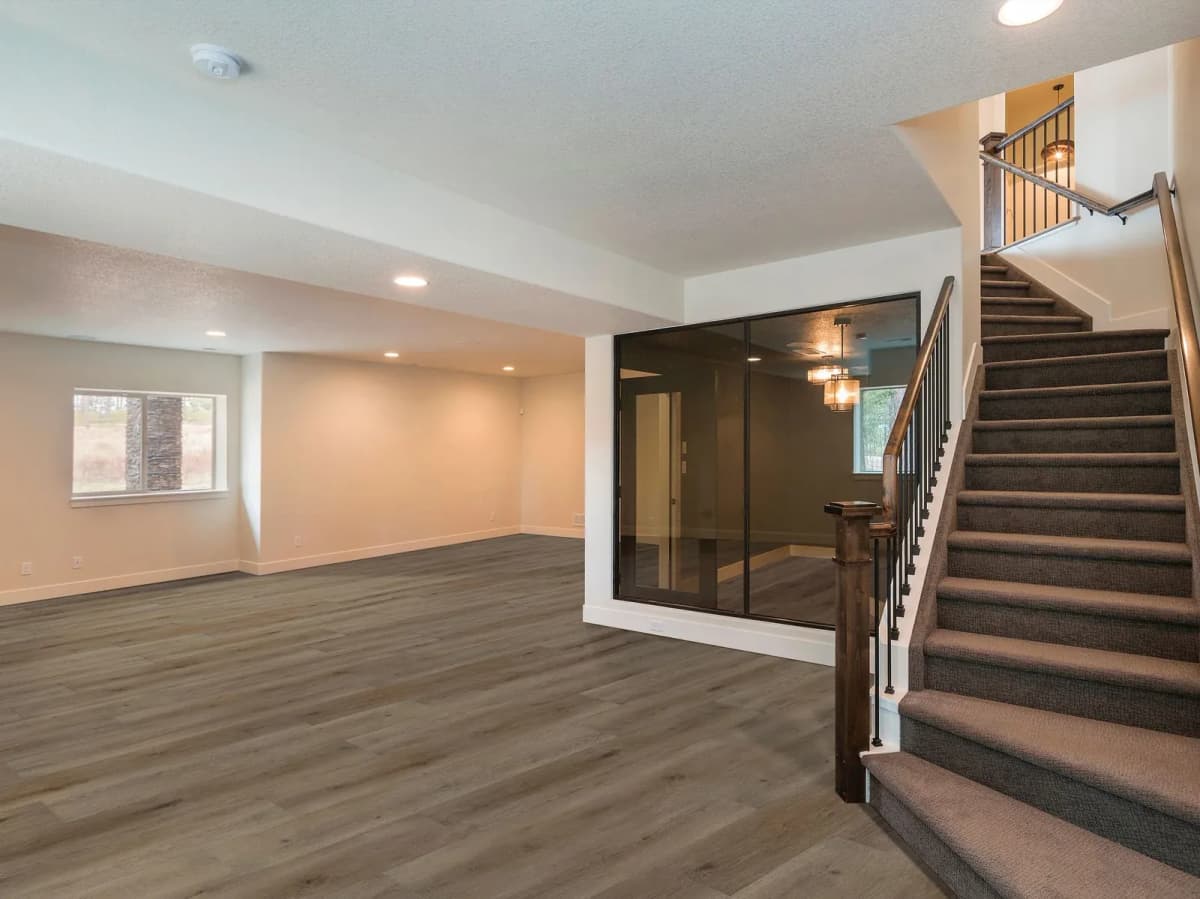
For most basements, rigid-core luxury vinyl is the easiest right answer. Shaw lists LVP/LVT as one of its recommended waterproof categories for basements precisely because the spaces are so prone to moisture, and the material is inherently waterproof.
This is where COREtec — one of the brands we ship — shines. COREtec markets its rigid-core vinyl as 100% waterproof, built around a waterproof core with hydrophobic finishes and tight locking systems that work together to stop water,Source 1 and it explicitly positions the product for transforming basements with fluctuating humidity. If you're new to the category, our explainer on what COREtec flooring is covers how the rigid core works.
One honest caveat, because "waterproof" gets oversold across the whole industry (we wrote a whole piece on what waterproof flooring actually means): a waterproof plank is not the same as a waterproof installation. Even COREtec requires that the subfloor be clean, flat, dry, structurally sound, and moisture-tested, with any issues treated first. The plank survives standing water; the subfloor underneath still needs to be protected. More on that in the moisture-test section below, and in our full LVP installation guide.
Option 2: Waterproof laminate (read the label)
Laminate is on Shaw's list of recommended waterproof basement categories — but with a critical asterisk. Shaw is explicit that traditional laminate is not waterproof. Only laminate engineered with a dedicated protective waterproof layer qualifies below grade.
This is the kind of distinction the brochures gloss over. "Water-resistant" and "waterproof" are not the same word, and standard laminate's fiberboard core swells permanently once moisture reaches it. If a laminate isn't specifically rated waterproof, treat it as off-limits for a basement.
Option 3: Tile and stone
Shaw's third recommended waterproof category is tile and stone — ceramic, porcelain, and natural stone — all naturally impervious to moisture, which is why they've been a basement staple for decades. They're the most labor-intensive and least forgiving underfoot of the four options, but if you want a hard, cold-tolerant surface in a below-grade bath, gym, or entry, they're a sound choice. (We focus our catalog on Shaw, COREtec, and Anderson Tuftex, so tile is included here for completeness rather than as a product we stock.)
Option 4: Engineered hardwood — real wood, below grade
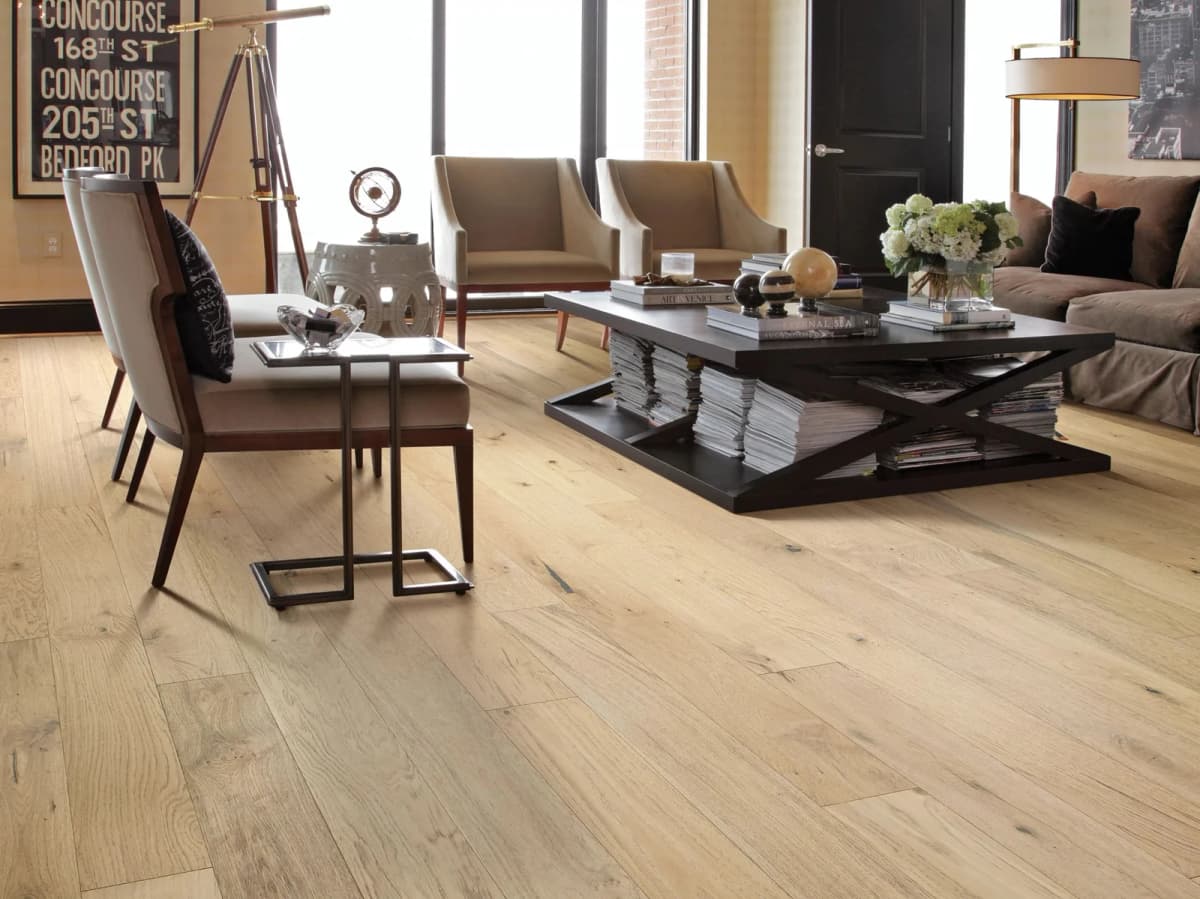
If you want the warmth of genuine hardwood downstairs, engineered is the path — and it's a legitimate one, not a compromise.
Engineered hardwood is built as a real-wood veneer over a cross-layered core, which makes it far more dimensionally stable than solid wood. Anderson Tuftex — another brand we carry — notes that its engineered hardwood is "less prone to warping or splitting due to changes in humidity and temperature than solid hardwood."Source 2 Wagner Meters backs this up, preferring engineered below grade because it "resists buckling and cupping." Shaw points hardwood-loving basement owners straight at it: "Have a basement and want hardwood? Engineered hardwood can do that!" — and confirms its engineered lines install on all grade levels, including below.
A note on installation method: people often hear "engineered can only float below grade," but that's outdated. Shaw's current guidelines permit engineered hardwood on, above, or below grade and allow glue-down over a below-grade slab when moisture testing passes — so floating isn't the only approved method. The real rule is simpler: follow the spec sheet for your exact product, because approved methods vary by line. When you're choosing between engineered wood and vinyl for the space, our LVP vs engineered hardwood guide lays out the trade-offs.
The step everyone skips: test your slab first
This is the section that separates a floor that lasts from a warranty claim. No matter which of the four you choose, the concrete underneath has to be tested before anything goes down.
There are two industry-standard tests, and your floor's installation guide will reference them:
- ASTM F1869 — the calcium chloride test, which measures moisture vapor emission rate (MVER) in pounds per 1,000 sq ft per 24 hours.
- ASTM F2170 — an in-situ probe that measures relative humidity inside the slab, read at 40% of the slab's depth.
The thresholds matter, and they're not all the same number — so don't let anyone hand you a single "industry figure":
- The NWFA treats a reading above 3 lbs MVER (F1869) or above 80% in-slab RH (F2170) as a trigger for further slab drying or a Class 1 (impermeable) vapor retarder.
- Shaw's engineered hardwood spec is tighter: 75% RH or less by F2170 and 3 lbs or less by F1869, with anything above 75% RH requiring a proper vapor retarder.
The 3-lb MVER limit is consistent across both sources, so it's a safe common benchmark; the RH ceiling depends on your specific product, so follow its sheet. One more timing detail: a new slab needs to cure for at least 30 days before you even test it, and excess moisture has to evaporate before installation begins. Rushing this is the most common way a below-grade floor fails.
If you're installing engineered hardwood: climate matters too
Engineered wood is forgiving, but it isn't indifferent. Beyond the slab test, the room itself has to be conditioned. Shaw requires the jobsite be held at 35–55% relative humidity and 65–75°F before and during hardwood installation to prevent the planks from expanding or shrinking after they're down.
In practice, that means your basement's HVAC should be running and stable before the floor arrives — not switched on the morning of the install. Our hardwood acclimation guide covers why jobsite climate, not just the boxes sitting in the room, is what actually protects a wood floor.
Planning your basement floor
Once you've matched a floor to your slab conditions, the rest is project math: measure the space, add a waste factor for cuts and the inevitable mistakes, and order a little extra so your whole floor comes from the same production run. Our flooring calculator guide walks through the measuring and waste-factor math room by room.
A quick budgeting note: rigid-core LVP is typically the most cost-effective below-grade option, with engineered hardwood sitting higher for the real-wood look, and tile variable depending on the material and labor. Order a $5 sample before you commit — a basement's cooler light and concrete acoustics change how a floor reads, and the only way to know is to see it in your actual space. When you're ready for an exact number on your project, request a personalized quote and our team will put it together.
What works, and what to avoid
| Flooring type | Below grade? | Why | Key requirement |
|---|---|---|---|
| Luxury vinyl (LVP/LVT, incl. COREtec) | ✅ Recommended | Inherently waterproof; COREtec's core is 100% waterproof and built for fluctuating-humidity basements | Subfloor clean, flat, dry, and moisture-tested |
| Waterproof laminate | ✅ Only if rated | Has a dedicated waterproof layer | Must be specifically rated waterproof — traditional laminate is not |
| Tile / stone | ✅ Recommended | Naturally impervious to moisture | Standard tile/stone prep |
| Engineered hardwood | ✅ Yes — the wood option | Cross-layered core resists buckling and cupping; approved on all grade levels | Pass the slab test; jobsite at 35–55% RH, 65–75°F |
| Solid hardwood | ❌ Avoid | Cups and buckles as moisture rises through the slab; needs a tight 30–50% RH basements rarely hold | Not recommended unless the manufacturer specifically approves |
The bottom line
Basements stopped being a flooring compromise years ago. Between rigid-core LVP that shrugs off standing water, genuinely waterproof laminate, classic tile, and engineered hardwood that delivers real-wood warmth below grade, you can finish a basement that looks like the rest of your house — not like a basement.
Just respect the slab. Choose one of the four below-grade-ready categories, skip solid hardwood, and never skip the moisture test. Do that, and your basement floor will outlast the renovation around it.
For related reading, see our deep dives on LVP vs engineered hardwood and the best waterproof flooring for bathrooms — the other room where getting moisture right is everything.
Common questions
Frequently Asked Questions
Can I put solid hardwood in my basement?
No. Both the National Wood Flooring Association (NWFA) and Shaw advise against solid hardwood below grade. Moisture migrating up through the concrete slab creates a moisture imbalance in the boards, and solid wood responds by cupping and buckling. If you want real wood downstairs, engineered hardwood is the approved path.
Can engineered hardwood really go below grade?
Yes. The NWFA permits engineered wood above, on, or below grade, and Shaw confirms its engineered hardwood installs on all grade levels. The conditions are non-negotiable, though: you must moisture-test the slab first, and the space needs to be climate-controlled (Shaw specifies 35–55% relative humidity and 65–75°F before and during installation).
Is laminate waterproof enough for a basement?
Only if it is specifically rated waterproof. Shaw is explicit that traditional laminate is not waterproof. Standard laminate swells and delaminates with moisture, so it does not belong below grade — only laminate built with a dedicated waterproof layer qualifies.
Is COREtec a good basement floor?
Yes. COREtec markets its rigid core as 100% waterproof and positions it specifically for basements with fluctuating humidity. The one caveat is universal to every floor below grade: the subfloor still has to be clean, flat, dry, structurally sound, and moisture-tested before anything goes down.
Do I really need a concrete moisture test?
Yes — it is the single step that protects your floor and your warranty. If the slab exceeds the limits (above 3 lbs per 1,000 sq ft per 24 hours by ASTM F1869, or above your product's RH ceiling by ASTM F2170), you need more drying time or a vapor retarder before installing. Skipping the test is the most common reason below-grade floors fail.
Referenced in this guide
Sources
Waterproof Flooring Guide: What It Is, Why It Matters, and Where It Works Best
COREtec (coretecfloors.com) · Accessed 2026-08-03
https://coretecfloors.com/en-us/blog/why-waterproof-floors-are-important-for-your-homeFlooring FAQs & Resources | Installation, Care, and More
Anderson Tuftex (Shaw Industries) · Accessed 2026-08-03
https://andersontuftex.com/en-us/faqs-and-resources
Related Posts
Keep Reading
LVP Wear Layer Explained: Why 12 Mil and 20 Mil LVP Overlap on Price and Wear Differently
9 min read
Shaw LVP Buyer's Guide: Classic Series vs Pro Series, and Where 5th and Main Fits (2026)
10 min read
Will Heavy Furniture Dent Vinyl Plank Flooring? What Holds Up (2026)
14 min read
What Flooring Can Go Over a Concrete Slab? Glue-Down vs Floating, Moisture Testing, and What to Buy
14 min read
Keep browsing