
Anderson Tuftex vs Shaw Hardwood: Is the Premium Tier Worth the Price Jump? (2026)
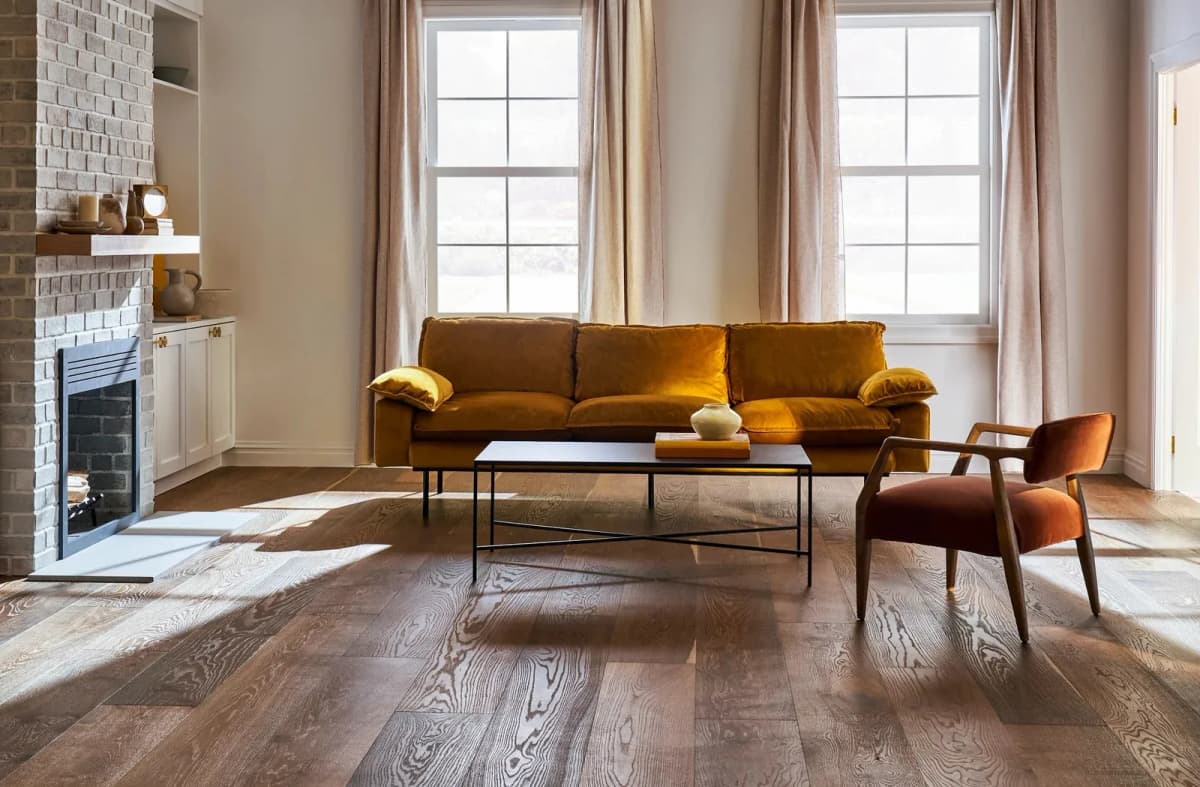
Floor names link to their product pages in a new tab.
Quick answer: They're the same company — Anderson Tuftex is Shaw's own premium hardwood brand, not a competitor. Where the two catalogs overlap ($7.79–$11.39/sq ft), Shaw gives you American manufacturing and water resistance for the money, and Anderson Tuftex gives you wider boards and, on three styles, a 3mm wear layer (smooth on Brasilia, wire-brushed on the other two) where every Shaw style in the band but Expressions runs 1.2mm. Above $11.39, Shaw has no product at all — so the wider planks, thicker cores, 4.5–6mm wear layers, and species like ash and walnut only exist on the AT side. Buy Shaw in the overlap. Buy Anderson Tuftex when you need something Shaw doesn't make.
Search "Anderson Tuftex vs Shaw hardwood" and you'll find forum threads where people argue about which brand holds up better, which has stricter quality control, which company stands behind its warranty. Nearly all of it misses the same fact.
They're the same company. Anderson Tuftex is Shaw Industries' premium hardwood brand — Shaw's own upmarket tier, sold under a preserved name. Comparing them isn't like comparing Toyota to Honda. It's like comparing Toyota to Lexus.
That reframes the question. You're not picking a manufacturer or a warranty department — you're picking a rung on one company's ladder, and the only honest way to do that is spec-for-spec at real prices. Full transparency: FloorFreight is an authorized dealer for both brands and sells every style below, so there's no version of this post where we win by steering you up or down. We've covered each side separately — the Shaw hardwood buying guide and the Anderson Tuftex tier breakdown — and this is the cross-brand comparison between them.
The Short Version: How the Two Brands Compare
Every price below is the manufacturer's advertised price (MAP) per square foot, and every product page shows that figure next to the full per-carton (box) total so you can budget the whole room before you buy.
| Shaw Hardwood | Anderson Tuftex | |
|---|---|---|
| Price band (MAP) | $5.19–$11.39/sq ft ✓ | $7.79–$21.99/sq ft |
| Styles to choose from | 26 ✓ | 21 |
| Wear layer range | 1.2mm (25 styles) · 4mm (1 style) | 1.2mm–6mm ✓ |
| Styles at 4mm or thicker | 1 — Expressions | 9 ✓ |
| Widest plank | 7.5" (Expressions) | 10.25" (Grand Estate) ✓ |
| Thickest core | 5/8" (Expressions) | 3/4" (Grand Estate) ✓ |
| Made in USA | 20 of 26 styles ✓ | 0 of 21 styles |
| Water-resistant option | Yes — the Repel line ✓ | None offered |
| Species | maple, hickory, oak, white oak, red oak, birch | + European ash, American walnut, European walnut, pecan, Brazilian oak ✓ |
| NWFA's 2.5mm minimum starts at | $11.39 — Expressions (wire-brushed) | $9.29 — Brasilia (smooth) ✓ |
| Catalog starts at | $5.19 — OCALA ✓ | $7.79 — Confection |
Two rows do most of the work. Styles at 4mm or thicker: Shaw has exactly one, Anderson Tuftex has nine — that single row explains most of the price gap and most of the reason to cross it. Made in USA runs the opposite direction: 20 of Shaw's 26 styles are domestically made, and not one AT style is. If you assumed the premium brand was the American-made one, the catalog says otherwise.
First, the Thing Nobody Says Plainly: Anderson Tuftex Is Shaw
Shaw acquired Anderson Hardwood Floors in 2007.Source 1 Instead of absorbing it into the Shaw label, they kept the name and pushed it upmarket, where it now serves as Shaw's design-led hardwood tier.
This matters practically, not just as trivia:
There is no "which company do I trust" question. Same parent, same corporate manufacturing network, warranties administered through the same organization. If you've been trying to decide which brand is more reputable, you can stop — that variable doesn't exist here.
Cross-shopping is legitimate. Because both lines come from one company, you can run Anderson Tuftex in the rooms guests see first and Shaw in the bedrooms without mixing two incompatible quality standards. Plenty of our customers do exactly that.
The premium is real, but it's a spec premium, not a pedigree premium. You're paying for thicker wood, wider boards, and species Shaw's standard lines don't run — not for a better factory. Our Anderson Tuftex hardwood review weighs that premium on its own terms; here we measure it against the standard Shaw tier.
The Overlap Zone: $7.79–$11.39, Where Both Brands Compete
Anderson Tuftex engineered hardwood runs $7.79–$21.99/sq ft MAP across 21 styles. Shaw engineered hardwood runs $5.19–$11.39 across 26 styles. The two catalogs share one band — roughly $7.79 to $11.39 — and that band is where most cross-brand shoppers actually are.
Here's what our own catalog data shows: in the overlap, three Anderson Tuftex styles carry a 3mm face veneer, above NWFA's 2.5mm sanding line, and only one Shaw style clears that line, at the band's $11.39 top.
AT's thickest wear layer at or below $11.39/sq ft is 3mm — Brasilia ($9.29, Brazilian oak), Transcendence ($10.79, hickory), and the glue-down Provincial Herringbone ($10.79, white oak). Three millimeters is above 2.5mm, the National Wood Flooring Association's minimum for a factory-finished floor to count as refinishable,Source 2 so smooth Brasilia can be sanded and refinished. Transcendence and Provincial Herringbone are wire-brushed: NWFA measures a textured floor's 2.5mm at the lowest point of the texture,Source 2 and sanding one flat removes the brushed look,Source 3 so have a flooring professional measure the lowest point before you count on refinishing either. Shaw's 1.2mm styles sit under NWFA's line: its guidelines say a floor with less than 3/32 inch (2.5mm) of wear layer should not be sanded.Source 3 What 3mm doesn't come with is a promised number of refinishes; NWFA ties that to the wear layer left, the floor's flatness and the skill of the person sanding it — the mechanics of that line are in our engineered hardwood wear layer explainer.
So what else does the extra money buy inside the overlap? Three concrete things:
- Wider planks. Shaw's fixed-width styles in the band run 5" to 7.5", and only Expressions, at the band's $11.39 top, reaches 7.5". AT fields 8.66" boards at similar money — Natural Timbers Smooth is 8.66" wide at $8.69/sq ft.
- Thicker cores, on some styles. Most Shaw hardwood is built on a 3/8" or 1/2" core; Expressions is its only 5/8". AT's overlap styles reach 9/16" (Brasilia, Transcendence) and 5/8" (Provincial Herringbone).
- Species Shaw doesn't carry. Pecan, Brazilian oak, and European walnut have no Shaw equivalent at any price.
And what does Shaw give you in the same band that AT can't?
- American manufacturing on most styles.
- Water resistance. Shaw's Repel line seals the top and sides of each plank; Shaw says floors with Repel technology are "2X more water resistant than traditional hardwood." Anderson Tuftex offers no equivalent anywhere in its lineup. Sanctuary Oak ($8.29/sq ft, 6.38" oak, made in USA)Source 4 shows what that buys; we compare Repel to Shaw's Gallery line in Repel vs The Gallery.
- A lower floor on price. OCALA at $5.19/sq ft and Albright Oak 5 at $5.99 sit $2-plus below anything Anderson Tuftex makes.
The honest read on the overlap: if you have kids, pets, or a spill-prone room, Shaw's Repel styles win this band outright — you're getting a treatment AT doesn't sell, usually on an American-made plank, inside the same price band. Choose Anderson Tuftex here only if you specifically want a wide board, a thicker core, a species Shaw doesn't stock, or a 3mm wear layer to sand later (Brasilia's is smooth; have a wire-brushed one measured first).
The $0.30 Decision: Shaw Expressions vs Anderson Tuftex Artisan Oak
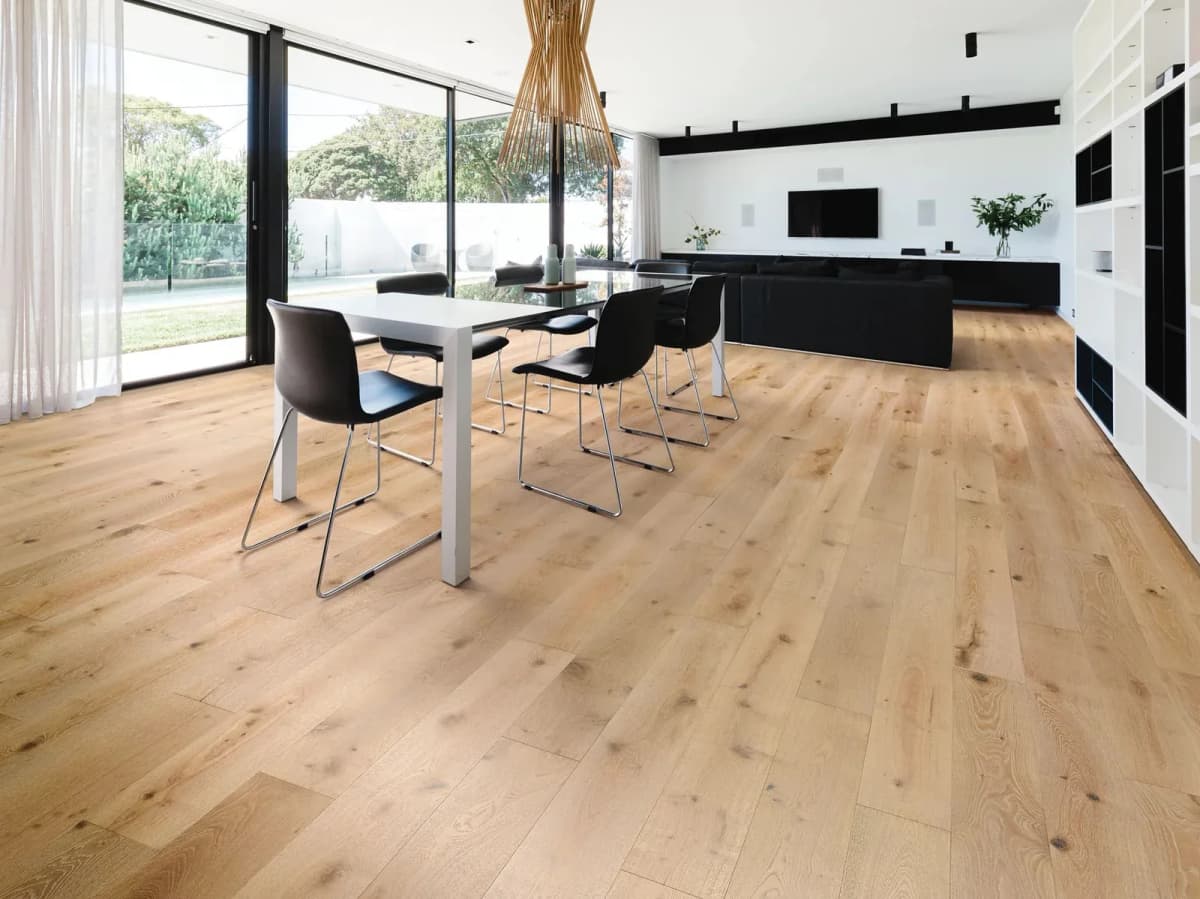
If you want the single cleanest test of whether the premium tier is worth it, it's this pair. These two floors are thirty cents apart per square foot, and they are where 4mm coverage begins in each brand.
| Shaw Expressions | AT Artisan Oak | |
|---|---|---|
| Price (MAP) | $11.39/sq ft ✓ | $11.69/sq ft |
| Wear layer | 4mm | 4mm |
| Core thickness | 5/8" | 5/8" |
| Species | White oak | White oak |
| Finish | UV aluminum oxide, wire-brushed | UV oil, distressed |
| Colorways | 14 ✓ | 5 |
| Plank width | 7.5" (published) ✓ | Not published |
| Radiant heat | Approved ✓ | Not listed |
| Install methods | Nail, staple, glue, floating | Nail, staple, glue, floating |
| Country of origin | Vietnam | Vietnam |
Read that table twice, because it's the answer to the headline question at the crossover point: the premium tier isn't buying you much here. Same wear layer, same core thickness, same species, same country of origin, same four install methods, thirty cents apart. Expressions actually hands you nearly three times the color choice and a radiant-heat approval that Artisan Oak doesn't list.
What Artisan Oak offers instead is the finish. UV oil reads warmer, more matte, and more hand-finished than aluminum oxide — the texture people mean when they say a floor looks like Anderson Tuftex. Anderson Tuftex's care guide gives it no routine of its own: the same flat microfiber pad and neutral-pH cleaner apply whatever the finish.Source 5
The verdict on this pair: if you want a 4mm white oak floor around $11.50 and you're open on the look, Expressions is the stronger pick on choice and versatility. If the UV oil finish is specifically what drew you to Anderson Tuftex, pay the thirty cents — but pay it for the finish, not for a durability upgrade that isn't there.
What the Price Jump Actually Buys — Above $11.39
Here's the structural fact that reframes everything: Shaw's hardwood catalog stops at $11.39/sq ft. Above Expressions, Shaw has nothing at all — so the comparison stops being "which brand" and becomes "do I need what only exists up here."
Four things live above that line.
1. Wear Layer Past 4mm
Beyond 4mm, only Anderson Tuftex goes: Revival Walnut at 4.5mm ($13.59/sq ft) and Grand Estate at 6mm ($15.09). A thicker wear layer leaves more wood for future sand-and-refinish jobs. NWFA doesn't put a fixed count on it — that depends on the wear layer left, the floor's flatness and the skill of the person sanding itSource 3 — but Grand Estate's 6mm is the most wood of any floor either brand makes. Grand Estate is wire-brushed, so its first sanding also takes that texture off.
For a long stay this is the strongest argument in the whole Anderson Tuftex catalog. A 1.2mm floor can't be sanded when its finish wears through; a 6mm floor can, with more wood to work with than anything else we carry — and comes back as a smooth floor, so have a flooring professional assess the texture before you plan on it.
Where the jump pays off: staying put. If this is a forever-floor, 6mm is worth crossing $11.39 for. If you'll move in a decade, it isn't.
2. Plank Width and Core Thickness
Shaw's widest board is Expressions at 7.5", on a 5/8" core. Anderson Tuftex keeps going: 8.66" (Chateau Oak, Natural Timbers Smooth, Ravenwood), and 10.25" on Grand Estate — which also runs a 3/4" core, the thickest either brand makes.
Width is aesthetic and thickness is structural, but the combination is what people are reacting to when they say a floor "feels expensive." A 10.25" board changes how a room reads in a way no color choice can. It's also more demanding: Grand Estate is nail, staple, or glue only — it is not rated for a floating install, and like every Anderson Tuftex floor it wants the home's HVAC holding living conditions before the wood is delivered.Source 6
Where the jump pays off: large, open rooms. Wide boards need floor area to justify themselves. In a small bedroom, a 10.25" plank mostly just costs more.
3. Species and Formats Shaw Doesn't Make
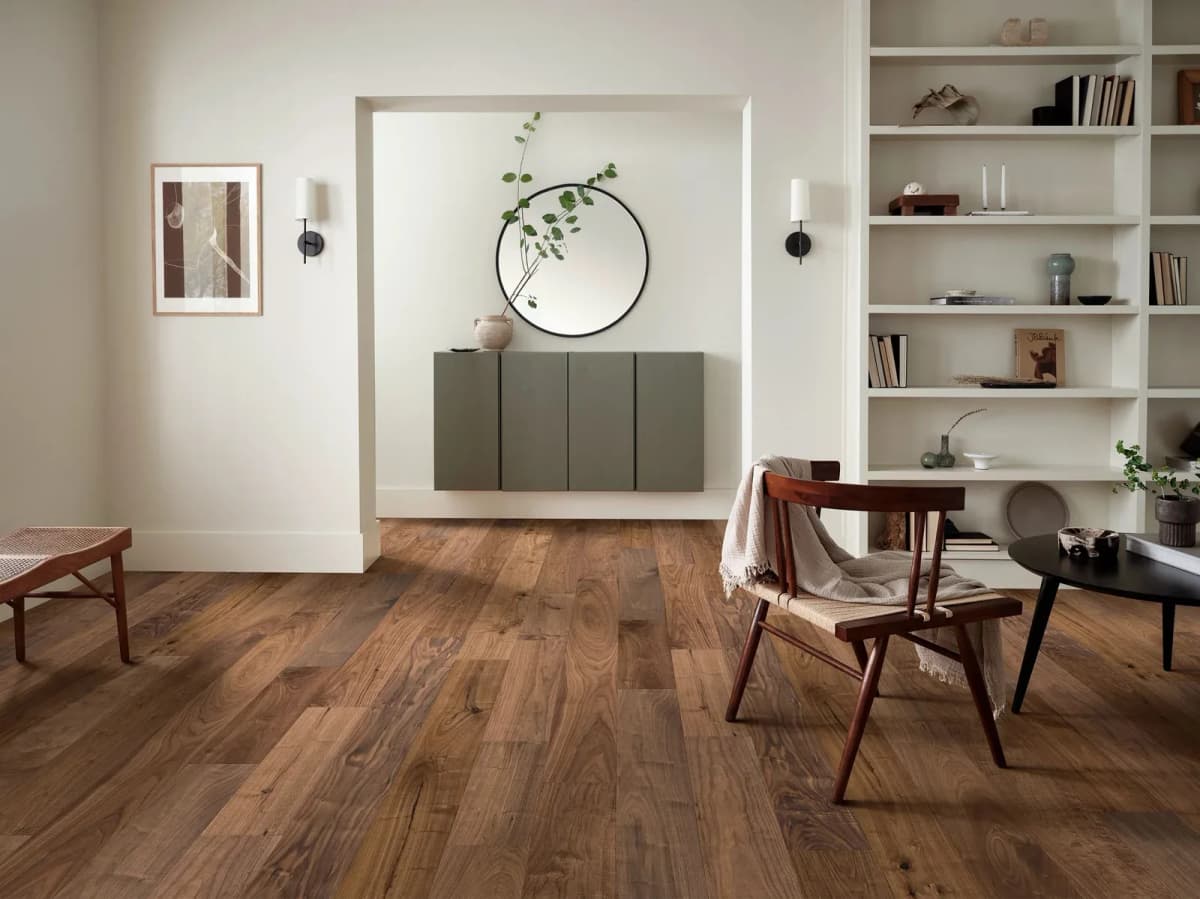
Shaw's hardwood species list is maple, hickory, oak, white oak, red oak, and birch. Anderson Tuftex adds European ash, American walnut, European walnut, pecan, and Brazilian oak.
If you want a light, clean, distinctly non-oak modern floor, European Ash ($12.19/sq ft, 7.48", 5/8" core, 4mm) has no Shaw counterpart. If you want formal American walnut, Revival Walnut is the only route. And for pattern work, AT runs herringbone in ash and walnut plus Provincial Parquet ($21.99/sq ft) in pre-assembled glue-down modules — the most expensive floor in our catalog by a wide margin, and a genuine centerpiece when the pattern is the point.
Where the jump pays off: when the look doesn't exist at Shaw. This is the least arguable reason to buy up. You can't negotiate a species into a catalog.
4. What It Does Not Buy: American Manufacturing
This one runs backward from what most buyers expect. Every Anderson Tuftex hardwood style is imported — Vietnam, Indonesia, Malaysia, Cambodia, or Paraguay, depending on the style. Twenty of Shaw's 26 styles list the United States.
There's a further twist: Shaw's own premium style, Expressions, is made in Vietnam as well. So domestic manufacturing in hardwood is effectively a property of Shaw's 1.2mm lines — Reflections White Oak ($9.09/sq ft, 7" wide, made in USA) is about as far up as you can go and keep it. The moment you shop for a wear layer thick enough to sand in either brand, you're buying imported wood.
Read this before you assume: if country of origin is a hard requirement, it constrains you more than price does.
Which Should You Buy
Buy Shaw if:
- You're spending under $11.39/sq ft — which is most buyers. In the overlap band, Shaw adds water resistance and domestic manufacturing that AT does not offer at any price.
- You want water resistance. Repel has no Anderson Tuftex equivalent at any price.
- American manufacturing matters to you. 20 of 26 Shaw styles qualify; zero AT styles do.
- You want an honest entry into engineered hardwood — OCALA at $5.19/sq ft.
- You want a 4mm wear layer with the widest color choice: Expressions, $11.39/sq ft — where 4mm coverage starts in either catalog.
Buy Anderson Tuftex if:
- You want a wear layer past 4mm — Revival Walnut at 4.5mm, or Grand Estate at 6mm for the most wood to refinish.
- You want a plank wider than 7.5" or a core thicker than 5/8". Shaw makes neither.
- You want a species Shaw doesn't carry: European ash, American walnut, European walnut, pecan, or Brazilian oak.
- You want herringbone or parquet in something other than white oak.
- The UV oil finish and AT's design language are specifically what you're after — a legitimate reason, as long as you're buying it for the look.
The honest pick for most households: Shaw, and the reason is arithmetic rather than brand loyalty. Most people shopping this comparison budget under $12/sq ft, and inside that budget Shaw delivers water resistance, domestic manufacturing, and — at Expressions — the same 4mm spec Anderson Tuftex charges more for. The premium tier becomes right at one specific moment: when you want something above $11.39 that Shaw doesn't make. That's a real moment. It's just not where most buyers are.
What You're NOT Getting From Either Brand
Refinishability, on most styles. Twenty-five of Shaw's 26 hardwood styles run a 1.2mm wear layer, Anderson Tuftex's entry styles (Imperial Pecan, Noble Hall) do too, and five more Anderson Tuftex styles run 1.8mm to 2mm (Bernina Hickory, Confection, Natural Timbers Smooth, Coast to Coast, Ravenwood). All of them are under NWFA's 2.5mm sanding line. When the factory finish on one of those floors wears through in a traffic lane, the fix is replacement, not sanding. That's a category, not a defect — just don't buy one expecting to refinish it later.
Water resistance, from Anderson Tuftex. AT has no Repel equivalent. If spills are a daily fact of your household and you want to stay in hardwood, that points toward Shaw specifically.
A floor for standing water, from either. This is engineered hardwood on both sides. Repel's sealant buys a cleanup window for spills — it does not make hardwood suitable for a full bathroom or a laundry room with leak risk. Those rooms want a rigid-core vinyl floor, and no amount of wear layer changes that. A basement is different: engineered hardwood from either brand can go below grade, but only over a slab that passes the moisture test first (our basement flooring guide walks through it).
Solid hardwood. Both brands are engineered top to bottom — real wood over a stable multi-ply core. That's an advantage in humidity and over radiant heat, but if you want a solid 3/4" board, we don't sell solid hardwood, and a specialty retailer will serve you better.
Final Word
Anderson Tuftex versus Shaw isn't a rivalry, and treating it like one is what sends people to the wrong floor. It's one company's good tier and its premium tier, and the two catalogs meet in a narrow band where the standard tier usually wins.
The scenarios where the choice is clear:
- Budget under $11/sq ft, kids or pets in the house: Shaw Repel. Water resistance AT doesn't sell, usually on an American-made plank.
- You want 4mm around $11.50: Shaw Expressions ($11.39/sq ft) — same 4mm, same 5/8" core, same white oak as Artisan Oak, with 14 colors instead of 5.
- A forever-floor with the most wood to sand: Anderson Tuftex Grand Estate ($15.09/sq ft) — 6mm and 10.25" wide, with nothing comparable anywhere in Shaw's catalog. It is wire-brushed, so a sanding brings it back smooth.
- A species or format Shaw doesn't make: Anderson Tuftex, no argument needed.
The scenario where it's genuinely close: you're at roughly $11.50, you want a floor you can sand someday, and you're weighing Expressions against Artisan Oak — both textured, so sanding either one returns it to smooth. On paper Expressions wins on color range and radiant-heat approval; in person, the UV oil on Artisan Oak may simply be the floor you want. That's a finish decision, not a durability one — the clearest case here for deciding by sample rather than spec sheet.
Browse both lineups side by side — the Shaw hardwood catalog, the Anderson Tuftex catalog, or the full hardwood collection. Prices here are the manufacturer's advertised price (MAP); lower prices may be available — request a quote by email using the "Email for today's best price" form on any product page.
When you've narrowed it to two or three, order a $5 sample of each before you commit. The $5 comes back as credit when you sign in at checkout with the same email you used for samples (guests get $0). Anderson Tuftex's UV oil finishes and Shaw's aluminum-oxide finishes read very differently in your own light than they do on a screen — and at thirty cents apart, the floor you choose on paper isn't always the one your living room agrees with.
In this article
The floors from this guide

Shaw Hardwood
Expressions
Poetry
Samples are $5 each, credited back at checkout when you sign in.

Anderson Tuftex
Artisan Oak
Canvas
Samples are $5 each, credited back at checkout when you sign in.

Anderson Tuftex
Grand Estate
Thorndon Hall
Samples are $5 each, credited back at checkout when you sign in.

Anderson Tuftex
European Ash
Metro
Samples are $5 each, credited back at checkout when you sign in.
Common questions
Frequently Asked Questions
Is Anderson Tuftex owned by Shaw?
Yes. Anderson Tuftex is Shaw Industries' own premium hardwood brand, not a rival company. Shaw acquired Anderson Hardwood Floors in 2007 and, rather than fold it into the Shaw name, kept the brand and elevated it into their luxury hardwood tier. So "Anderson Tuftex vs Shaw" isn't really a fight between two manufacturers — it's a choice between two tiers inside one company's hardwood division, built in the same corporate manufacturing network and warranted through the same parent. That's why you'll never find a head-to-head quality scandal between them: the comparison that actually matters is spec-for-spec and dollar-for-dollar, not brand-versus-brand.
Is Anderson Tuftex worth the extra cost over Shaw hardwood?
It depends entirely on where you land in the price range. Below about $11.39/sq ft the two catalogs overlap, and in that overlap Anderson Tuftex's thickest wear layer is 3mm (Brasilia, Transcendence, Provincial Herringbone) — above 2.5mm, the National Wood Flooring Association's minimum for a factory-finished floor to count as refinishable, measured at the lowest point on a textured floor — while every Shaw style except one runs 1.2mm, below it. Brasilia is smooth; Transcendence and Provincial Herringbone are wire-brushed, and on a textured floor NWFA measures that minimum at the lowest point of the texture, so have a flooring professional measure one before you count on sanding it. Along with those 3mm styles, what AT gives you in that band is width, core thickness, and species Shaw doesn't offer. Above $11.39, Shaw simply has no product — its most expensive hardwood is Expressions at $11.39/sq ft — so anything wider than 7.5", thicker than a 5/8" core, or beyond a 4mm wear layer only exists on the Anderson Tuftex side. That's where the premium genuinely earns it. All figures are the manufacturer's advertised price (MAP).
What's the entry point for a refinishable floor at Shaw or Anderson Tuftex?
On the Anderson Tuftex side, Brasilia at $9.29/sq ft (MAP): its 3mm Brazilian-oak wear layer is above 2.5mm, the National Wood Flooring Association's minimum for a factory-finished floor to count as refinishable. On the Shaw side, Expressions at $11.39/sq ft is the only choice. It's the only Shaw hardwood style with a 4mm wear layer; the other 25 styles in Shaw's hardwood catalog all run 1.2mm, under the 3/32 inch (2.5mm) line below which NWFA says a floor should not be sanded. If you want 4mm specifically, Expressions and Anderson Tuftex Artisan Oak ($11.69/sq ft) are where it starts in each brand: $0.30 apart, both white oak on a 5/8" core, both imported from Vietnam. Both are textured, Expressions wire-brushed and Artisan Oak distressed, and sanding either one flat removes that texture. How many times any of these floors can be refinished isn't a fixed number; NWFA ties it to the wear layer left, the floor's flatness and the skill of the person sanding it.
Is Shaw or Anderson Tuftex made in the USA?
Shaw, mostly — and Anderson Tuftex, not at all. Twenty of Shaw's 26 hardwood styles list the United States as country of origin on their product pages, including the whole value end of the line: OCALA, Albright Oak, Sanctuary Oak, Reflections White Oak. Every one of Anderson Tuftex's 21 hardwood styles is imported, sourced from Vietnam, Indonesia, Malaysia, Cambodia, or Paraguay depending on the style. The wrinkle worth knowing: Shaw's own premium style, Expressions, is made in Vietnam too. So if domestic manufacturing is a deciding factor for you, it lives in Shaw's 1.2mm lines specifically — and it disappears the moment you shop for a wear layer thick enough to sand in either brand.
Referenced in this guide
Sources
Our Company — History
Shaw Industries Group, Inc. · Accessed 2026-08-19
https://shawinc.com/Our-Company/HistoryNWFA Launches Engineered Wood Flooring Refinishable Program (Hardwood Floors magazine, Aug/Sept 2022)
National Wood Flooring Association · Accessed 2026-09-15
https://nwfa.org/wp-content/uploads/2022/09/HFM_AugSept22_final_refinishable_small.pdfWood Flooring Sand and Finish Guidelines (2016), pp. 19 and 25
National Wood Flooring Association · Accessed 2026-09-15
https://www.oldewoodltd.com/uploads/nwfa-sand-finish-wood-floors-2016.pdfSanctuary Oak — specifications (Species: Oak; Plank Width: 6.38"; Country of Origin: United States)
Shaw Floors · Accessed 2026-09-14
https://shawfloors.com/en-us/hardwood/sanctuary-oak-hearth-6-38-in-12-mm-oak-wirebrushed-25-4-sq-ft-carton-/sw714-05093Hardwood Maintenance (Anderson Tuftex)
Shaw Industries, Inc. (Anderson Tuftex) · Accessed 2026-10-10
https://pdmsview.shawinc.com/viewer/document/doc/22188Engineered Hardwood Installation (Anderson Tuftex, rev. 05/03/2024)
Shaw Industries, Inc. (Anderson Tuftex) · Accessed 2026-10-10
https://pdmsview.shawinc.com/viewer/document/doc/19216
Related Posts
Keep Reading
Anderson Tuftex Tiers Compared: Entry vs Mid vs Premium (2026)
10 min read
How to Match New Hardwood to an Existing Floor (Even If It's Discontinued)
10 min read
Shaw Hardwood Buying Guide: Repel, The Gallery and Expressions (2026)
9 min read
What Is the Best Flooring for Stairs? Hardwood, LVP and the Stair Nose (2026)
13 min read
Keep browsing