
Resources
Flooring Terms Glossary
Plain-English definitions of the flooring terminology you’ll encounter when shopping. From wear layer ratings to subfloor types — what the words actually mean and why they matter.
Floor names link to their product pages in a new tab.
AC Rating
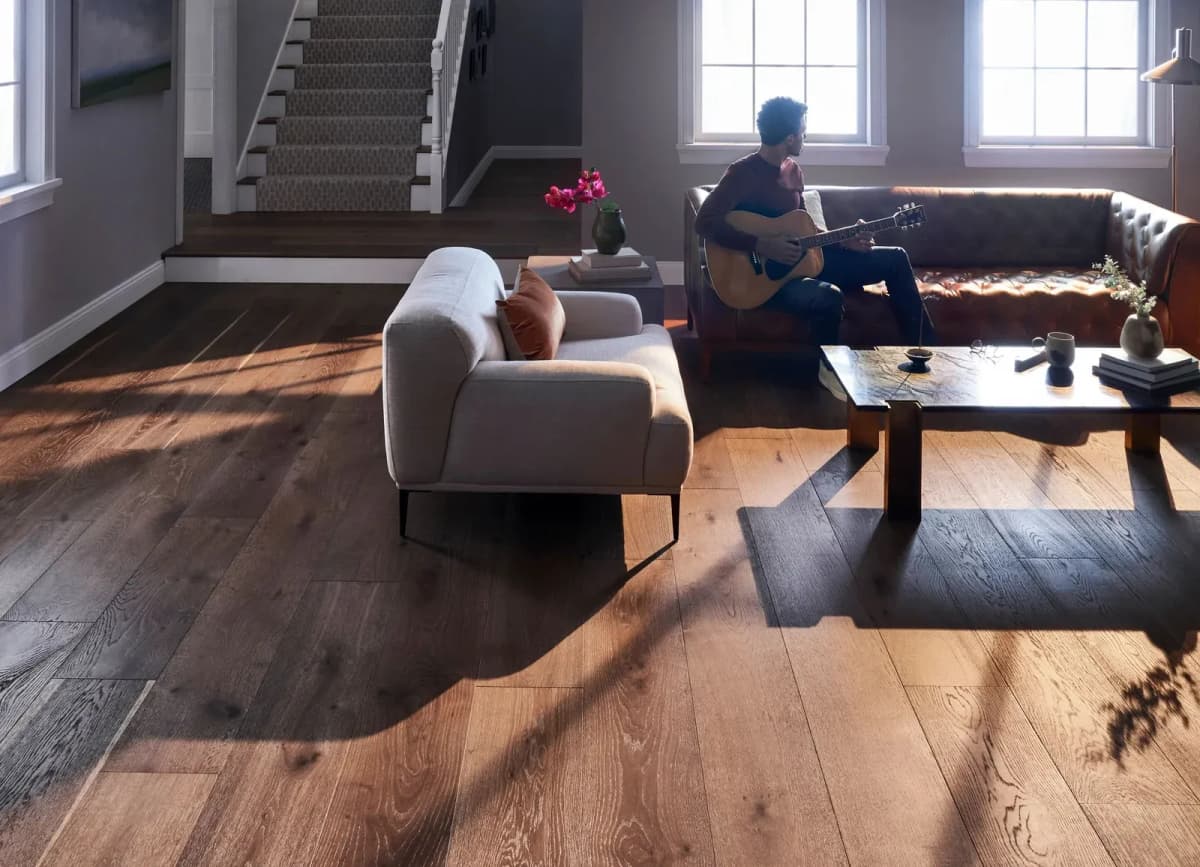
The Abrasion Class rating measures laminate flooring's resistance to wear, from AC1 (light residential) to AC5 (heavy commercial). For a typical home, AC3 or AC4 is sufficient.
Why it matters: A higher AC rating means the floor will hold up longer under traffic, but you don't need to overpay for AC5 in a bedroom.
Acclimation
Getting a floor, and the room it is going into, to the conditions the floor will live in before it is installed. What the installation guides ask for depends on the floor. Floating luxury vinyl needs no acclimation. Shaw’s and COREtec’s installation guides ask for a climate-controlled room instead, between 55°F and 85°F when the floor goes in. Shaw also publishes a direct-glue guide for glued-down vinyl, and it requires the flooring and the adhesive to sit in the installation area for at least 48 hours first. If your floor is being glued down, ask which installation guide your installer is working from. One Shaw guide, for its Angle/Tap WPC floors, also asks for the HVAC to be running and holding 55–85°F for 7 days before installation, during it and afterward, so check the installation guide for your style.
Why it matters: For engineered hardwood the rule is about the home and the wood, not the calendar. Shaw’s and Anderson Tuftex’s installation guides ask for the home’s permanent HVAC to be running for at least 5 days, holding 65–75°F and 35–55% relative humidity, before the flooring is delivered, during installation and afterward. They give no number of days for the wood to sit. The test is moisture. Over a wood subfloor, the wood should be within 4% of the subfloor’s moisture content; over concrete, the guides call for a calcium chloride or relative-humidity test of the slab instead. The installation guide for your style is the rule, and the manufacturer’s warranty requires the floor to be installed to it.
Click-Lock
A floating-floor installation method where planks snap together via tongue-and-groove joints with no glue, nails, or staples. The floor "floats" over the subfloor.
Why it matters: Click-lock is the most DIY-friendly installation method available. Most LVP and laminate uses click-lock.
Dye Lot
A batch of flooring manufactured at the same time. Different dye lots of the same SKU can have subtle color variations.
Why it matters: Order all the flooring you need at once. If you run short and reorder later, the new boxes may not match.
Engineered Hardwood
Real wood flooring made from a thin top layer of hardwood (the wear layer) bonded to a multi-ply core of plywood or HDF. Distinct from solid hardwood, which is one continuous piece of wood.
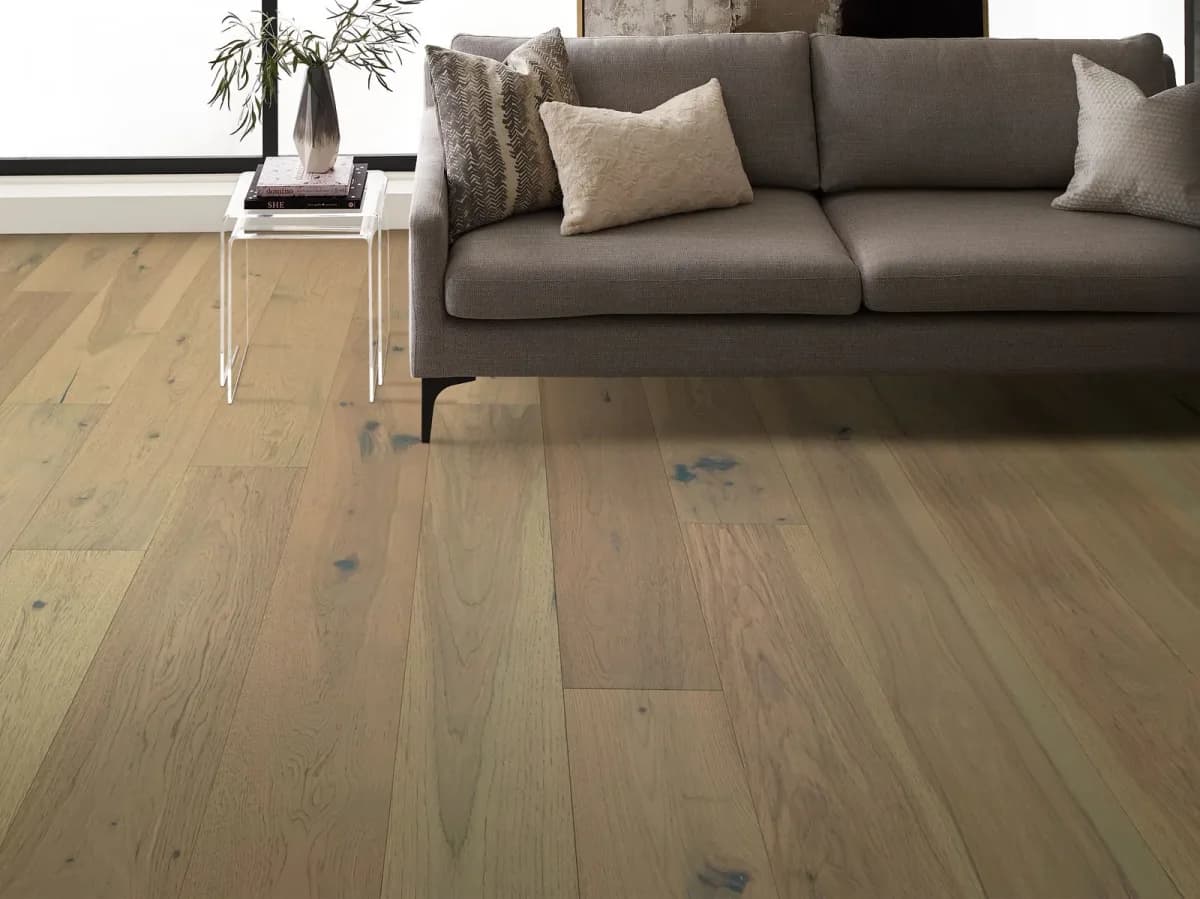
Why it matters: Engineered hardwood is more dimensionally stable than solid hardwood, making it suitable for basements, over concrete subfloors, and over radiant heat.
Face Veneer
The layer of real hardwood on top of an engineered hardwood plank, bonded over a multi-ply core of plywood or HDF. It's the wood you see and walk on; the core beneath it is hidden once the floor is down.
Why it matters: It's the real-wood part of an engineered plank, and each engineered hardwood product page states its thickness in millimeters under Face Veneer, so you can compare styles on the same measurement.
Floating Floor
Any flooring installation that doesn't attach to the subfloor (no glue, no nails). The floor "floats" on top, held in place by its own weight and the perimeter walls.
Why it matters: Floating installations are faster, easier to DIY, and easier to replace later. Most modern LVP and laminate is floating.
HDF (High-Density Fiberboard)
Compressed wood fiber used as the core layer in laminate and many engineered hardwood products. Denser and harder than MDF.
Why it matters: Higher-quality HDF cores resist moisture and impact better than cheap fiberboard.
Janka Hardness
A scale that measures wood hardness by how much force it takes to embed a small steel ball halfway into the wood. Higher numbers mean harder wood.
Why it matters: Janka tells you how dent-resistant a wood species will be. Hickory (1820) is significantly harder than red oak (1290) or walnut (1010).
Laminate Flooring
A floor made from a printed image of wood (or stone, or tile) bonded to a fiberboard core, with a clear protective wear layer on top. Not real wood.
Why it matters: Laminate is a budget-tier product: most of it is only water-resistant, not waterproof, and it can't be refinished. Modern laminate looks better than ever, but that's the trade-off.
LVP (Luxury Vinyl Plank)
A multi-layer waterproof flooring product with a printed wood-look design layer and a clear wear layer on top. Made from PVC vinyl.
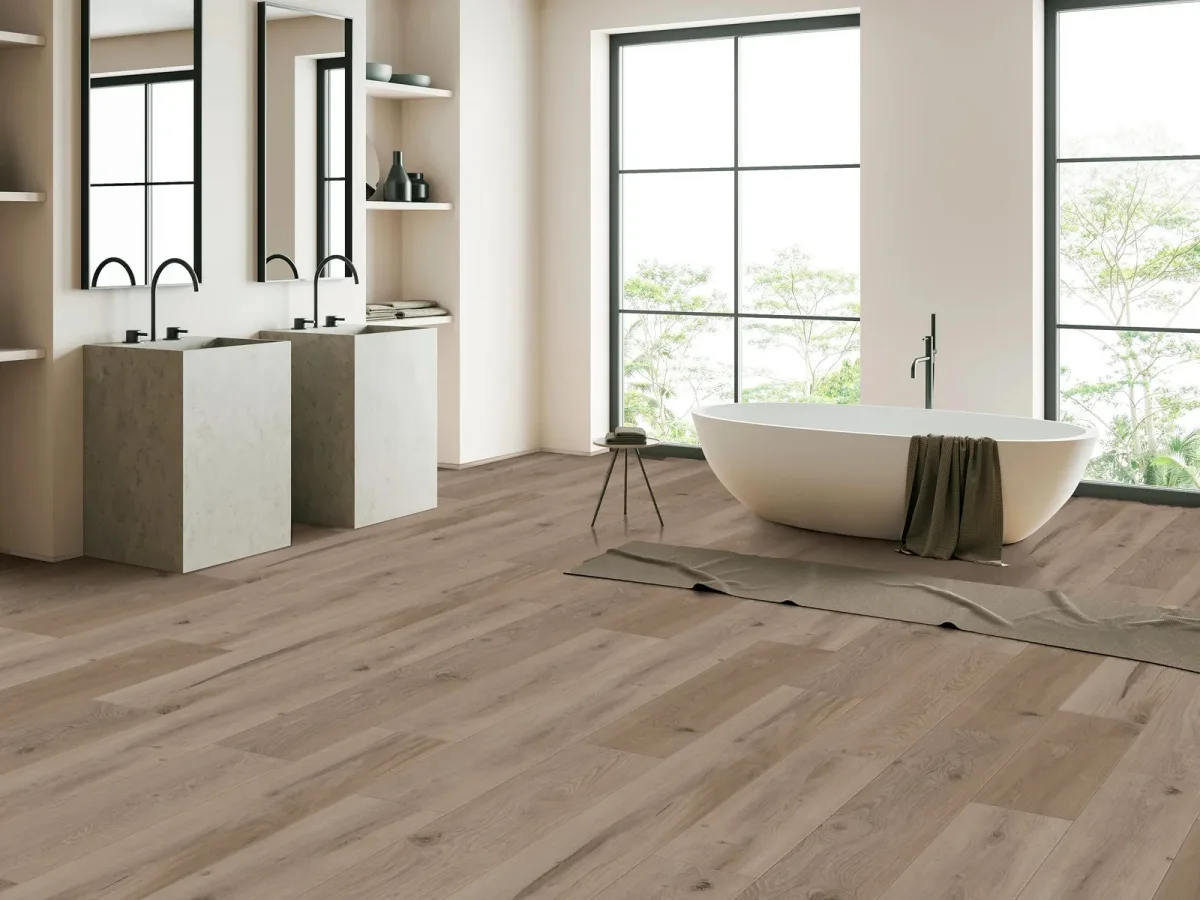
Why it matters: Nearly all LVP is 100% waterproof and durable. It's the fastest-growing category in flooring for good reason — it works in kitchens, bathrooms, basements, and high-traffic areas where hardwood doesn't.
MAP (Minimum Advertised Price)
The minimum price a manufacturer allows authorized dealers to publicly advertise for its products. Set by the manufacturer, enforced by contract.
Why it matters: Every price on FloorFreight is the MAP — the floor of public pricing for that SKU across all authorized dealers. It is the price, not a markdown off some other number.
Mil (Wear Layer Thickness)
One thousandth of an inch (0.001 inch, or 0.0254 mm). On luxury vinyl it measures the clear wear layer on top of the plank, not the thickness of the plank itself.
Why it matters: The luxury vinyl we sell runs from 6 mil to 30 mil, and each product page states the figure under Wear Layer. Our recommendation is 20 mil for a busy household: kids, most dogs, kitchens and entryways. We’d choose 6 mil only for light-use rooms such as a guest room or a closet, not for dogs or a busy household; 12 mil for bedrooms and lighter-traffic homes, for cats, or for one small, calm dog; and 22 or 30 mil for several dogs, one large high-energy dog, or the hardest-used floors in the house. That is our advice, not a manufacturer’s, and it promises nothing about how a floor wears.
Nail-Down Installation
A hardwood installation method where each plank is fastened to the subfloor with cleats or staples. Standard for solid hardwood over wood subfloors.
Why it matters: Nail-down is the most permanent and stable hardwood installation, but it requires a plywood subfloor (won't work over concrete).
Pre-Finished
Flooring that arrives from the factory already stained and sealed. The opposite of site-finished, where finish is applied after installation.
Why it matters: Pre-finished floors are faster to install (no drying time, no dust), and the factory finish is typically more durable than on-site polyurethane.
Quarter-Round / Shoe Molding
A small molding strip installed where the flooring meets the baseboard to cover the expansion gap.
Why it matters: Floating floors require an expansion gap around the perimeter. Quarter-round hides it. Don't skip it.
Reducer
A transition strip used where flooring meets a lower surface, like transitioning from hardwood to vinyl or carpet.
Why it matters: Quality transitions matter for the final look. Buy reducers, T-moldings, and stair nosings in matching colors when you order your flooring.
SPC (Solid Polymer Core)
A rigid-core LVP construction with a solid polymer core, also called stone plastic composite or stone polymer composite. COREtec describes its SPC construction as compact and dent-resistant.
Why it matters: For a floating floor in a space that goes without climate control for part of the year, Shaw’s and COREtec’s installation guides allow room temperatures after installation from -25°F to 155°F on SPC and from 32°F to 100°F on WPC. Shaw’s care guide for its vinyl floors is narrower: it says surface temperature should not exceed 100°F and temperatures should not fall below 55°F. Either core is still installed in a climate-controlled room at 55–85°F. Check the installation guide and the care guide for your style before a floor goes into a space without year-round climate control.
Solid Hardwood
Real wood flooring made from one continuous piece of hardwood, typically 3/4" thick. Distinct from engineered hardwood, which is a wood veneer over a plywood/HDF core.
Why it matters: Solid hardwood can be refinished multiple times over its lifetime, making it the longest-lived flooring option (50+ years possible). Not suitable for basements or concrete subfloors.
Subfloor
The structural floor underneath your finish flooring. Usually plywood, OSB, or concrete.
Why it matters: Your finish floor is only as good as the subfloor under it. Uneven, damaged, or moisture-affected subfloor causes most flooring failures.
T-Molding
A T-shaped transition strip used where two floors of equal height meet, typically in doorways.
Why it matters: T-molding allows two floating floors to expand and contract independently while hiding the gap.
Tongue-and-Groove
A method of joining flooring planks where one edge has a protruding "tongue" that fits into a "groove" cut into the next plank.
Why it matters: Modern click-lock floors use a sophisticated tongue-and-groove design that locks mechanically without needing glue.
Underlayment
A thin layer of cushioning material installed between the subfloor and the finish floor. It reduces sound and adds a little insulation. It is not a fix for an uneven subfloor: Shaw’s, COREtec’s and Anderson Tuftex’s installation guides require the subfloor itself to be flat to within 3/16 inch in 10 feet, and the floating-vinyl guides say a soft underlayment weakens a plank’s locking.
Why it matters: Every luxury vinyl floor we sell has its pad already attached, so it needs no separate cushion underlayment. A floating engineered hardwood floor takes a separate one. Where a product page lists a pad, it is under Attached Underlayment.
Vapor Barrier
A plastic sheet, typically 6-mil polyethylene film, laid over a concrete subfloor to slow moisture vapor rising into the floor above.
Why it matters: Whether you need one depends on the floor and its installation guide. Over concrete, one Shaw vinyl guide and Shaw’s and Anderson Tuftex’s floating engineered hardwood guides require 6-mil poly film under a floating floor, COREtec’s Pro guide recommends it, and the other floating-vinyl guides, COREtec’s among them, allow it as an added layer of protection. Check the guide for your style before you install.
Wear Layer
The clear top layer of a luxury vinyl plank, over the design layer that gives the plank its look.
Why it matters: Its thickness is given in mils (thousandths of an inch), and the luxury vinyl we sell runs from 6 mil to 30 mil. Our recommendation is 20 mil for a busy household: kids, most dogs, kitchens and entryways. The warranty term does not follow the mil number, so read both on the product page. On engineered hardwood the real-wood top layer is listed as Face Veneer, in millimeters.
WPC (Wood Plastic Composite)
A rigid-core LVP construction with a foamed core. COREtec describes its WPC floors as softer, warmer and quieter underfoot.
Why it matters: For a floating floor in a space that goes without climate control for part of the year, Shaw’s and COREtec’s installation guides allow room temperatures after installation from -25°F to 155°F on SPC and from 32°F to 100°F on WPC. Shaw’s care guide for its vinyl floors is narrower: it says surface temperature should not exceed 100°F and temperatures should not fall below 55°F. Either core is still installed in a climate-controlled room at 55–85°F. Check the installation guide and the care guide for your style before a floor goes into a space without year-round climate control.