
LVP vs Engineered Hardwood: Which Should You Actually Buy? (2026 Decision Guide)
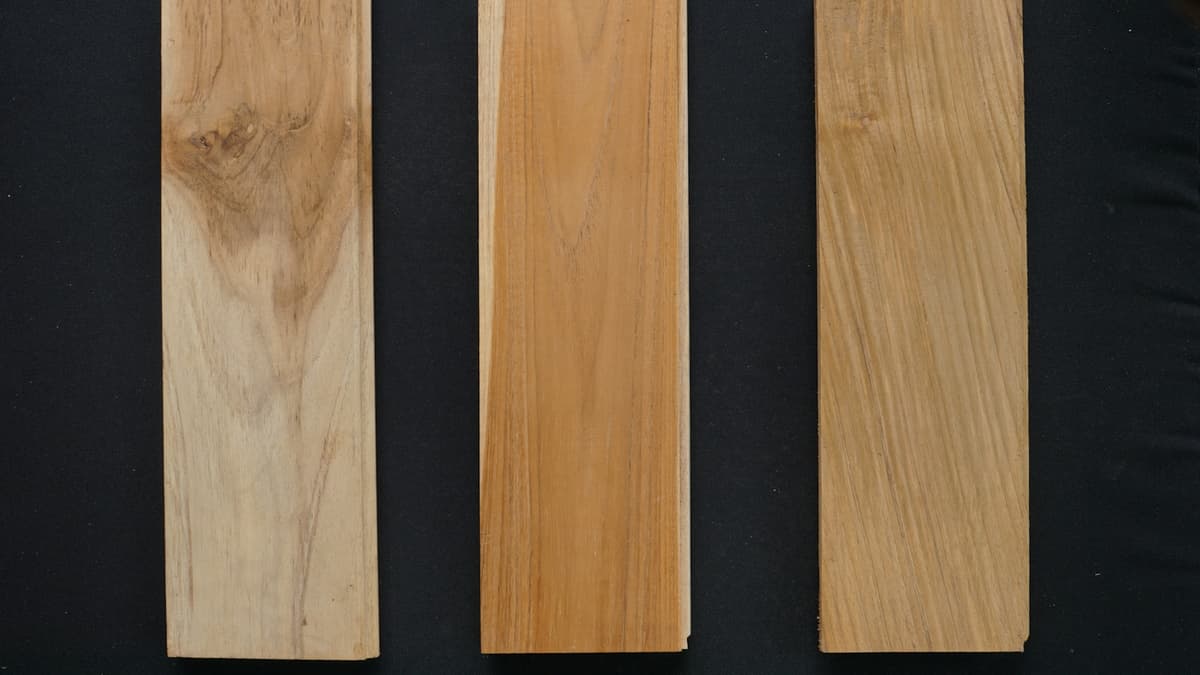
Floor names link to their product pages in a new tab.
Note: This guide replaces our earlier "Hardwood vs Luxury Vinyl Plank" comparison post with a deeper, more specific analysis focused on engineered hardwood (the type most buyers actually consider) and LVP. For the broader category context, see our LVP wear layer guide and engineered hardwood wear layer guide.
The internet is full of "LVP vs engineered hardwood" articles that pick a winner and call it done. Most are wrong, because the winner depends entirely on what you're optimizing for: up-front cost, longest life, best resale value, easiest installation, best moisture handling, or most authentic wood look. Different goals point to different floors.
This guide doesn't declare a winner. Instead, we'll lay out the honest tradeoffs and give you a clear framework for which is right for your situation. We sell both categories at FloorFreight as an authorized Shaw, COREtec, and Anderson Tuftex dealer, so we have no incentive to push you toward one or the other.
Quick answer: Choose LVP if waterproofing is critical (bathrooms, kitchens, basements) or your budget is under $7/sq ft installed. Choose engineered hardwood if resale value, refinishing capability, or authentic wood aesthetics matter most. Both perform well in most residential settings — the right pick depends on your room and priorities, not which is "better."
LVP vs engineered hardwood: which should you choose?
| Luxury Vinyl Plank | Engineered Hardwood | |
|---|---|---|
| Material cost | $2.99–$10.69/sq ft ✓ | $5.19–$21.99/sq ft |
| Installed cost | $4–$15/sq ft ✓ | $9–$30/sq ft |
| Waterproof | 100% (SPC/WPC core) ✓ | Water-resistant only |
| Refinishable | No | Yes, from a 2.5mm wear layer (on a textured floor, measured at its lowest point) ✓ |
| DIY install | Click-lock floating — yes | Floating click — yes; nail/glue — pro recommended |
| Resale value | Mid-tier | Premium (new wood flooring: 118% cost recovered, NAR 2022) ✓ |
| Best rooms | Bathrooms, kitchens, basements, mudrooms | Living areas, bedrooms, dining rooms |
| Surface you walk on | A printed design layer under 6–30 mil of clear coat | Real wood, 1.2mm to 6mm of it ✓ |
If you only have 30 seconds: buy LVP for active spaces and moisture, buy engineered hardwood for main living areas and resale value.
- Choose LVP for bathrooms, basements, kitchens with active cooking, kids' playrooms, mudrooms, pet households, and rental properties
- Choose engineered hardwood for living rooms, bedrooms, formal dining rooms, primary bedrooms, and any home you're planning to sell within 5-10 years
Both can be the right answer. The rest of this post explains why and helps you decide between them for specific rooms in your home — most people end up buying both.
What They Actually Are
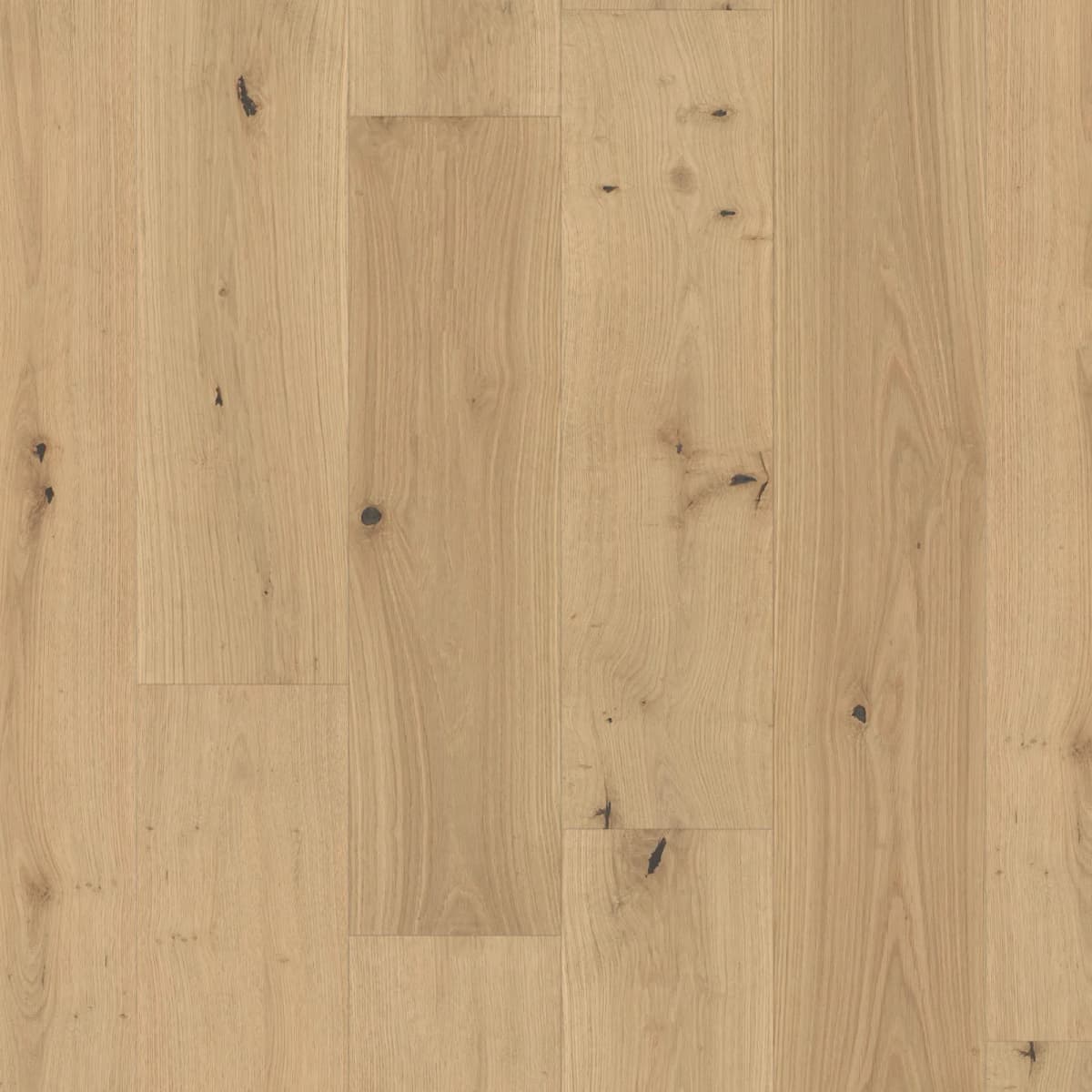
Different materials, different construction, different problems they solve.
Luxury Vinyl Plank (LVP) is engineered vinyl flooring with five layers: an attached underlayment (usually cork or foam), a backing layer for stability, a rigid waterproof core (WPC wood-plastic composite or SPC stone-plastic composite), a printed photographic design layer, and a clear protective wear layer on top. No real wood anywhere in the construction. The "wood look" comes entirely from high-resolution printing technology and embossed surface texture.
Engineered hardwood is real wood with a stable plywood-style backing. The construction is a real-wood top veneer (1.2mm to 6mm thick, depending on grade) bonded to a plywood core typically made of 7-11 cross-grained layers. The plywood backing makes the floor dimensionally stable through humidity swings. The real-wood top layer gives the floor authentic wood appearance, refinishability (in grades with a wear layer of 2.5mm or more), and the prestige of being actual hardwood.
The key distinction: LVP is wood-looking material; engineered hardwood is wood. This single fact drives most of the differences below.
Cost Comparison
LVP wins on upfront cost.
LVP material cost: $2.99–$10.69/sq ft (our catalog range) Engineered hardwood material cost: $5.19-$21.99/sq ft (our catalog range)
LVP installation cost: typically $2-4/sq ft for floating click-lock; somewhat more for glue-down Engineered hardwood installation cost: typically $4-8/sq ft, often requires professional installation
Total LVP installed: $4-15/sq ft depending on product tier Total engineered hardwood installed: $9-30/sq ft depending on product tier
For an average 1,500 sq ft home, the upfront cost difference is significant — roughly $6,000-$22,000 of additional cost to install engineered hardwood throughout vs LVP throughout.
The honest take on cost: LVP costs meaningfully less upfront. The question is whether that gap is offset by other factors over the floor's life — particularly resale value (which we'll cover below).
Durability and Refinishing
This is where the two categories genuinely part company, and it is not about a number of years — neither Shaw nor COREtec nor Anderson Tuftex publishes a service life in years for any floor we carry. It is about whether a worn floor can be brought back.
LVP cannot be brought back. The design layer is a print. Once the clear wear layer above it is gone, the plank is replaced, not restored, whether that plank was 12 mil or 30 mil.
Engineered hardwood sometimes can. Engineered hardwood with a wear layer of 2.5mm or more — the National Wood Flooring Association's minimum for a factory-finished floor to count as refinishableSource 1 — can be sanded and refinished if its surface is smooth. On a wire-brushed, scraped or distressed floor, NWFA measures that 2.5mm at the lowest point of the texture,Source 1 sanding removes the texture, and such floors often cannot be sanded,Source 2 so have a flooring professional assess a textured floor before you count on refinishing it. How many times depends on the wear layer left, the floor's flatness and the skill of the person sanding it, not a fixed number.Source 2
That difference favors engineered hardwood meaningfully — but with caveats:
Engineered hardwood requires refinishing investment. Where a 4mm-veneer engineered hardwood can be refinished, the refinishing cost ($3-7/sq ft) adds to total cost of ownership every time the floor is refinished. LVP doesn't need refinishing — it gets replaced when worn.
Most engineered hardwood in our catalog isn't refinishable. Of Shaw's 28 hardwood styles, only Expressions (4mm wear layer) is thick enough to consider refinishing, and it's wire-brushed, so the wood left at the lowest point of the brushing is what counts. The other 27 are 1.2mm, under the 3/32 inch (2.5mm) line below which NWFA says a floor should not be sanded — so they get replaced when worn, exactly like LVP. Anderson Tuftex runs the other way: 14 of its 21 styles are 2.5mm or thicker, up to Grand Estate at 6mm, and 7 run 1.2mm to 2mm.
The honest take on durability: a premium engineered hardwood (4mm+ face veneer) is the only one of these that a professional can sand back to new. A mid-tier engineered hardwood (1.2–2mm) is a replace-when-worn floor like LVP, at a higher upfront cost.
For our complete wear layer breakdowns, see LVP wear layer explained and engineered hardwood wear layer explained.
Water and Moisture Performance
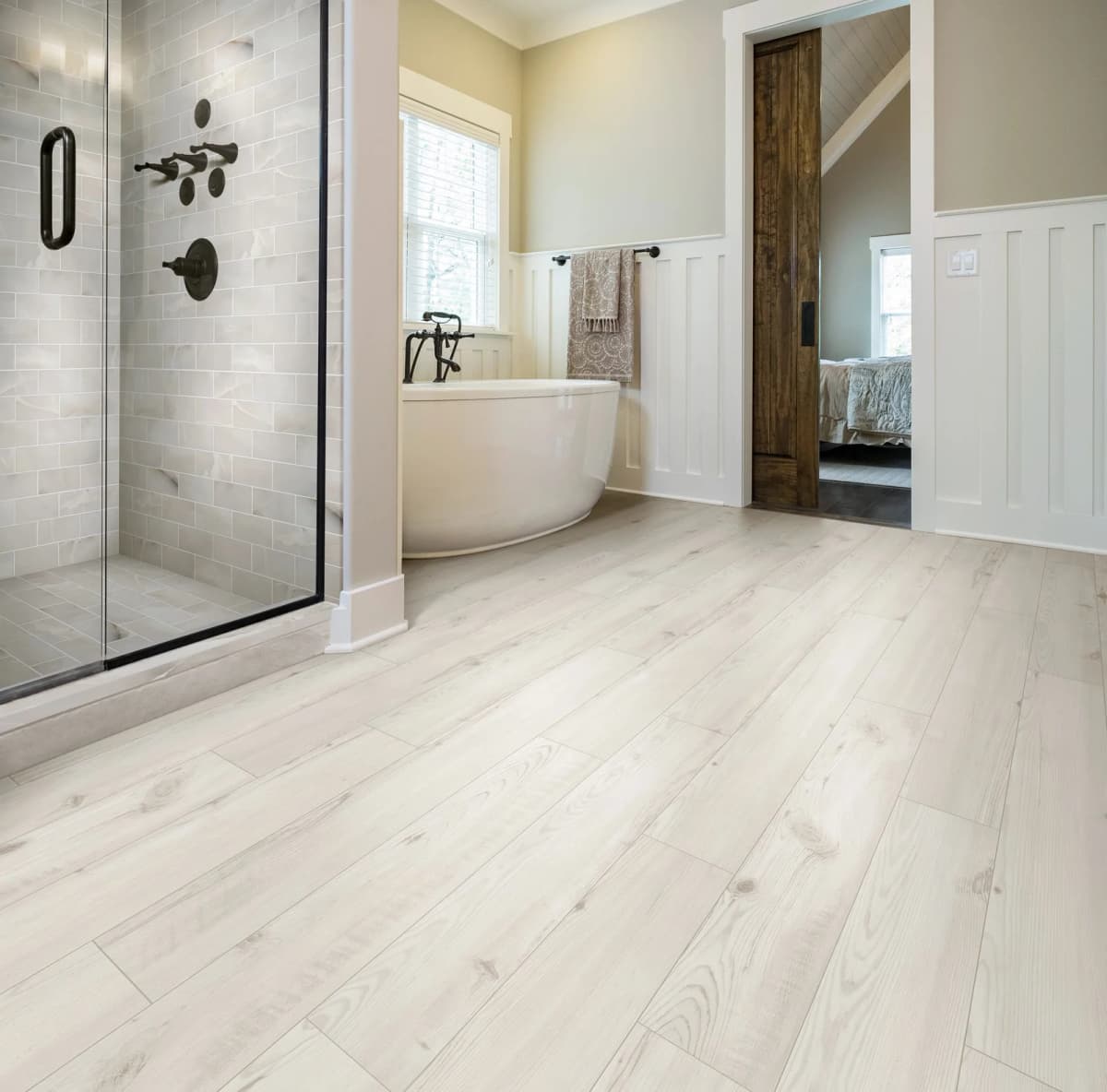
LVP wins decisively.
LVP is built to handle water. Every active LVP style we carry is flagged 100% waterproof — the rigid core won't swell or warp under standing water, and the surface handles humidity, splashes, and cleaning chemicals indefinitely. Bathrooms, basements, kitchens with active cooking, mudrooms — LVP handles all of it.
Engineered hardwood is dimensionally stable through normal humidity swings (its big advantage over solid hardwood), but it's still real wood. It will swell, warp, and stain if exposed to standing water or extreme humidity. Engineered hardwood is appropriate for living rooms, bedrooms, dining rooms, and home offices — but not bathrooms, basements, or laundry rooms.
This category isn't close. If a room sees moisture, LVP is the right call. Don't put engineered hardwood in a bathroom regardless of marketing claims about "waterproof hardwood" — those products handle splashes, not the conditions of an actual bathroom.
For LVP in moisture-prone rooms, see our bathroom flooring guide.
Authenticity and Appearance
Engineered hardwood is real wood. LVP is photographed-wood pretending to be wood.
This sounds like an obvious win for engineered hardwood, but it's worth being honest about. Modern premium LVP is visually convincing. From across a room, most people can't tell a quality $7/sq ft LVP from a $12/sq ft engineered hardwood. The print resolution is high, the embossed texture aligns with the printed grain, and the visual richness is genuinely impressive.
Up close, in good lighting, the difference is visible. Real wood has subtle imperfections, color variation between planks, and grain depth that printing can't replicate. Most people don't notice in normal use. Some people notice immediately.
Sound matters too:
- Engineered hardwood sounds like real wood when you walk on it — slightly hollow, slightly creaky, characteristically wooden
- LVP sounds slightly artificial — softer, sometimes more padded depending on the attached underlayment
The honest take on appearance: If wood authenticity is important to you, choose engineered hardwood. If you're convincing yourself that "modern LVP is just as good," walk into a showroom and look at both side-by-side. Either you can tell the difference, or you can't. Trust your own eye.
Resale Value
Engineered hardwood wins, by a real margin.
The data: Real estate professionals consistently rank hardwood (including engineered) as the highest-value flooring upgrade. The National Association of Realtors' 2022 Remodeling Impact Report put the cost recovered on new wood flooring at 118% — realtors valued the finished project above what it cost — with refinishing existing hardwood higher still at 147%.Source 3 Treat that as a 2022 data point rather than a promise: NAR's 2025 edition doesn't publish a flooring cost-recovery figure at all, and what you actually recover comes down to your market and your buyer.
LVP is gaining recognition in the market, but it doesn't carry the same premium perception. Buyers and appraisers consistently associate hardwood with quality, permanence, and higher-value homes — characteristics that LVP, despite its real performance benefits, doesn't yet carry in resale conversations.
The math for sellers: If you're planning to sell within 5-10 years, the resale value gap can offset the higher upfront cost of engineered hardwood in main living areas. The math doesn't work for bathrooms, basements, or rental properties — but for living rooms, dining rooms, and bedrooms in a home you'll list within a decade, engineered hardwood often pays back the difference.
The math for homeowners planning to stay 15+ years: Resale ROI matters less. The decision comes down to lifestyle fit, not investment recovery.
Comfort Underfoot
Slight edge to LVP in most cases.
LVP with attached cork or foam underlayment feels softer underfoot and is slightly warmer in cold weather. Standing on LVP for long periods (kitchen cooking, kid play areas) is more comfortable than standing on hardwood. Sound dampening is also better.
Engineered hardwood is harder underfoot, slightly colder, and louder when walked on. None of these are major issues for typical residential use, but they're real.
For radiant floor heating, both materials work — LVP with SPC core handles radiant heat better than WPC, while engineered hardwood is generally fine if installation specs are followed.
Installation Complexity
LVP wins decisively.
LVP with click-lock floating installation is DIY-friendly. A weekend warrior can install LVP in a typical room in a day. SPC core LVP skips hardwood's moisture-based acclimation entirely: Shaw states that acclimation is not required for its luxury vinyl as long as the room is climate-controlled,Source 4 and COREtec says the same of its planks and tiles.Source 5 Hardwood, by contrast, has to come into moisture equilibrium with the room before it can go down.
Engineered hardwood typically requires professional installation. There's no universal waiting period to quote — the NWFA frames pre-installation acclimation as matching the wood's moisture content to the conditions it will live in, and says flooring delivered at a moisture content that already coincides with the in-use and subfloor conditions may be installed immediately, while other material can take considerably longer.Source 6 Most engineered hardwood installs glue-down or staple-down rather than floating, requiring more skill and specialized tools.
The installation cost gap reflects this. LVP DIY is genuinely doable; engineered hardwood DIY is usually not the right call for non-professionals.
For installation specifics on each, see our LVP installation guide and the hardwood installation considerations covered in each brand's buyer's guide.
Pet and Kid Damage
LVP wins.
LVP is built for accident-handling: scratch-resistant wear layer, pet-stain warranty coverage (COREtec's Petproof warranty explicitly covers stains from pet urine, feces, and vomit for as long as you own the floorSource 7 — though that same document excludes surface scratches unless a scratch warranty covers them, so the wear layer is what protects you there), and surfaces that clean easily.
Engineered hardwood scratches more visibly. Premium wear-layer engineered hardwood (4mm+) handles pet damage acceptably, but visible scratches accumulate. Pet urine that sits on engineered hardwood for hours can permanently stain.
For families with multiple pets, active kids, or pet households generally, LVP is the practical choice. For households with no pets and adult-only traffic, engineered hardwood handles fine.
For our complete pet-friendly LVP recommendations, see our best LVP for pets guide.
The Honest Decision Framework
Here's how to think through your specific home.
Buy engineered hardwood if any of these are true:
- You're planning to sell within 5-10 years and want maximum resale value
- You want a forever-floor with the wood to refinish (premium 4mm+ wear layer products; have a pro confirm a textured one can be sanded)
- Wood authenticity matters to you — you want real wood, not a print of wood
- Your household is adult-only or has minimal pets/kids
- The rooms in question are bedrooms, living rooms, dining rooms, or home offices (not moisture-prone)
Buy LVP if any of these are true:
- The rooms include bathrooms, basements, kitchens, mudrooms, or laundry rooms
- You have active pets (especially large dogs) or multiple kids
- Upfront cost is a real constraint
- You want DIY installation
- You're flooring a rental property or investment property
- You want flooring that handles your household's reality without you needing to be careful
Buy both for different rooms. Most homeowners doing whole-house flooring end up here. Engineered hardwood in living rooms and bedrooms, LVP in bathrooms and basements. The combined approach maximizes resale value where it counts (main living areas) and practicality where it matters (moisture-prone rooms).
Room-by-Room Recommendations
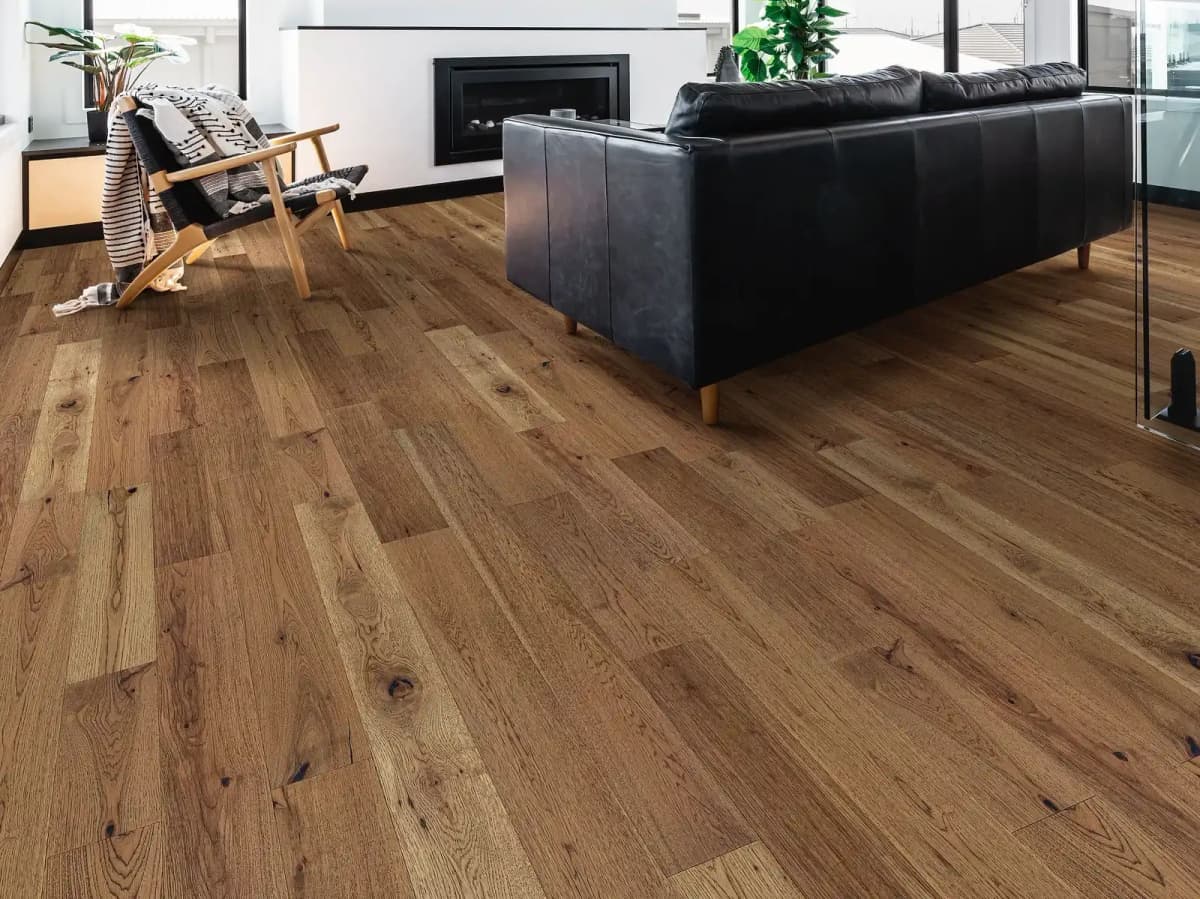
Whole-house flooring decisions are rarely "one floor for everything." Here's how to think about each room.
Living rooms and family rooms. Choose engineered hardwood for resale value and authentic wood appearance. These are the rooms buyers scrutinize during showings, and hardwood signals quality. If you have active pets or kids and the resale-value gap doesn't matter for your timeline, premium LVP (20-30 mil wear layer) is a defensible alternative.
Primary bedrooms and guest bedrooms. Engineered hardwood works well here. The traffic is low, water exposure is minimal, and the warmth and authenticity of real wood matters in a personal space. Mid-tier engineered hardwood (2-3mm wear layer) is sufficient.
Kitchens. Mixed. If your kitchen is moderate-use (you cook a few times a week but don't run a Test Kitchen), engineered hardwood handles it fine with proper care. If you cook actively every day, host frequently, or have kids, choose LVP for the spill-handling. COREtec Pro Classics or Shaw Infinite SPC at $4-5/sq ft are right for active kitchens.
Bathrooms. LVP with SPC core, no exceptions. Don't put engineered hardwood in any bathroom regardless of marketing claims. See our complete bathroom flooring guide for specific picks.
Basements. LVP, always. Below-grade installations face moisture vapor from the slab even when there are no visible leaks. Engineered hardwood doesn't belong below grade.
Mudrooms and laundry rooms. LVP, ideally tile-format SPC (COREtec CT Plus Tile or Shaw Paragon Tile Plus). The combination of moisture and grit destroys hardwood; LVP handles both indefinitely.
Home offices. Engineered hardwood works well for traditional home offices in main living areas. For basement offices or offices with bathroom-adjacent walls, LVP is the safer call.
Open floor plans. This is where most whole-house buyers face the hardest decision. Open layouts that flow from living room to kitchen to dining can't easily split between engineered hardwood and LVP without visible transitions that disrupt the flow. Two paths: (1) install engineered hardwood throughout if your cooking style is moderate and you'll be selling within 10 years, or (2) install premium LVP throughout and accept the resale-value gap in exchange for whole-house water performance.
Kids' playrooms. LVP. The combination of dropped toys, juice spills, art-project accidents, and pet incidents that come with kid spaces destroys engineered hardwood faster than anywhere else in the house.
Specific Recommendations
If you've decided LVP is right for your situation:
- Best LVP value: COREtec Pro Classics VV017 ($4.09/sq ft) — see our COREtec LVP buyer's guide
- Best Shaw LVP value: Shaw Endura Plus ($2.99/sq ft) — see our Shaw LVP buyer's guide
If you've decided engineered hardwood is right:
- Best Shaw hardwood value: Shaw Sanctuary Hickory ($8.59/sq ft) — see our Shaw hardwood buying guide
- Best premium engineered hardwood: Anderson Tuftex Grand Estate ($15.09/sq ft) — see our Anderson Tuftex hardwood buying guide
For the deep dive on engineered vs solid hardwood (both real wood, different constructions), see our solid vs engineered hardwood post.
Final Word
LVP and engineered hardwood are different products solving different problems. Neither is universally better. The question is which solves your specific problem in your specific home.
If you're optimizing for upfront cost, water performance, ease of installation, or active-household practicality, LVP is the call.
If you're optimizing for resale value, wood authenticity, or the option to sand the floor back rather than replace it, engineered hardwood is the call.
For most homes, the right answer is "both" — engineered hardwood in main living areas, LVP in moisture-prone rooms. This is what professional builders increasingly install in new construction, and it's the most defensible whole-house approach for homeowners doing a comprehensive flooring project.
Order $5 samples of both before deciding. The visual and tactile difference between LVP and engineered hardwood is real, but it's also real that quality LVP is much closer to engineered hardwood today than it was even 5 years ago. Trust your own eye in your own lighting.
In this article
The floors from this guide

COREtec Floors
COREtec Pro Classics VV017
Chesapeake Oak
Samples are $5 each, credited back at checkout when you sign in.

Shaw Floors
Endura Plus
Cinnamon Walnut
Samples are $5 each, credited back at checkout when you sign in.

Shaw Hardwood
Sanctuary Hickory
Reunion
Samples are $5 each, credited back at checkout when you sign in.

Anderson Tuftex
Grand Estate
Thorndon Hall
Samples are $5 each, credited back at checkout when you sign in.
Common questions
Frequently Asked Questions
Should I buy LVP or engineered hardwood?
Choose LVP for bathrooms, basements, kitchens with active cooking, mudrooms, pet households, and rental properties — it's 100% waterproof and costs less upfront ($2.99–$10.69/sq ft material). Choose engineered hardwood for living rooms, bedrooms, formal dining rooms, and homes you plan to sell within 5-10 years — it adds more resale value and is real wood. Most whole-house projects end up with both: hardwood in main living areas, LVP in moisture-prone rooms.
Which flooring adds more home value — LVP or hardwood?
Engineered hardwood adds more resale value. The National Association of Realtors' 2022 Remodeling Impact Report put the cost recovered on new wood flooring at 118%, and realtors consistently highlight hardwood as a top recommendation for sellers. Treat that as a 2022 data point rather than a guarantee — NAR's 2025 edition doesn't publish a flooring cost-recovery figure at all. LVP is gaining acceptance but doesn't yet carry the same premium perception with buyers and appraisers. If you're selling within 5-10 years, the resale value gap can offset the higher upfront cost of engineered hardwood in main living areas.
Is LVP waterproof? Is engineered hardwood?
LVP is 100% waterproof on the vast majority of modern SPC and WPC construction — every active LVP style in our catalog is flagged waterproof. Engineered hardwood is dimensionally stable through normal humidity swings but is NOT waterproof. It will swell, warp, and stain under standing water or extreme humidity. Don't install engineered hardwood in bathrooms, basements, or laundry rooms regardless of marketing claims about water resistance.
Can engineered hardwood be installed in kitchens?
Yes, with caveats. For moderate-use kitchens (cooking a few times a week), engineered hardwood handles it fine with proper care. For actively used kitchens with frequent cooking, kids, or pets, LVP is the safer choice for spill handling. Choose engineered hardwood styles with 4mm+ wear layers for kitchen installs; avoid entry-tier 1.2-2mm wear layer products in kitchens.
Referenced in this guide
Sources
NWFA Launches Engineered Wood Flooring Refinishable Program (Hardwood Floors magazine, Aug/Sept 2022)
National Wood Flooring Association · Accessed 2026-09-15
https://nwfa.org/wp-content/uploads/2022/09/HFM_AugSept22_final_refinishable_small.pdfWood Flooring Sand and Finish Guidelines (2016), pp. 19 and 25
National Wood Flooring Association · Accessed 2026-09-15
https://www.oldewoodltd.com/uploads/nwfa-sand-finish-wood-floors-2016.pdf2022 Remodeling Impact Report
National Association of REALTORS® Research Group · Accessed 2026-08-03
https://www.nar.realtor/sites/default/files/documents/2022-remodeling-impact-report-04-19-2022.pdfLuxury Vinyl Installation
Shaw Floors · Accessed 2026-08-03
https://shawfloors.com/en-us/plan-and-install/vinylInstallation & Maintenance
COREtec · Accessed 2026-08-03
https://coretecfloors.com/en-us/installation-maintenanceNWFA Installation Guidelines
National Wood Flooring Association · Accessed 2026-08-03
https://nwfa.org/wp-content/uploads/2026/02/NWFA-Installation-Guidelines.pdfResidential Resilient Limited Warranty — Defects, Wear, Waterproof, Petproof (USFloors/COREtec, rev. 06/28/2023)
Shaw Industries, Inc. (USFloors / COREtec) · Accessed 2026-08-05
https://pdmsview.shawinc.com/viewer/document/doc/19721
Related Posts
Keep Reading

LVP Wear Layer Explained: Why 12 Mil and 20 Mil LVP Overlap on Price and Wear Differently
9 min read
Shaw LVP Buyer's Guide: Classic Series vs Pro Series, and Where 5th and Main Fits (2026)
10 min read
Will Heavy Furniture Dent Vinyl Plank Flooring? What Holds Up (2026)
14 min read
What Flooring Can Go Over a Concrete Slab? Floating vs Glue-Down, Moisture Testing, and What to Buy
14 min read
Keep browsing