
Will Luxury Vinyl Plank Buckle in a Sunroom? Heat, Sunlight, and What to Choose
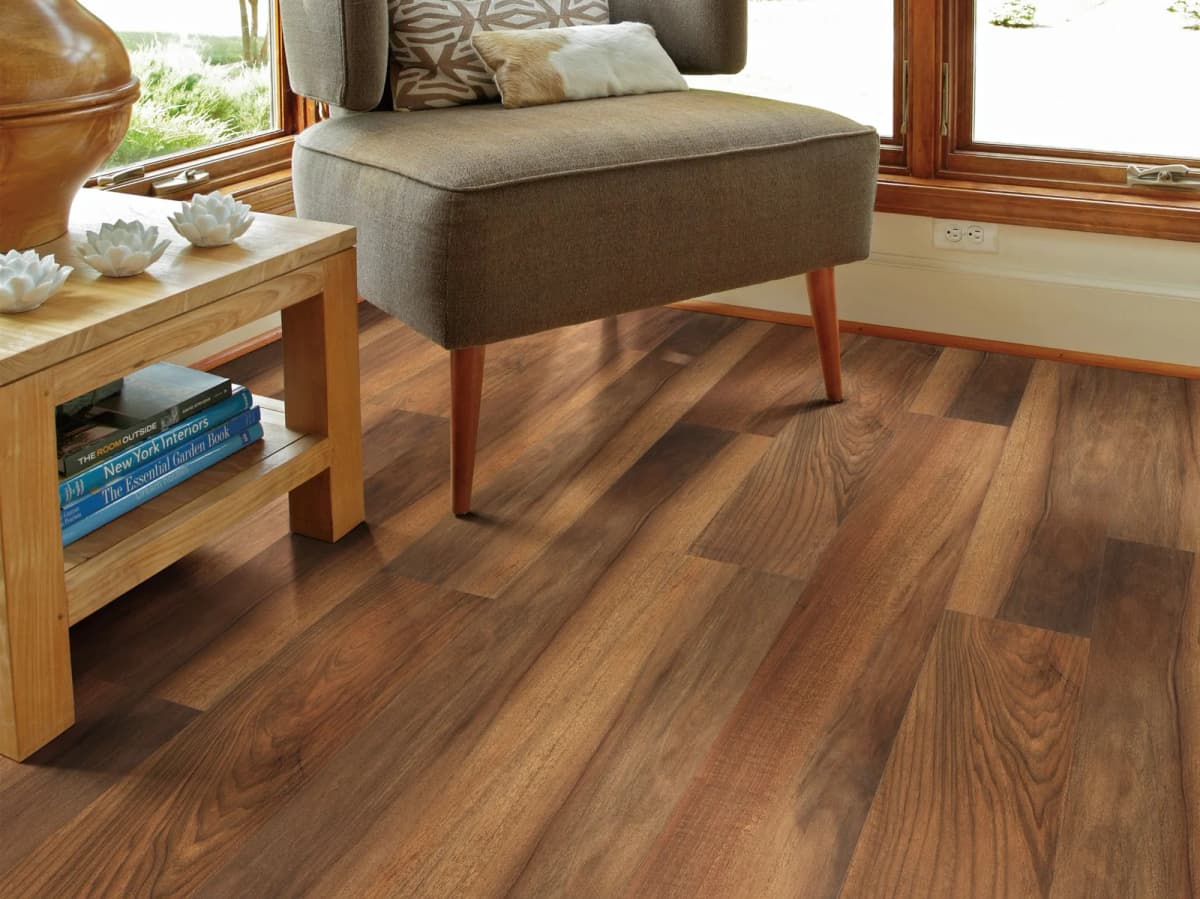
Quick answer: Luxury vinyl plank doesn't have to buckle in a sunroom: Shaw's SPC installation guide allows a floating floor in a three-season room at -25°F to 155°F,Source 1 COREtec's WPC guide allows 32°F to 100°F,Source 2 and both ask for a 55°F to 85°F room during installation and a 1/4-inch expansion gap in rooms under 2,500 square feet. Close blinds or drapes during peak sun, float the floor if the room goes unconditioned, and know that color change from sunlight or heat is excluded from the current Shaw and COREtec resilient warranties.Source 3Source 4
A sunroom asks more of a floor than any other room in the house. There's glass on two or three sides, sun lands directly on the planks for hours, and plenty of sunrooms go without heat or air conditioning for a season or two. A lot of advice on the subject stops at "vinyl is waterproof and handles temperature," which doesn't tell you what happens in July.
So this guide goes to the paperwork instead: the installation guides and warranty documents Shaw, COREtec, and Anderson Tuftex publish for their own floors. We sell all three brands at FloorFreight as an authorized dealer. Every one of the 466 luxury vinyl colorways active in our catalog as of September 12, 2026 is rigid core (178 SPC and 288 WPC), and every one can be installed as a floating floor. None of those 466 product records carries a sunroom-specific note from the manufacturer, which is exactly why the installation guide is where the real answer lives.
Sunroom Flooring at a Glance
| Question | What the manufacturer documents say |
|---|---|
| Can vinyl plank go in a three-season room? | Yes, floating installations only, within a stated temperature range |
| Room temperature during installation | 55°F to 85°F, or an average of 70°F (WPC and SPC guides) |
| Three-season range after installation, SPC | -25°F to 155°F ambient, floating only |
| Three-season range after installation, WPC | 32°F to 100°F ambient, floating only |
| Glue-down in an unconditioned room | The three-season allowances do not apply to glue-down |
| Perimeter expansion gap, vinyl | 1/4 inch under 2,500 sq ft; 1/2 inch above |
| Direct sunlight | Drapes or blinds during peak hours; can cause discoloration and thermal expansion |
| In-floor radiant heat, vinyl | Operating temperature never above 85°F |
| Warranty and sun or heat | Color or appearance change from sunlight or heat is excluded |
| Engineered hardwood | HVAC at 65°F to 75°F and 35% to 55% humidity; no three-season clause |
Can Luxury Vinyl Plank Go in a Sunroom or Three-Season Room?
Yes, and the manufacturers address it by name. Shaw's and COREtec's installation guides for both WPC and SPC describe "3 season" installations, meaning a home or room that goes without climate control for extended periods during certain seasons, and each gives a post-installation temperature allowance for that situation.Source 2Source 5Source 1Source 6
Two conditions come attached, and they're easy to miss:
- The allowance is for floating floors only. Each of those guides states that it does not apply to glue-down installations.
- Installation still happens in a controlled room. The guides ask for a climate-controlled environment of 55°F to 85°F (13°C to 29°C), or an average of 70°F, while the floor goes in.
It helps to be honest about which kind of sunroom you have. If yours is heated and cooled with the rest of the house, it already looks like the climate-controlled environment the guides describe. If it gets closed off for the winter or left to bake through August, you're in three-season territory, and the core you choose matters a great deal.
One edge case: if your "sunroom" is really a porch that's open or screened to the weather, ask us before you order. The current Shaw and COREtec resilient warranties exclude outdoor applications.Source 3Source 4
What Temperatures Do Shaw and COREtec Allow in a Sunroom?
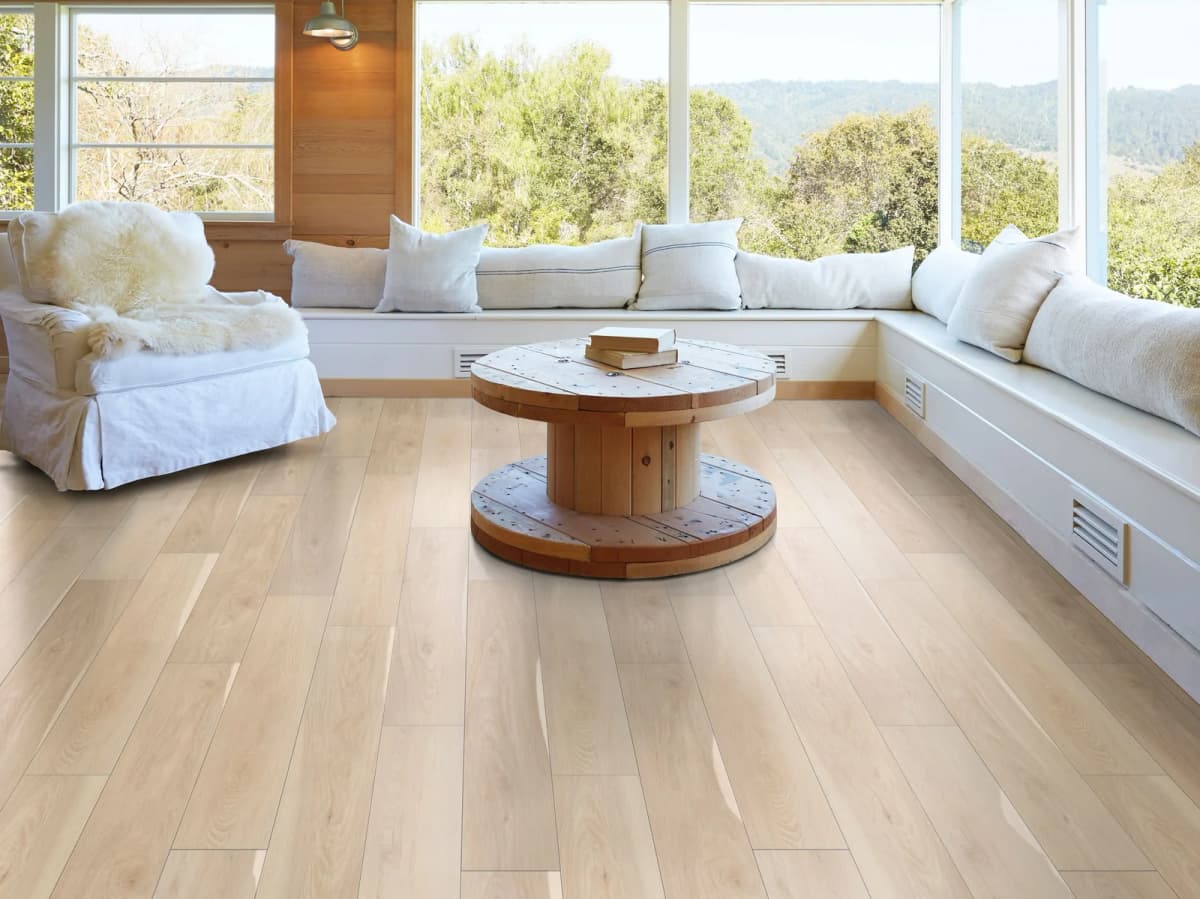
During installation, 55°F to 85°F for both core types. After installation, in a three-season room with a floating floor, the numbers split sharply by core: -25°F to 155°F for SPC and 32°F to 100°F for WPC.
| Condition | Shaw and COREtec WPC | Shaw and COREtec SPC |
|---|---|---|
| Installation environment | 55°F to 85°F (13°C to 29°C), or 70°F average | 55°F to 85°F (13°C to 29°C), or 70°F average |
| Three-season room, after installation | 32°F to 100°F (0°C to 37.7°C), floating only | -25°F to 155°F (-31.6°C to 68.3°C), floating only |
| Radiant heat, maximum operating temperature | 85°F | 85°F |
The WPC figures appear in both COREtec's WPC installation guide and Shaw's WPC guide.Source 2Source 5 The SPC figures appear in both Shaw's SPC guide and COREtec's Pro SPC guide.Source 1Source 6 All four frame the post-installation range as a three-season allowance for floating floors only.
A few things to read carefully in those numbers:
They're room temperatures. The three-season allowances are written as ambient room temperature, meaning the air in the room. The guides treat direct sunlight as its own concern, covered below, rather than folding it into the range.
They're specific guide revisions. The COREtec WPC guide we read is a 2022 revision, Shaw's WPC guide a 2021 revision, and Shaw's SPC and COREtec's Pro SPC guides 2024 revisions. The installation guide for your exact product is the one that governs your floor, so find it and read its temperature lines before you buy. If you can't locate it, ask us and we'll help you find it.
Radiant heat has its own ceiling. If your sunroom also has in-floor heat, the WPC and SPC guides all say maximum operating temperature should never exceed 85°F.Source 2Source 5Source 1Source 6 Our guide to flooring over radiant heat covers the rest of that setup.
Why Does Vinyl Plank Buckle in Heat, and How Big Should the Expansion Gap Be?
Vinyl plank grows when it gets hot, and a needs a gap around the room's edge to grow into. For COREtec WPC, the required perimeter gap is 1/4 inch in areas under 2,500 square feet and 1/2 inch in larger areas, whether the floor is floated or glued.Source 2
Here's the mechanism in plain terms. A floating floor isn't fastened to the subfloor; it locks together and rests in place. When the planks warm and expand, the gap hidden under the baseboard is the room they expand into. If that gap is too tight, or something fills it, the floor has nowhere to go but up. That lift is what people mean by buckling or peaking.
The manufacturers name sunlight directly as a cause of that expansion. COREtec's WPC guide says excess temperature from direct sunlight "can result in thermal expansion and UV fading,"Source 2 and Shaw's SPC guide carries the same warning.Source 1 Both guides also include it in their installation steps, telling the installer to protect the finished floor from direct sunlight "to reduce fading and thermal expansion."Source 2Source 1
What that means for a sunroom:
- A sunroom under 2,500 square feet takes the 1/4-inch gap in both the WPC and SPC guides.
- Larger rooms take a bigger gap. Above 2,500 square feet, the WPC and SPC guides both call for 1/2 inch.Source 2Source 1 Confirm the number against your product's own guide.
- Check the gap before the trim goes on. Once baseboard covers it, nobody can see whether it's right. Our LVP installation guide walks through gaps and transitions, and how to find a flooring installer covers what to ask before you hire.
Does SPC Handle Heat Better Than WPC?
On paper, yes, by a wide margin. In the same manufacturer family's own guides, a floating floor is documented for a three-season room from -25°F to 155°F,Source 1Source 6 while a floating WPC floor is documented from 32°F to 100°F.Source 2Source 5 That's 55°F more room on the hot end and 57°F more on the cold end.
This matters because "SPC handles temperature swings better" is often repeated without a number behind it. Here the numbers come from the manufacturers' installation instructions, which is where the warranty points too (more on that below).
| For a sunroom | SPC (stone-plastic composite) | WPC (wood-plastic composite) |
|---|---|---|
| Three-season range, floating | -25°F to 155°F | 32°F to 100°F |
| Installation environment | 55°F to 85°F | 55°F to 85°F |
| Perimeter gap, under 2,500 sq ft | 1/4 inch | 1/4 inch |
| Sunlight guidance | Drapes or blinds during peak sun | Drapes or blinds during peak sun |
| In our catalog (Sept. 12, 2026) | 178 colorways | 288 colorways |
WPC isn't ruled out. A sunroom that's heated and cooled with the house and stays in the 55°F to 85°F band sits inside what the WPC guide describes, and a three-season room that genuinely stays between 32°F and 100°F sits inside its allowance. The difference is how much margin you have if the room runs hotter or colder than you planned. For how the two cores compare on everything else, see our SPC vs WPC guide.
Will Direct Sunlight Fade Luxury Vinyl Plank?
It can, and the manufacturers say so plainly. COREtec's WPC guide says to avoid exposure to direct sunlight for prolonged periods because it "may result in discoloration," and recommends drapes or blinds during peak sunlight hours.Source 2 Shaw's SPC guide uses the same language.Source 1
The warranties don't cover sun-related color change. The current Shaw and COREtec Residential Resilient Limited Warranties both exclude "changes in color or appearance resulting from, but not limited to, sunlight exposure or heat exposure."Source 3Source 4
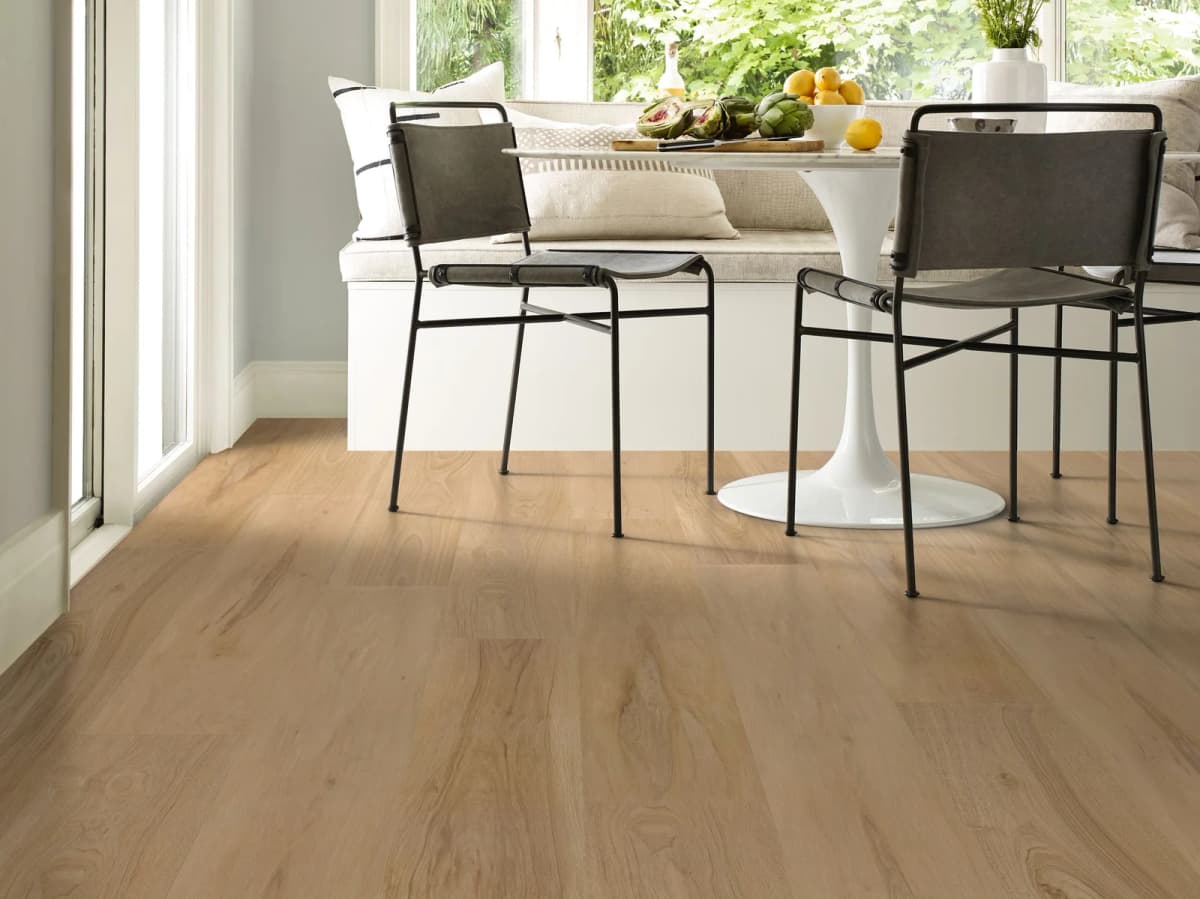
On window treatments, it's worth knowing what the documents don't say. None of the manufacturer documents we reviewed gives a window-film recommendation or a UV-blocking percentage. The instruction in the vinyl guides is simply drapes or blinds during peak sunlight hours, and the current Shaw and Anderson Tuftex hardwood warranties name no window treatment at all; they exclude sun fading and leave it there.Source 7Source 8 In a sunroom, that makes window coverings part of the flooring plan rather than an afterthought.
Does an Unheated Sunroom Void the Flooring Warranty?
Not automatically. The current Shaw and COREtec Residential Resilient Limited Warranties (docs 28855 and 19721, both revision 06/28/2023) don't mention three-season rooms and don't name a temperature at all.Source 3Source 4 What they do is exclude three things that matter in a sunroom:
- Performance failures from not following the appropriate Shaw installation instructions. That's where the temperature ranges and gap sizes live.
- Changes in color or appearance from sunlight or heat exposure.
- Outdoor applications.
Our reading of how those pieces fit together: the warranties hand the specifics to the installation guide. Stay inside your product's documented range, float the floor if the room goes unconditioned, and leave the gap the guide requires, and you're following the instructions the warranties point to. Fading from sun is excluded no matter what kind of room the floor is in.
It's also worth separating "waterproof" from "heat-proof." Every luxury vinyl plank in our catalog is listed as waterproof, all 466 of 466. The warranties' own titles name defects, wear, waterproof, and petproof coverage, and the exclusion for sun and heat color change sits right alongside them in the same documents.
Can Engineered Hardwood Go in a Sunroom?
Only a fully conditioned sunroom fits what the hardwood paperwork asks for. Shaw's engineered hardwood installation guide calls for permanent HVAC running for at least 5 days at 65°F to 75°F and 35% to 55% relative humidity, before the flooring arrives, during installation, and after, and says flooring should not be exposed to extremes of humidity or moisture.Source 9
There's no three-season allowance to lean on. Shaw's hardwood warranty, Shaw's engineered hardwood installation guide, and Anderson Tuftex's hardwood warranty contain no three-season or sunroom clause like the one in the vinyl installation guides.Source 7Source 9Source 8 We also didn't find a manufacturer document giving an explicit yes or no for engineered hardwood in a sunroom, so we won't pretend one exists.
What the hardwood documents do say, attribute by attribute:
Moisture movement. Shaw's hardwood warranty states that all wood-based products are hygroscopic, meaning they react to moisture and expand or contract accordingly.Source 7 That's a second kind of movement, on top of the heat-driven expansion the vinyl guides describe.
Dry air. Below 35% humidity, planks may shrink and show surface checking, which Shaw's warranty doesn't cover; it notes a humidifier or dehumidifier may be needed to hold 35% to 55%.Source 7 Anderson Tuftex's current hardwood warranty uses the same language.Source 8
Sunlight. Shaw's hardwood warranty says the sun and its UV rays can cause the stain or wood to fade, darken, or change color, and that fading or discoloration from sunlight isn't covered. It separately excludes discoloration from UV light and heat sources, and damage due to thermal heat sources.Source 7 Anderson Tuftex's current hardwood warranty carries the same sunlight and UV exclusions.Source 8 Shaw's installation guide adds that some species are light-sensitive, so uncovered areas may change color.Source 9
Surface temperature. In its radiant-heat section, Shaw's guide says not to let the floor's surface temperature exceed 80°F, and that surface checking can be expected above it or when humidity falls outside 35% to 55%.Source 9 That limit is written for radiant heat, and the guide gives no separate figure for a sun-warmed floor.
Expansion gap. For floating installations, Shaw's engineered hardwood guide requires at least 1/2 inch around the perimeter, regardless of the flooring's thickness.Source 9
If you love real wood and your sunroom is truly part of the conditioned house, those are rules you can plan around. Our LVP vs engineered hardwood comparison and hardwood acclimation guide are good next reads, and you can browse engineered hardwood from Shaw and Anderson Tuftex.
Which Floor Should You Choose for Your Sunroom?
For a room that goes unconditioned for part of the year, SPC vinyl plank installed floating has the widest documented range. For a sunroom that's heated and cooled with the house, WPC and engineered hardwood both come back into the picture.
Choose SPC luxury vinyl plank if:
- The room goes without heat or air conditioning for part of the year
- Summer highs or winter lows could push past WPC's 32°F to 100°F allowance
- You'll install it floating, which is the method the three-season allowance covers
Two SPC options worth a look: Shaw Infinite SPC in Pampas (20 mil wear layer, attached EVA pad, floating installation) and COREtec Pro Plus Enhanced HD 9" in Canterbury Elm (20 mil wear layer, attached cork, floating or direct glue).
Choose WPC luxury vinyl plank if:
- The sunroom is heated and cooled with the rest of the house
- Or, if it's a three-season room, you're confident it stays between 32°F and 100°F
- You'd like a thicker plank underfoot (the two below measure 0.472 inch, against 0.173 and 0.204 inch for the SPC picks above)
Two WPC options: Shaw Titan HD Plus Platinum in Autumn Barnboard (30 mil wear layer, attached IXPE pad, floating or direct glue) and COREtec Originals Premium in Pride Oak (30 mil wear layer, attached cork, floating or direct glue).
Choose engineered hardwood if:
- The sunroom is fully conditioned year-round at 65°F to 75°F
- You can hold humidity between 35% and 55%, with a humidifier if needed
- You're comfortable that fading from sunlight isn't covered by the hardwood warranties
Think twice about glue-down if the room will go unconditioned. The three-season allowances in the WPC and SPC guides exclude glue-down installations, and we didn't find an equivalent range for glue-down in them.
Before you order, run through this list:
- Decide honestly whether the room is conditioned year-round or three-season.
- Find the installation guide for your exact product and read its temperature and gap lines.
- Confirm the perimeter gap with your installer before trim goes on.
- Plan drapes or blinds for peak sun.
- If there's in-floor heat, keep it within the guide's limit and read our radiant heat guide.
- Order samples and look at them in the sunroom itself, in morning and afternoon light.
A sunroom can be the room you use most, with the right floor under it. Pick the core that matches how the room really lives, follow the guide that comes with it, and give the windows some cover when the sun is at its strongest. Browse every rigid-core style in our luxury vinyl plank collection, or start with Shaw and COREtec.
In this article
The floors from this guide

Shaw Floors
Infinite SPC
Pampas
Samples are $5 each, credited back at checkout when you sign in.

COREtec Floors
COREtec Pro Plus Enhanced HD 9" VV488
Canterbury Elm
Samples are $5 each, credited back at checkout when you sign in.

Shaw Floors
Titan HD Plus Platinum
Autumn Barnboard
Samples are $5 each, credited back at checkout when you sign in.

COREtec Floors
COREtec Originals Premium VV457
Pride Oak
Samples are $5 each, credited back at checkout when you sign in.
Common questions
Frequently Asked Questions
Will luxury vinyl plank buckle in a sunroom in summer?
It doesn't have to, if the room stays inside the manufacturer's temperature range and the floor keeps its expansion gap. Shaw's SPC installation guide allows a floating floor in a three-season room at an ambient temperature of -25°F to 155°F, and COREtec's WPC guide allows 32°F to 100°F. Both guides warn that excess heat from direct sunlight can cause thermal expansion, recommend drapes or blinds during peak sun, and require a 1/4-inch perimeter gap in rooms under 2,500 square feet.
What temperature range does COREtec allow in a three-season room?
For COREtec WPC floors installed floating, COREtec's WPC installation guide allows an ambient room temperature of 32°F to 100°F (0°C to 37.7°C) after installation in a space without climate control for extended periods, and it states that this three-season allowance applies to floating floors only, not glue-down. COREtec's Pro SPC guide gives -25°F to 155°F for the same three-season situation, also for floating floors only. Both guides ask for a climate-controlled 55°F to 85°F environment during installation.
Does putting vinyl plank in an unheated sunroom void the warranty?
Not automatically. The current Shaw and COREtec Residential Resilient Limited Warranties (revision 06/28/2023) do not mention three-season rooms or name a temperature. They exclude performance failures caused by not following the appropriate Shaw installation instructions, changes in color or appearance from sunlight or heat exposure, and outdoor applications. The installation guide for your product is where the temperature limits and gap sizes live, so following it is what keeps coverage in play.
Should vinyl plank be glued down or floated in a sunroom?
If the room goes without heat or air conditioning for part of the year, the three-season temperature allowances in Shaw's and COREtec's SPC and WPC installation guides are written for floating floors only, and each guide states that the allowance does not apply to glue-down installations. We did not find an equivalent post-installation range for glue-down in those guides, so check your specific product's guide before choosing glue-down for an unconditioned room.
Can engineered hardwood go in a sunroom?
Only a fully conditioned one fits the paperwork. Shaw's engineered hardwood installation guide calls for permanent HVAC running at least 5 days at 65°F to 75°F and 35% to 55% relative humidity, before, during, and after installation. Neither Shaw's nor Anderson Tuftex's hardwood documents include a three-season or sunroom clause, and both hardwood warranties exclude fading or discoloration from sunlight and UV exposure.
Will sunlight fade vinyl plank flooring?
It can. Shaw's and COREtec's vinyl installation guides say prolonged direct sunlight may cause discoloration and recommend drapes or blinds during peak sunlight hours. The current Shaw and COREtec resilient warranties exclude changes in color or appearance resulting from sunlight or heat exposure. None of the documents we reviewed gives a window-film or UV-blocking percentage; the vinyl guides name drapes and blinds.
Referenced in this guide
Sources
Luxury Vinyl Angle/Angle SPC Installation Guidelines (doc 7273, rev. 09/18/2024)
Shaw Floors (Shaw Industries) · Accessed 2026-09-12
https://pdmsview.shawinc.com/viewer/document/doc/7273COREtec Resilient Installation Guidelines for WPC Products (doc 11746, rev. 03/01/2022)
COREtec (Shaw Industries) · Accessed 2026-09-12
https://pdmsview.shawinc.com/viewer/document/doc/11746Shaw Residential Resilient Limited Warranty: Defects, Wear, Waterproof, Petproof (doc 28855, rev. 06/28/2023)
Shaw Floors (Shaw Industries) · Accessed 2026-09-12
https://pdmsview.shawinc.com/viewer/document/doc/28855COREtec Residential Resilient Limited Warranty: Defects, Wear, Waterproof, Petproof (doc 19721, rev. 06/28/2023)
COREtec (Shaw Industries) · Accessed 2026-09-12
https://pdmsview.shawinc.com/viewer/document/doc/19721Floorte and Floorte Plus WPC Installation Guidelines (doc 3881, rev. 03/18/2021)
Shaw Floors (Shaw Industries) · Accessed 2026-09-12
https://pdmsview.shawinc.com/viewer/document/doc/3881COREtec Pro SPC Installation Guidelines (doc 10195, rev. 11/05/2024)
COREtec (Shaw Industries) · Accessed 2026-09-12
https://pdmsview.shawinc.com/viewer/document/doc/10195Shaw Hardwood Limited Residential Warranty (doc 1475, rev. 06/14/2024)
Shaw Industries, Inc. · Accessed 2026-09-12
https://pdmsview.shawinc.com/viewer/document/doc/1475Anderson Tuftex Hardwood Limited Residential Warranty (doc 22123, rev. 06/14/2024)
Anderson Tuftex (Shaw Industries) · Accessed 2026-09-12
https://pdmsview.shawinc.com/viewer/document/doc/22123Engineered Hardwood Flooring Installation Guidelines (doc 7793, rev. 05/03/2024)
Shaw Floors (Shaw Industries) · Accessed 2026-09-12
https://pdmsview.shawinc.com/viewer/document/doc/7793
Related Posts
Keep Reading

LVP Wear Layer Explained: Why 12 Mil and 20 Mil LVP Cost the Same and Wear Differently
9 min read
Shaw LVP Buyer's Guide: Classic Series vs Pro Series, and Where 5th and Main Fits (2026)
10 min read
Will Heavy Furniture Dent Vinyl Plank Flooring? What Holds Up (2026)
14 min read
What Flooring Can Go Over a Concrete Slab? Glue-Down vs Floating, Moisture Testing, and What to Buy
14 min read
Keep browsing