
My Dog Ruined the Hardwood: Repair It, or Switch to Waterproof LVP?
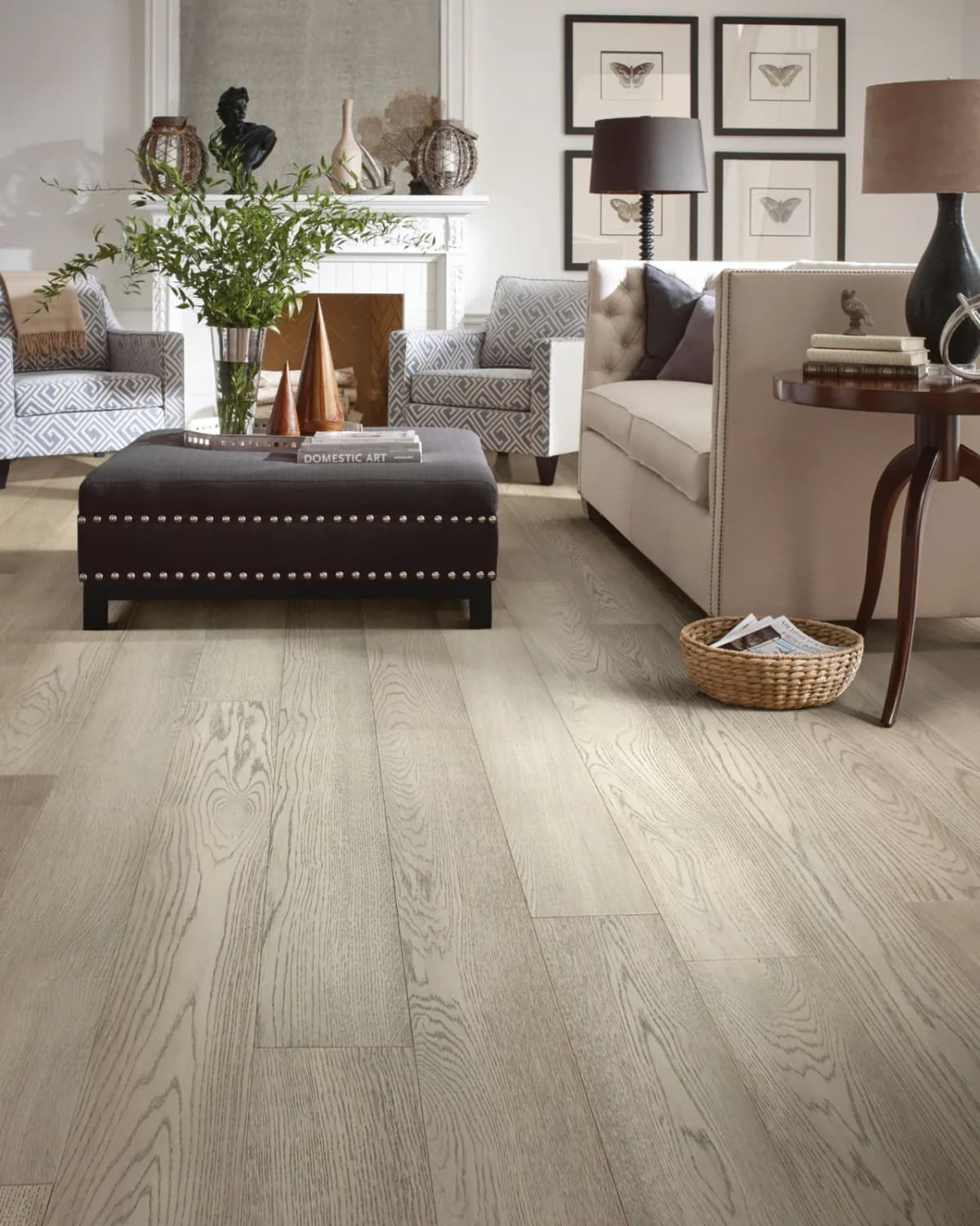
Floor names link to their product pages in a new tab.
Quick answer: If dog urine has damaged your hardwood, sand and refinish if the floor can be sanded — solid hardwood, or engineered with a face veneer of 2.5mm or more — the damage is in the finish or the top fibers, and the odor is gone once the boards are clean and dry. On a thinner veneer, a stained board gets replaced, not sanded. If a stain survives a test sanding or the smell returns in humid weather, the damage went deeper than a sanding reaches: replace the damaged boards and look at the subfloor under them. And if the dog is going to keep having accidents — an elderly dog, a medical issue — a refinished hardwood floor is the same failure waiting to happen again. Fix whatever the subfloor needs first; then waterproof rigid-core LVP is the structural fix, from $3.29/sq ft in our catalog at the 20 mil wear layer we recommend for most dogs, and the standard Shaw and COREtec warranties cover pet stains in writing.
You already know how this went. One board went gray, then a couple more went dark at the edges. You cleaned it, then cleaned it harder with the enzyme cleaner you'd been told to use, and the smell was gone for a week — until it rained and the room smelled like a kennel again. Somewhere around here you found the midnight forum threads, and the people three years ahead of you saying the same thing: the stain was never the whole problem, just the part that showed.
That's the crisis this post is written for: not which floor to buy, but whether the one you have can be saved, what saving it costs, and how to tell a damaged floor from one that's done.
Our position, stated up front: we sell flooring, not installation or restoration. We don't make a dollar if you refinish, and we'd rather tell you your floor is salvageable than sell you a replacement you didn't need.
How dog urine damages hardwood: three layers, three different problems
Pet urine damages hardwood in three stages, and treating them as one problem is how people end up paying for the wrong fix.
The finish. A urethane finish is a thin film, not a waterproof barrier — it resists liquid for a while, and it fails where the coat is thin, where the boards meet, and anywhere foot traffic has already worn it. Damage that stops here usually shows as a cloudy or light patch, and it's cosmetic: on a floor that can be sanded, a refinish takes care of it. On a thinner veneer, ask about a screen-and-recoat first: the existing finish is cleaned and lightly abraded and a fresh coat goes on top, without sanding into the wood,Source 1 so a 1.2mm veneer can take it. A recoat renews a dulled finish and reaches nothing in the wood beneath it; where the finish has worn through to bare wood, it's a board replacement or something you live with.
The wood. Once liquid gets past the finish, oak does what oak does: its tannins react with the ammonia in urine and with any iron present — urine speeds up that iron reactionSource 2 — and the wood turns gray, then brown, then black, following the moisture down and sideways through the board; the darker it gets, the deeper the reaction usually runs. Meanwhile liquid that runs through the seams wets the undersides of the boards, and a board that's wetter underneath than on top cups.
The subfloor. Liquid that reaches the seams runs between and under the boards and soaks into plywood or OSB, which is far more absorbent than a finished floorboard. This is the stage you can't see from above, and it decides the whole project: urine in the subfloor keeps smelling no matter what happens to the boards on top of it.
Urine leaves salts behind when it dries. Those salts are hygroscopic: they pull moisture back out of humid air, rehydrate, and start releasing ammonia again. That's the mechanism behind the complaint those forum threads keep repeating — it smelled fine for months and now it's back. It didn't come back. It was never removed; it just got dry.
Five questions about the floor
Answer these before you book any work; they tell you what the floor itself needs. Whether the dog is going to do it again is a separate question, and it gets its own section below.
| Question | What "good news" looks like | What "bad news" means |
|---|---|---|
| Can the floor be sanded? | Solid hardwood, or engineered with a face veneer of 2.5mm or more | A thinner veneer — a stained board gets replaced, not sanded |
| What color is the stain? | A cloudy or light patch in the finish, or gray to brown in the top fibers | Black — the reaction usually runs deeper than a sanding reaches |
| Does the smell return in humid weather? | No — clean and dry means gone | Yes — salts remain deeper than a sanding reaches, or in the subfloor; drying is not removal |
| Are the boards flat? | Flat, tight seams | Cupped, crowned, or lifting — the boards took on real water |
| What does a blacklight show? | A glow about the size of the visible stain | A much larger glowing area — more urine, across more seams, than the stain shows; the subfloor is more likely involved |
If you're clean across all five, the floor is a refinishing job, and one worth booking once the accidents are over. Bad news on any of them means keep reading before you book a sander. Not sure of your veneer? It's on the product's spec sheet; our product pages print it as Face Veneer. Two checks need whoever quotes the job: on a wire-brushed or distressed floor, or a solid floor that's been refinished before, have them measure the wood that's left, and have them lift a board or two in the worst spot to settle the subfloor question.
When a sand-and-refinish still saves the floor
A refinish is a good outcome, and plenty of pet-damaged floors qualify: a floor that can be sanded, with damage in the finish or the top fibers, no odor left once things are clean and dry, and a dog that isn't going to repeat it. Two limits are worth knowing first.
A refinish removes very little wood. A sanding should take off less than 1/32 of an inchSource 3 — enough to reach damage in the finish or the top fibers, no help against a stain that traveled a quarter of the way through a board. Solid hardwood has more wood above the tongue than a sanding removes, but sanding down to a stain that deep would dish the floor in that spot, so it's a board-replacement job, not a sanding job.
Much engineered hardwood can't be sanded. Its face veneer, the real wood over the plywood core, is commonly 1.2mm to 2mm, as it is on most of the engineered styles we sell. Refinishable engineered hardwood starts at a 2.5mm face veneer, the National Wood Flooring Association's minimum for a factory-finished floor (measured at the lowest point on a textured one), and NWFA says a thinner one generally shouldn't be sanded;Source 3 our engineered hardwood veneer guide, which calls the face veneer the wear layer, covers which veneers qualify. If your veneer is under 2.5mm, "sand and refinish it" was never really on the table: a stained board gets replaced, not sanded, and if new boards won't blend, our matching guide explains when to move the seam to the nearest doorway.
Cost guides put professional sand-and-refinish work at about $3 to $8 per square foot, and repairs or custom stain color can push it higher.Source 4 Treat that as a range, not our number; the only way to know your price is two or three local bids.
When a refinish can't fix it
Three findings mean a refinish alone won't fix the floor.
A stain survives a test sanding. On a floor that can be sanded, ask for a test sanding: a square-foot patch in the worst spot, sanded as deep as the full refinish would go. If the color is still there, it runs deeper than a sanding reaches: replacing those boards is the dependable fix. Bleaching is a gamble: oxalic acid, sold as wood bleach, can lift iron staining, but on oak it can leave a pink cast if it sits too long, and the stain can return if the wood gets wet again.Source 2 The alternative to both is living with it.
The odor survives cleaning and returns with humidity. Sanding the top of a board does nothing about salts that reached the bottom of it, or the subfloor beneath. Refinishing an odor problem buys you a beautiful floor that smells like a kennel every August.
The boards are cupped, crowned, or the seams have opened. Sometimes a floor flattens as it dries and can then be sanded; sometimes the boards are done. Cupping in particular means the liquid got underneath.
The remediation ladder
Roughly in order of escalation. Each rung addresses something the one above it doesn't.
| Step | What it actually fixes | What it doesn't | Typical contractor pricing |
|---|---|---|---|
| Enzyme cleaning | Surface residue and light odor | Anything below the finish | DIY materials; cheap |
| Screen-and-recoat (any veneer, where the finish is dulled but intact) | A dulled finish | Anything in the wood — gray, brown or black stains, odor — and finish worn through to bare wood | By local bid |
| Full sand and refinish (solid hardwood, or engineered with a face veneer of 2.5mm or more) | Stains in the finish or the top fibers, wear, appearance | Stains deeper than a sanding reaches; the subfloor | Commonly $3–$8/sq ft |
| Spot board replacement ("weave-in") | Individual ruined boards | Color match — beside an aged floor, new boards read new until the room is refinished, which a veneer under 2.5mm can't be | Per board, plus refinishing the room where it can be sanded |
| Seal the subfloor | Odor in a sound subfloor, via a shellac-based stain-blocking primer once dry | Wood that's saturated or delaminating | Cheap in materials, priced with the labor |
| Replace subfloor sections | Saturated plywood or OSB — the actual source | Nothing above it; the boards above come up either way | Carpentry rates, plus the new floor |
Costs stack. Spot replacement and a full refinish and subfloor work can add up to a quote that approaches the price of a new floor. Get the estimate itemized so you can see which rung you're on.
The one thing a new floor cannot fix
If the subfloor is contaminated, no flooring you install on top of it will solve the smell. Not hardwood, not laminate, not any waterproof LVP we sell. A waterproof floor won't soak up the next accident; it does nothing about what's already down there.
So the sequence is fixed, whatever you buy: pull the damaged flooring, let the subfloor dry, treat or replace it, confirm the smell is gone with the room closed up on a humid day — then install. Anyone quoting you a new floor over a subfloor they haven't looked at is skipping the step that decides whether you're happy in a year.
When the dog isn't going to stop
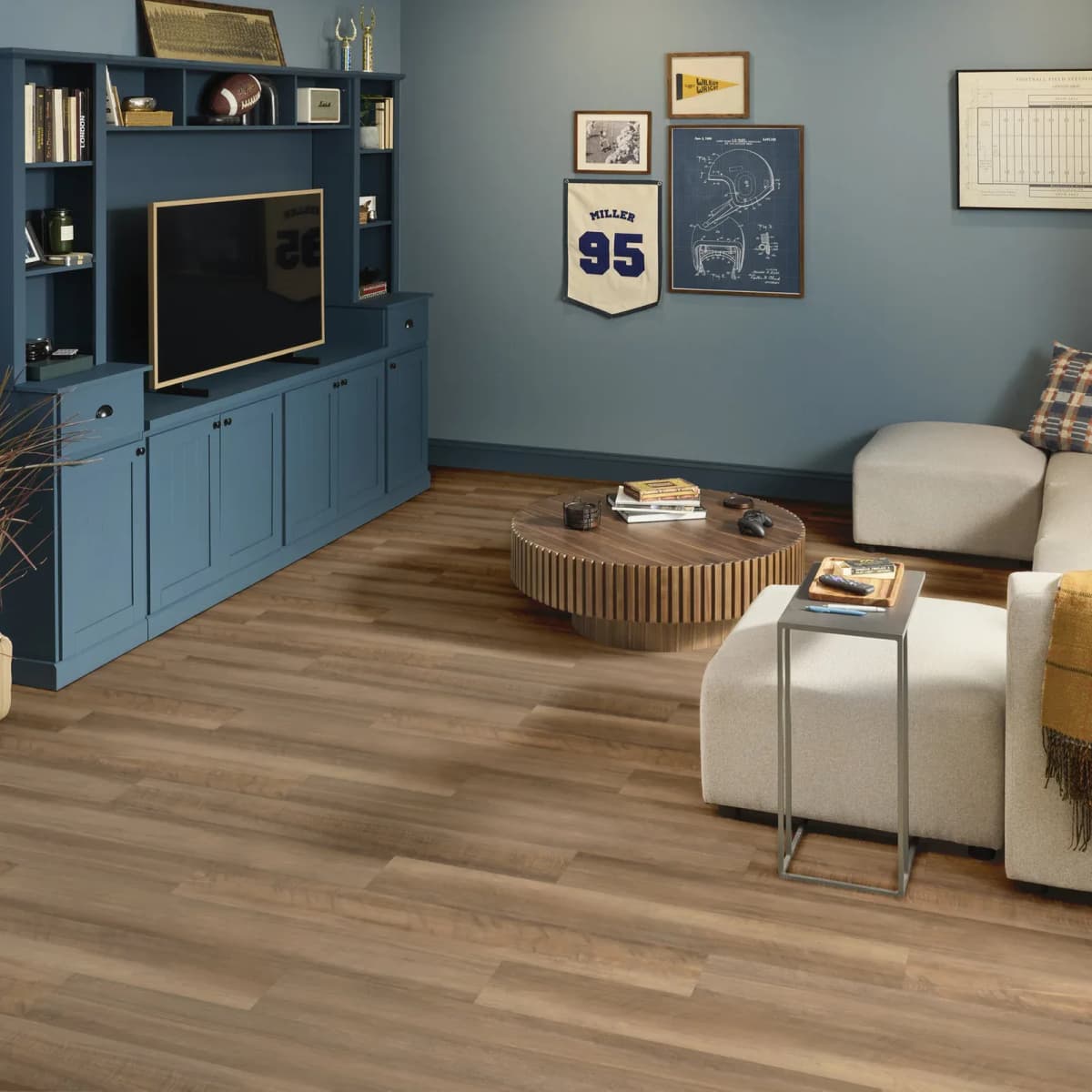
If your dog is an old dog losing bladder control or a dog with a medical condition, a refinished hardwood floor isn't a solution — it's the same floor with the same relationship to liquid, waiting for the same thing to happen again. That can be thousands of dollars for a reset, not a fix. (A puppy mid-training is a timing question instead: hold the refinish until the accidents stop.)
That's where switching materials is the structural answer. Rigid-core luxury vinyl plank is built around a waterproof core — limestone-and-PVC in SPC construction, foamed wood-flour-and-PVC in WPC — and neither absorbs water the way a wood board does. Our waterproof flooring explainer covers what that rating does and doesn't promise, and SPC vs WPC covers which core belongs in which room. An accident on the plank becomes a paper-towel cleanup once you find it, instead of a race to save the wood.
COREtec's residential resilient warranty promises the floor will resist staining from pet urine, feces, and vomit for as long as you own it, and it's the one document behind every COREtec line we sell.Source 5 Read the exclusions too: the same document carves out surface scratches unless a scratch warranty applies, and none of the COREtec floors we sell carries one. The warranty doesn't mention wear-layer thickness either, so the 20 mil we recommend for most dogs is our own rule of thumb, not a scratch rating. It also asks for cleanup to begin as soon as you find an accident, and its waterproof clause covers liquid that stays on the surface, not liquid that flows over the edge of the room or a cut board.
Shaw's standard residential resilient warranty is the same document word for word, footer aside,Source 6 and it covers nearly every Shaw LVP colorway we sell. The exceptions sit on a separate Shaw document that covers defects and wear only, with no pet or waterproof clause,Source 7 and the assignment is made colorway by colorway: Shaw Infinite SPC has colorways on both. So if warranty coverage is why you're buying, open the warranty link on your exact colorway's product page.
If the room is already torn apart: COREtec and Shaw both state that acclimating their vinyl planks before installation is not required, and ask that the room be climate-controlled.Source 8Source 9Source 10 Replacement hardwood adds a check: under the NWFA's guidelines it goes in immediately only when its moisture content matches the room and the subfloor; otherwise it's conditioned first.Source 11 Either way, the subfloor has to be dry before anything goes down.
What you give up leaving hardwood
This isn't a free trade. If you loved your floors, you're giving up real things:
- Real wood. Premium LVP is convincing from across a room and isn't wood up close. Some people never notice; some notice immediately. Trust your own eye, not our copy.
- Refinishability. Solid hardwood, or engineered with a face veneer of 2.5mm or more, can be sanded and refinished when it wears. LVP gets replaced when it's worn — that's the category, not a defect.
- Resale perception. To many buyers, hardwood still reads as the permanent, premium floor, and LVP doesn't carry that signal the same way.
- The sound. Wood sounds like wood underfoot; LVP over an attached pad sounds softer and slightly padded.
Our full two-way lives in LVP vs engineered hardwood. Easy to lose in a crisis: you're not comparing LVP against the hardwood you remember. You're comparing it against the hardwood you have now, plus a repair bill, plus the odds of a repeat.
If you must have wood
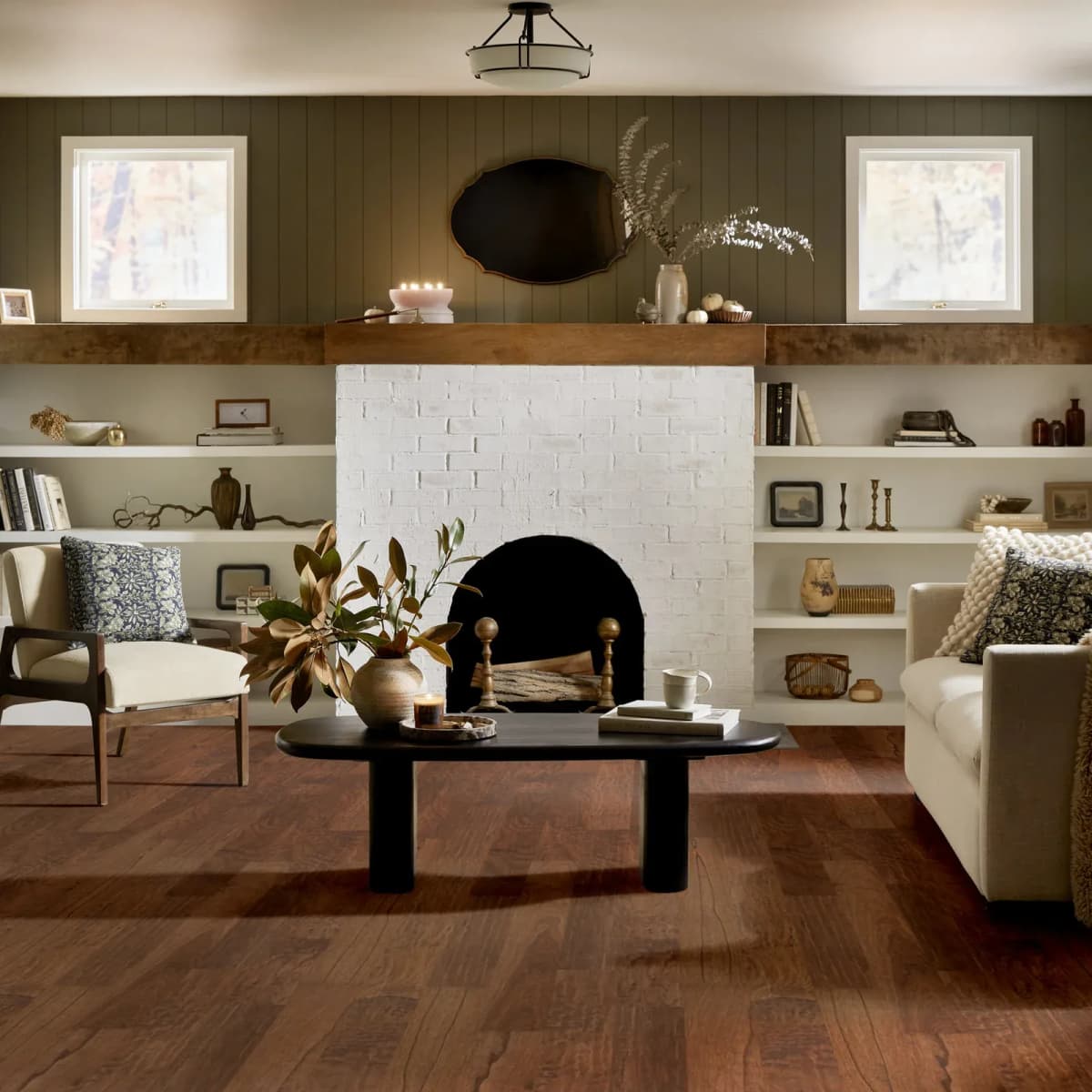
Some readers will still want wood. That's a legitimate choice, with four caveats attached.
None of the hardwood we sell is waterproof, Repel included. Water-resistant finishes help: Shaw calls Repel a splashproof finish and says it makes floors 2X more water resistant than traditional hardwood.Source 12 Repel's own warranty says the floor is water resistant but not waterproof, asks that spills be dried immediately, and doesn't cover moisture that gets through the seamsSource 13 — we spell out the limits in Repel vs The Gallery.
None of the hardwood warranties behind the floors we sell covers pet damage. Shaw's, Shaw Repel's and Anderson Tuftex's residential hardwood warranties have no pet clause; they list stains, spillage and standing water left on the floor among what they don't cover, and name pet claws and scratches outright.Source 14Source 13Source 15
Choose the trade-off knowingly. Every Repel style we sell has a 1.2mm face veneer, so a stained board gets replaced, not sanded; the styles we sell with a face veneer of 2.5mm or more don't have Repel's finish.
Put the wood where the dog isn't. A workable compromise: hardwood in the bedrooms and formal rooms the dog doesn't use, waterproof LVP through the kitchen, entry, mudroom, and wherever the crate and the water bowl live. The hardwood catalog covers the first half of that plan.
The floors we'd actually put in an accident-prone house
Every price below is per square foot at the manufacturer's advertised price (MAP); each product page shows the carton price beside it. Every floor in the table is flagged waterproof and, as of this writing, sits on a warranty document with the Petproof clause in every colorway. Lower prices may be available — request a quote by email using the "Email us for today's best price" form on any product page.
| Floor | Price | Wear layer | Why it's here |
|---|---|---|---|
| COREtec Pro Classics VV017 | $4.09/sq ft | 20 mil | The default. SPC core, attached cork, pet-stain coverage in writing |
| Shaw Anvil Plus 20 Mil | $3.29/sq ft | 20 mil | Where 20 mil starts in our catalog, on an SPC core |
| COREtec Pro Enhanced VV491 | $4.79/sq ft | 20 mil | SPC with attached cork like VV017, in a wider, longer plank (9.06" × 72.83") — fewer seams |
| Shaw Endura Plus | $2.99/sq ft | 12 mil | The budget answer. Waterproof like the rest, and fine for one small, calm dog, but not for a large dog with long nails |
| COREtec Originals Enhanced CR501 | $5.89/sq ft | 22 mil | WPC core — softer and warmer underfoot, for a living room |
| Shaw Titan HD Plus Platinum | $6.79/sq ft | 30 mil | Shaw's thickest wear layer in our catalog, in an 8.98" × 72.05" plank |
| COREtec Originals Premium VV457 | $9.09/sq ft | 30 mil | The top of this table: 30 mil over a thick WPC core, 3mm attached cork |
Two specs decide most of this. Wear layer is the clear layer claws have to get through before a mark reaches the printed design — 20 mil is our rule of thumb for most dogs, not a manufacturer rating, and our best LVP for pets guide explains the reasoning. Core decides feel and dent behavior, not waterproofing; both cores handle liquid the same way, and heavy furniture on LVP covers denting. For the full brand walkthrough, start with our COREtec LVP buyer's guide.
Setting the new floor up to survive the next accident
Three things worth doing, none of which cost much:
- Float it rather than glue it. COREtec's and Shaw's installation guidelines say their SPC and WPC planks are designed to be installed floating,Source 16Source 17Source 9Source 10 and every floor in the table above can go down that way. The pet-house bonus: if the subfloor ever needs another look, a floating floor comes up without adhesive to scrape off it.
- Silicone the perimeter in the problem zone. The same guidelines call for silicone caulk around the perimeter in wet areas; treat the corner with the crate and the water bowl as one. It keeps urine that reaches the wall from running into the expansion gap and under the floor — past the edge where the waterproof clause stops.
- Keep the right cleaner by the crate. Both brands' care guidance calls for a pH-neutral cleaner: COREtec warns that polish, detergent or other harmful chemicals could void the warranty,Source 8 and Shaw names quaternary ammonium salts, found in some disinfectants, as harmful to the floor over time.Source 18 Check a pet-odor spray's label before it goes on the new floor.
And map the dog's routes before you order — crate corner, doorways, the path to the back door. That's where claws do their work and where the 20 mil belongs, even if a room the dog rarely uses gets something thinner.
Final Word
The short version is three questions: Can the floor be sanded? Is the damage in the finish or the top fibers, or deeper? And is the dog going to do it again?
A floor that can be sanded, damage in the finish or the top fibers, dog unlikely to repeat — refinish it and enjoy your floors. A stain in the wood of a veneer thinner than 2.5mm, or damage deeper than a sanding reaches — replace the boards it reached, look at the subfloor under them, and treat or replace it if it's stained or smells before anything goes back down. A dog who's going to keep having accidents — whatever the subfloor needs, finish with a floor that won't soak it up. Refinishing a floor that will be soaked again in six months is an expensive way to end up back here.
If you land on a new floor, order $5 samples and look at them in the actual room, in daylight and at night, before you commit. Every sample dollar comes back as credit toward your order when you sign in at checkout with the same email you used for samples. Full orders ship freight from Dalton, Georgia, with free shipping when the flooring on your order comes to $1,799 or more, and LTL freight is curbside delivery.
You did not do anything wrong. Hardwood and an incontinent dog is a materials mismatch, not a housekeeping failure — and it's a solvable one.
In this article
The floors from this guide

COREtec Floors
COREtec Pro Classics VV017
Chesapeake Oak
Samples are $5 each, credited back at checkout when you sign in.

COREtec Floors
COREtec Pro Enhanced VV491
Madrid Oak
Samples are $5 each, credited back at checkout when you sign in.

COREtec Floors
COREtec Originals Enhanced 9x72 CR501
Saffron Pecan
Samples are $5 each, credited back at checkout when you sign in.

COREtec Floors
COREtec Originals Premium VV457
Grandure Oak
Samples are $5 each, credited back at checkout when you sign in.
Common questions
Frequently Asked Questions
Will dog urine smell come back after refinishing hardwood?
If the urine never got past the finish, no — cleaning removes what the finish held, and on a floor that can be sanded (solid hardwood, or engineered with a face veneer of 2.5mm or more) a refinish takes care of the discoloration. If it soaked deeper into the wood than a sanding reaches, or reached the subfloor, yes. A sanding should take off less than 1/32 of an inch of wood; urine salts that wicked deeper than that stay exactly where they are. Those salts are hygroscopic — they pull moisture out of humid air — which is why a floor that smelled fine all winter starts smelling again the first muggy week of summer. The tell before you spend the money: if the odor is worse in humid weather, or came back after the boards had fully dried, the contamination is deeper than a sanding reaches. Diagnose first, refinish second.
Can pet urine stains be sanded out of hardwood floors?
On solid hardwood, or engineered with a face veneer of 2.5mm or more, sometimes; on a thinner veneer, a stained board gets replaced, not sanded. A cloudy or light patch in the finish, or gray to brown in the top fibers, often sands out cleanly. Black usually doesn't: it's the same reaction between urine and the wood's tannins that turns it gray and brown, run further down through the board with the moisture, so refinishers often sand a full pass and still find it underneath. The practical check is a test sanding: a square-foot patch in the worst spot, sanded as deep as the full refinish would go. If the stain is still there, sanding is not the fix and board replacement is. Oxalic acid, sold as wood bleach, can lift iron staining, but on oak it can leave a pink cast if it sits too long, and the stain can return if the wood gets wet again.
How do I know if dog urine has soaked into the subfloor?
Four signals, in rough order of how much they cost to check. The odor persists after a thorough cleaning and comes back in humid weather. The boards near the accident zone are cupped or lifting at the seams. A blacklight in a dark room shows a glowing area noticeably larger than the visible stain — dried urine you can't see in daylight, across more seams than the stain suggests. And the definitive one: lift a board or two in the worst area and look. Ask any contractor quoting the job to do that as part of the estimate. If the subfloor is stained or smells, no flooring installed on top of it will fix the odor — that has to be remediated before anything new goes down.
What flooring is best for a dog that keeps having accidents?
Waterproof rigid-core luxury vinyl plank, with a 20 mil or thicker wear layer for most dogs. The core doesn't absorb liquid, the planks click together over a floating install, and an accident on the surface is a paper-towel cleanup once you find it, rather than a race to save the wood. Shaw's and COREtec's standard luxury vinyl warranties, which cover every COREtec floor and nearly every Shaw colorway we sell, promise the floor will resist pet urine, feces, and vomit stains for as long as you own it, though they exclude surface scratches whatever the wear layer, so the 20 mil is our own rule of thumb, not a scratch rating. Reasonable starting points in our catalog are COREtec Pro Classics VV017 at $4.09/sq ft or Shaw Anvil Plus 20 Mil at $3.29/sq ft, both SPC cores with 20 mil wear layers. One caveat that applies no matter what you buy: a new floor does not fix a contaminated subfloor. Deal with that first.
Referenced in this guide
Sources
Refinishing Your Floors
National Wood Flooring Association (woodfloors.org) · Accessed 2026-10-07
https://woodfloors.org/refinishing-your-floors/Iron Stain on Wood (FinishLine, revised July 2013)
USDA Forest Service, Forest Products Laboratory · Accessed 2026-09-26
https://www.fpl.fs.usda.gov/documnts/finlines/finishline_mknaebe_2013_006.pdfNWFA Launches Engineered Wood Flooring Refinishable Program (Hardwood Floors magazine, Aug/Sept 2022)
National Wood Flooring Association · Accessed 2026-09-26
https://nwfa.org/wp-content/uploads/2022/09/HFM_AugSept22_final_refinishable_small.pdfHow Much Does It Cost To Refinish Hardwood Floors?
This Old House · Accessed 2026-09-26
https://www.thisoldhouse.com/flooring/cost-to-refinish-hardwood-floorsResidential Resilient Limited Warranty — Defects, Wear, Waterproof, Petproof (USFloors/COREtec, rev. 06/28/2023)
Shaw Industries, Inc. (USFloors / COREtec) · Accessed 2026-09-26
https://pdmsview.shawinc.com/viewer/document/doc/19721Residential Resilient Limited Warranty — Defects, Wear, Waterproof, Petproof (rev. 06/28/2023)
Shaw Industries, Inc. · Accessed 2026-09-26
https://pdmsview.shawinc.com/viewer/document/doc/28855Residential Resilient Limited Warranty — Defects, Wear (rev. 06/28/2023)
Shaw Industries, Inc. · Accessed 2026-09-26
https://pdmsview.shawinc.com/viewer/document/doc/28854Installation & Maintenance
COREtec · Accessed 2026-09-26
https://coretecfloors.com/en-us/installation-maintenanceLuxury Vinyl Angle/Angle SPC Installation Guidelines (rev. 09/18/2024)
Shaw Industries, Inc. · Accessed 2026-09-26
https://pdmsview.shawinc.com/viewer/document/doc/7273Resilient Installation Guidelines for WPC Products (Floorté, rev. 03/18/2021)
Shaw Industries, Inc. · Accessed 2026-09-26
https://pdmsview.shawinc.com/viewer/document/doc/3881NWFA Installation Guidelines
National Wood Flooring Association · Accessed 2026-09-26
https://nwfa.org/wp-content/uploads/2026/02/NWFA-Installation-Guidelines.pdfRepel Hardwood
Shaw Floors · Accessed 2026-09-26
https://shawfloors.com/en-us/hardwood-collections/repel-hardwoodResidential Repel Hardwood Limited Warranty (rev. 05/31/2024)
Shaw Industries, Inc. · Accessed 2026-09-26
https://pdmsview.shawinc.com/viewer/document/doc/9128Shaw Hardwood Limited Residential Warranty (rev. 06/14/2024)
Shaw Industries, Inc. · Accessed 2026-09-26
https://pdmsview.shawinc.com/viewer/document/doc/1475Hardwood Limited Residential Warranty (Anderson Tuftex, rev. 06/14/2024)
Shaw Industries, Inc. (Anderson Tuftex) · Accessed 2026-09-26
https://pdmsview.shawinc.com/viewer/document/doc/22123COREtec Pro SPC Installation Guidelines (rev. 11/05/2024)
Shaw Industries (USFloors / COREtec) · Accessed 2026-09-26
https://pdmsview.shawinc.com/viewer/document/doc/10195Resilient Installation Guidelines for WPC Products (rev. 03/01/2022)
Shaw Industries (USFloors / COREtec) · Accessed 2026-09-26
https://pdmsview.shawinc.com/viewer/document/doc/11746Residential Resilient Maintenance (rev. 08/04/2021)
Shaw Industries, Inc. · Accessed 2026-09-26
https://pdmsview.shawinc.com/viewer/document/doc/4313
Related Posts
Keep Reading
COREtec Tile & Stone Looks: The DIY Alternative to Ceramic and Porcelain (2026)
9 min read
LVP Wear Layer Explained: What 6, 12, 20, 22 and 30 Mil Mean, and Which to Choose
9 min read
Shaw LVP Buyer's Guide: Classic Series vs Pro Series, and Where 5th and Main Fits (2026)
10 min read
Will Heavy Furniture Dent Vinyl Plank Flooring? What Holds Up (2026)
14 min read
Keep browsing