
Can You Put Vinyl Plank Over Tile? What COREtec's and Shaw's Install Guides Say

Floor names link to their product pages in a new tab.
Quick answer: Yes, you can put vinyl plank over tile, as long as the tile is solidly bonded to the subfloor and the floor is flat. COREtec's and Shaw's install guides for their floating SPC and WPC planks allow it over ceramic and porcelain tile with grout joints up to 1/4 inch wide, and require wider joints to be filled flush with a cementitious patching compound.Source 1Source 2 We go a step further and typically have customers skim coat over the grout joints, because grout can telegraph through over time. Don't cover tile that's loose, cracked or peaking until it's fixed: one or two bad tiles can be replaced first, but widespread trouble means the tile comes out. And before you order, measure what the added height does to your doors, cabinet toe kicks and the rooms next door, because that's the biggest mistake we see.
Covering tile instead of tearing it out is one of the most common questions we get, and it's easy to see why. Demolishing a tile floor is loud, dusty, heavy work, and a lot of the tile people want to cover is perfectly solid. A floating vinyl plank floor clicks together on top of it without thinset, a wet saw or a dumpster.
The answers online don't agree. Some say grout lines up to 1/4 inch are fine as they are. Others say skim the whole floor, every time. Forum threads run dozens of posts without settling it. So here's what the manufacturers' own installation guides say, quoted where it matters, and where our experience as a dealer adds to them.
Our position, stated up front: we sell flooring, not installation. We'd rather you leave the tile where it is when it's sound, and repair or pull it when it isn't, than sell you a floor that fails over a bad base.
What COREtec's and Shaw's install guides allow over tile
COREtec's residential floating installation guidelines come in two versions, one for its SPC (stone-polymer core) floors and one for its WPC (wood-polymer core) floors, and the tile-format lines we carry follow the same two.Source 3 Shaw publishes matching SPC and WPC guides. All four say the same things about an existing tile floor:Source 1Source 4Source 2Source 5
- Tile is an approved base. In the guides' words, the product "can be installed over existing ceramic/porcelain tile products with up to a 1/4 inch wide grout joint."
- Wider joints get filled. If a grout joint is wider than 1/4 inch, a cementitious patching compound fills it, smooth with the surface of the tile.
- The old floor has to be sound. The existing floor must be fully adhered, clean, flat, dry, structurally sound and free of deflection.
- Flat has a number. The subfloor must be flat within 3/16 inch over 10 feet, or 1/8 inch over 6 feet.
Notice what isn't in that list. None of the four guides mentions natural stone tile, and none says what to do about a cracked or loose tile. "Fully adhered," "structurally sound" and "free of deflection" are the whole rule, so judging a damaged tile floor falls to you and whoever is installing.
| Question | What the guides say | What we tell customers |
|---|---|---|
| Is tile an approved base? | Yes: ceramic and porcelain, fully adhered, flat, structurally sound | Yes, if every tile is solidly bonded |
| Grout joints | Up to 1/4" wide is allowed; wider gets filled flush with cementitious patch | Skim coat the joints, typically for floating, and always for glue-down where a guide allows glue-down over tile |
| Cracked, loose or hollow tile | Not addressed beyond "fully adhered, structurally sound, free of deflection" | Don't cover it. One or two isolated tiles can be replaced or filled and prepped |
| Flatness | Within 3/16" in 10' or 1/8" in 6' | Check with a long straightedge, not a level |
| Added height | Not addressed | Measure doors, toe kicks, appliances and transitions before you order |
When we tell people not to go over their tile
We don't recommend putting vinyl plank over tile that isn't properly secured to the subfloor. Peaking tiles, cracked tiles, tiles that sound hollow when you tap them, grout that's crumbling out of the joints: any of those means the bond between the tile and the floor beneath it has already started to fail, and a new floor on top doesn't stop it. It hides it.
That matters more than it sounds, because a floating floor depends on what's under it. Tile that keeps letting go will lift, tent or shift under the new planks months after they're down, and the fix is pulling up the new floor to get at the old one. The guides' wording points the same way: the floor you install over has to be fully adhered and free of deflection.
An isolated problem can be fixed first. If it's one or two isolated cracked tiles in an otherwise solid floor, chip them out and fill the space, with a dummy tile set at the same height or with patching compound, then prep and install over it. Just go in knowing the risk: if whatever cracked that tile is still going on underneath, it's now going on under your new floor.
Widespread trouble means the tile comes out. Cracks running across several tiles, a floor that flexes or crunches underfoot, or hollow spots in more than one area point to a problem in the subfloor or the bond, not the tile. Covering it with a floating floor won't fix it, and the guides' "free of deflection" rule doesn't leave room for it either.
A quick way to check: walk the whole floor and tap every tile with the handle of a screwdriver. A solid tile gives a sharp click; a debonded one sounds dull and hollow. Mark every hollow tile and every crack, then decide.
What to do about grout lines and uneven tile
The guides' rule is a minimum: grout joints up to 1/4 inch wide are allowed, and wider ones must be filled flush with a cementitious patching compound.Source 1Source 4Source 2Source 5 Our practice goes further.
We typically have customers skim coat over the grout joints before a floating floor, and always before a glue-down floor, on a product whose guide allows glue-down over tile. (The COREtec and Shaw guides cited here approve glue-down only over wood and concrete substrates, so over tile the floors in this guide go down floating.) A skim coat is a thin layer of cementitious patch troweled across the tile so the joints come up flush with the tile faces. Skip it and the grout joints can telegraph through the vinyl plank over time: a faint grid of dips that shows up when light rakes across the floor. A glue-down floor sits right on the surface with nothing to bridge a joint, which is why we never skip it there.
Every manufacturer's guide is a little different, and the guide for your exact floor is the one that counts, including any primer the patch maker calls for over glazed tile. If you're not sure which guide covers the floor you're looking at, ask us, and we'll find it for you.
Then check flatness, not level. The 3/16-inch-in-10-feet tolerance applies over tile the same as anywhere else. Lay a long straightedge across the floor in several directions. A tile that sits proud of its neighbors gets ground down; a low spot gets filled. Our LVP installation guide walks through what a good installer does at this stage, and it's the same work over tile.
Don't add a pad to hide the grout. Every floor we recommend below has a pad attached. COREtec's and Shaw's guides allow a second underlayment under an attached-pad plank only if it's no thicker than 3 mm, and they warn that soft underlayment and soft substrates compromise the product's locking ability.Source 1Source 2 A thicker or softer pad over grout lines is the wrong fix. Fill or skim the grout instead; our attached underlayment guide covers the rest.
Tile on a concrete slab is a question for the guide. The SPC guides require 6-mil poly film under a floating installation over concrete.Source 1Source 2 They don't say whether tile bonded to a slab counts as a concrete substrate, so check the guide for your floor, or ask us before you order. Our flooring over a concrete slab guide covers moisture testing.
The biggest mistake we see: forgetting the floor just got taller
Covering tile skips the demolition, but it keeps the tile's height and adds the new floor on top. The biggest mistake we've seen with vinyl plank over tile is not accounting for that overall thickness before the floor goes down.
How much you're adding depends on the floor. On our product pages, Shaw Anvil Plus 20 Mil is 0.173 inch thick, just under 3/16 inch, and COREtec Pro Classics VV017 is 0.196 inch, about 3/16 inch. Shaw Titan HD Plus Platinum is 0.472 inch, nearly half an inch. A skim coat adds a little more. Then walk the house:
- The rooms next door. Where the new floor runs into a room that doesn't have tile, the step is now the tile plus the plank, measured against whatever floor is next door. Where the new floor ends up noticeably higher, that usually calls for a reducer rather than a T-molding, and the bigger the step, the more noticeable the ramp. Our transition strips guide explains which piece fits which height change.
- The doors. Will your doors clear the new floor, or will they rub? Interior doors often need their bottoms trimmed. The install guides also call for undercutting the door jambs so the planks can slide under them.Source 1Source 2
- The toe kicks. Over existing tile the cabinets are already in, so the new floor runs up to the cabinet base, and the toe kick gets shorter by the floor's thickness, plus whatever trim covers the expansion gap there. (The guides allow cabinets on top of these floors only where the floor is fully adhered, two feet beyond included, so a floating floor stops at the cabinets.)Source 4Source 2
- Anything that slides under a counter. A dishwasher or a slide-in range that fits its opening today can end up trapped once the floor in front of it is higher. Measure the opening before you order.
- The toilet. In a bathroom the toilet comes up for the install, and the flange is now lower relative to the finished floor. Have whoever resets it check that height.
None of that is a reason not to do it. It's a reason to measure first. If height is tight, a thinner SPC plank is the easier fit; if you want the thickest, softest-feeling floor, plan the transitions and door trims into the job.
In a bathroom or over heated tile
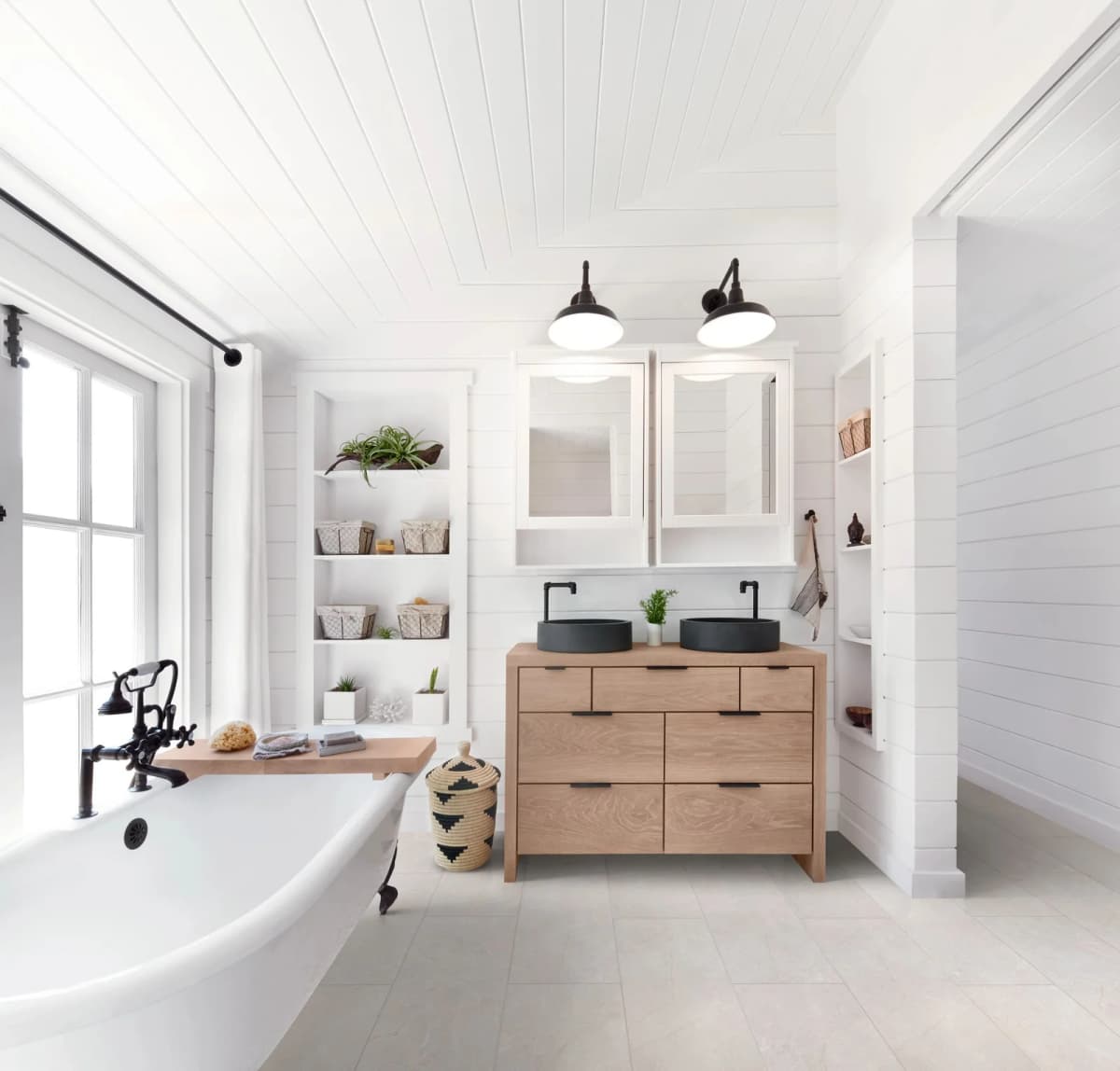
Tile is what a lot of bathrooms already have, so this is where the question comes up most. Two things to know from the guides.
Seal the perimeter. In wet areas such as bathrooms, COREtec's and Shaw's guides call for caulking the floor's perimeter with silicone caulk,Source 1Source 5 so water that reaches the wall stays out of the expansion gap. Our best waterproof flooring for bathrooms guide covers the rest of a wet-room install.
Mind the heat. COREtec's and Shaw's guides all say a radiant system's maximum operating temperature should never exceed 85°F.Source 1Source 4Source 2Source 5 COREtec's guides add that the heating components need at least 1/2 inch of separation from the flooring.Source 1Source 4 Over an existing heated tile floor, that means the tile and its setting bed have to give the heating cables at least 1/2 inch of cover; if you don't know how the system was built, find out before you order. A heated tile floor that's been running warmer has to be turned down for good, not just for install day. The guides also set start-up steps for the heat before and after installation; our radiant heat flooring guide walks through them.
The floors we'd put over tile
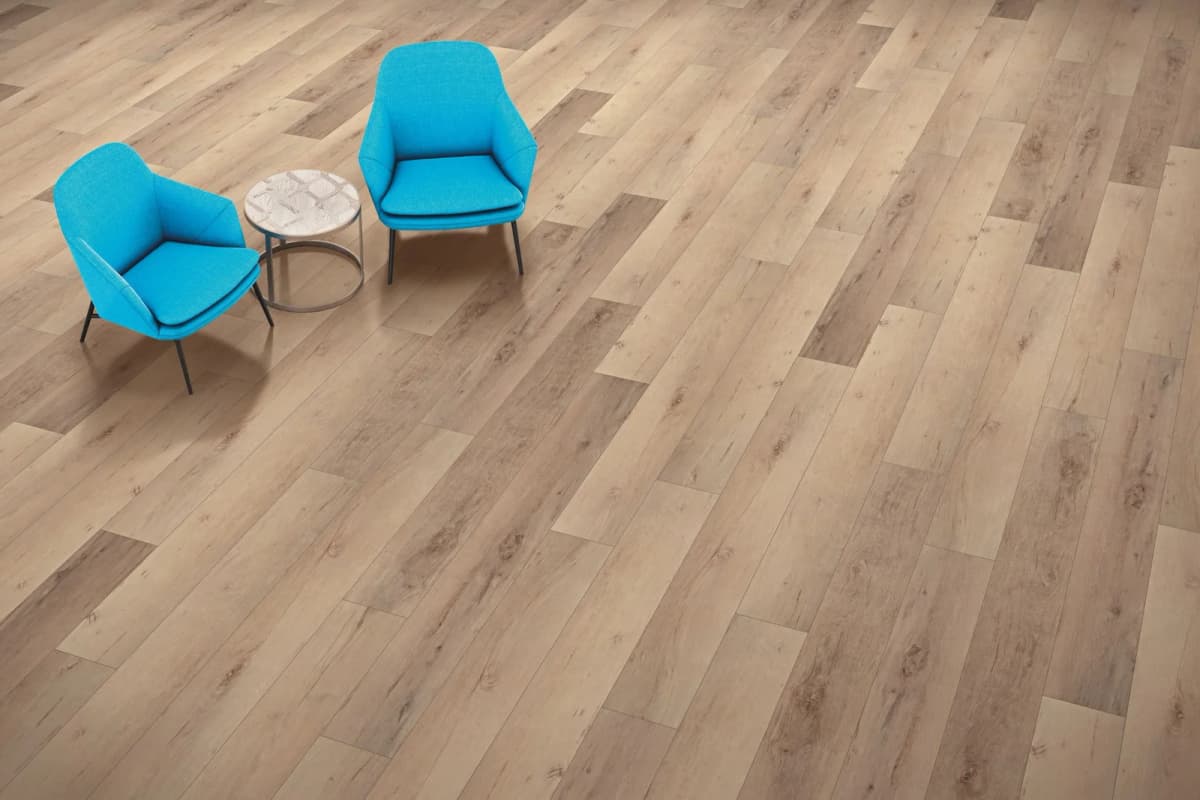
Over tile, thickness is the spec that decides most of the fit, so the table runs thinnest first. Every floor in it clicks together with a pad attached, and every one can be installed floating. Prices are per square foot at the manufacturer's advertised price (MAP); each product page shows the carton price beside it. Lower prices may be available: request a quote by email using the "Email us for today's best price" form on any product page.
| Floor | Price | Thickness | Core and pad | Why it's here |
|---|---|---|---|---|
| Shaw Anvil Plus 20 Mil | $3.29/sq ft | 0.173" | SPC, 1mm EVA pad | The least added height in this table, with a 20 mil wear layer |
| COREtec Pro Classics VV017 | $4.09/sq ft | 0.196" | SPC, 1mm attached cork | Our default pick: thin, rigid, 20 mil wear layer |
| COREtec Pro Plus Enhanced Tile VV870 | $5.99/sq ft | 0.196" | SPC, 1mm attached cork | A stone look in a 12" × 24" tile, for the bathroom you're re-covering |
| COREtec Pro Enhanced VV491 | $4.79/sq ft | 0.204" | SPC, 1.2mm attached cork | A long 9.06" × 72.83" plank: fewer seams across a big tiled room |
| Shaw Paragon Tile Plus | $6.29/sq ft | 0.217" | SPC, 1.5mm EVA pad | Shaw's tile format, 12" × 23.74", on a rigid SPC core |
| Shaw Pantheon HD Plus | $6.49/sq ft | 0.315" | WPC, attached pad | A softer, warmer WPC build, if you can spare the height |
| Shaw Titan HD Plus Platinum | $6.79/sq ft | 0.472" | WPC, attached IXPE pad | The thickest here, with a 30 mil wear layer. Plan the doors and transitions around it |
Core decides feel, not whether the floor can go over tile: SPC is denser and thinner, WPC is thicker and softer underfoot, and our SPC vs WPC guide covers the trade. If you're drawn to the stone looks, our COREtec tile guide compares the tile lines we carry.
A checklist before you order
- Tap every tile. Hollow, cracked or peaking tiles get fixed first, or the tile comes out.
- Check flatness with a long straightedge: within 3/16" over 10 feet, or 1/8" over 6 feet.
- Measure the grout joints. Wider than 1/4" must be filled. We typically skim coat the joints for a floating floor too.
- Find your floor's install guide and follow it, including primers and anything it says about concrete underneath. Ask us if you can't find it.
- Measure the height at every doorway, door bottom, toe kick, dishwasher opening and toilet flange, and choose a plank thickness that fits.
- Plan the transitions to every room without tile before the order goes in, so the trim ships with the floor.
Final Word
You can put vinyl plank over tile, and when the tile is sound it's often the smart way to do it: no demolition and far less mess, on a base that's usually stable and close to flat once it's checked and prepped. The manufacturer guides set the minimum: tile fully adhered, flat to 3/16 inch over 10 feet, grout joints over 1/4 inch filled. Our experience adds two habits on top: skim coat the grout joints so they're far less likely to telegraph, and measure the height before anything gets cut.
What we won't do is tell you to cover tile that's letting go. A new floor over a failing one is a botched install waiting underneath.
Order $5 samples and set them right on your tile, in daylight and at night, before you commit. Every sample dollar comes back as credit toward your order when you sign in at checkout with the same email you used for samples.
In this article
The floors from this guide

COREtec Floors
COREtec Pro Classics VV017
Chesapeake Oak
Samples are $5 each, credited back at checkout when you sign in.

COREtec Floors
COREtec Pro Enhanced VV491
Madrid Oak
Samples are $5 each, credited back at checkout when you sign in.

COREtec Floors
COREtec Pro Plus Enhanced Tile VV870
Serena Limestone
Samples are $5 each, credited back at checkout when you sign in.

Shaw Floors
Anvil Plus 20 mil
Chatter Oak
Samples are $5 each, credited back at checkout when you sign in.
Common questions
Frequently Asked Questions
Can you put vinyl plank over tile?
Yes, when the tile is sound. COREtec's and Shaw's installation guidelines for their floating SPC and WPC vinyl allow installation over existing ceramic and porcelain tile, provided the floor is fully adhered, clean, flat, dry, structurally sound and free of deflection, and flat means within 3/16 inch over 10 feet or 1/8 inch over 6 feet. The tile has to be solidly bonded to the subfloor: if tiles are loose, cracked, hollow-sounding or peaking, we don't recommend covering them. One or two isolated damaged tiles can be replaced or filled in and prepped, but anything wrong with the tile underneath is still underneath the new floor, and it can take the new floor with it.
Do you have to fill grout lines before installing vinyl plank over tile?
COREtec's and Shaw's floating-vinyl guidelines allow grout joints up to 1/4 inch wide and require joints wider than that to be filled with a cementitious patching compound, smooth with the surface of the tile. That's the manufacturer's minimum. Our own practice goes further: we typically have customers skim coat over the grout joints before a floating floor, and always before a glue-down floor on a product whose guide allows glue-down over tile, because grout joints can telegraph through vinyl plank over time. (The COREtec and Shaw guides cited here approve glue-down only over wood and concrete, so over tile their floors go down floating.) Every manufacturer's guide is a little different, so check the one for your exact floor, and we're happy to help you find it.
Do you need underlayment for vinyl plank over tile?
Not a cushion underlayment, when the plank has a pad attached, and every floor in this guide does. COREtec's and Shaw's floating-vinyl guidelines allow a second underlayment under a plank with an attached pad only if it is no thicker than 3 mm, and they warn that soft underlayment and soft substrates compromise the locking system, so a thick foam pad laid over tile to soften the grout lines works against the floor. Fill or skim the grout instead. COREtec's and Shaw's SPC guides also require 6-mil poly film under a floating floor over concrete; they don't say whether tile bonded to a slab counts, so check your floor's guide or ask us before you order.
How much higher will my floor be if I put vinyl plank over tile?
By the thickness of the plank, plus any skim coat. On our product pages, the thinnest floors in this guide are Shaw Anvil Plus 20 Mil at 0.173 inch, just under 3/16 inch, and COREtec Pro Classics and Pro Plus Enhanced Tile at 0.196 inch, about 3/16 inch; Shaw Titan HD Plus Platinum is 0.472 inch, nearly half an inch. That added height lands on top of the tile you already have, so check every doorway into a room without tile, the door bottoms, the toe kicks under the cabinets and anything that has to slide in under a counter, like a dishwasher, before you order.
Can you put vinyl plank over heated tile floors?
Yes, within limits. COREtec's and Shaw's floating-vinyl guidelines all say the system's maximum operating temperature should never exceed 85°F, and COREtec's guides add that the heating components need at least 1/2 inch of separation from the flooring. Over existing heated tile, that means the tile and its setting bed have to give the heating cables at least 1/2 inch of cover, so find out how the system was built before you order. A heated tile floor set warmer than 85°F has to be turned down for good, not just for the install. Our radiant heat guide covers the start-up steps the guides ask for.
Referenced in this guide
Sources
COREtec Pro SPC Installation Guidelines (rev. 11/05/2024)
Shaw Industries (USFloors / COREtec) · Accessed 2026-10-28
https://pdmsview.shawinc.com/viewer/document/doc/10195Luxury Vinyl Angle/Angle SPC Installation Guidelines (rev. 09/18/2024)
Shaw Industries, Inc. · Accessed 2026-10-28
https://pdmsview.shawinc.com/viewer/document/doc/7273Installation & Maintenance
COREtec · Accessed 2026-10-28
https://coretecfloors.com/en-us/installation-maintenanceResilient Installation Guidelines for WPC Products (rev. 03/01/2022)
Shaw Industries (USFloors / COREtec) · Accessed 2026-10-28
https://pdmsview.shawinc.com/viewer/document/doc/11746Resilient Installation Guidelines for WPC Products (Floorté, rev. 03/18/2021)
Shaw Industries, Inc. · Accessed 2026-10-28
https://pdmsview.shawinc.com/viewer/document/doc/3881
Related Posts
Keep Reading

Vinyl Plank Flooring Separating? Why It Happens and How to Fix It
12 min read
My Dog Ruined the Hardwood: Repair It, or Switch to Waterproof LVP?
13 min read

COREtec Tile & Stone Looks: The DIY Alternative to Ceramic and Porcelain (2026)
9 min read
LVP Wear Layer Explained: What 6, 12, 20, 22 and 30 Mil Mean, and Which to Choose
9 min read
Keep browsing