
Will Heavy Furniture Dent Vinyl Plank Flooring? What Holds Up (2026)
Quick answer: Yes, heavy furniture can leave a permanent dent in luxury vinyl plank: a 400-pound piece standing on four feet that each touch about one square inch of floor presses down at roughly 100 pounds per square inch (PSI), and the industry's static-load test passes a sample only if the dent left after 24 hours of recovery is 5 mils (0.005 inch) or less.Source 1 Pressure, not weight, decides the outcome, so the fix is a floor protector that spreads the weight: Shaw's and COREtec's residential resilient warranties call for exactly that, and they exclude indentations from heavy static loads.Source 2Source 3
The worry usually arrives as one of two questions. Will my refrigerator dent this floor? And: can our quartz-top island sit on it?
Most answers online stop at "use felt pads and don't drag." That advice isn't wrong, but it doesn't explain why it works, it treats a rolling desk chair and a parked refrigerator as the same problem, and it skips what the manufacturers' own installation guides and warranties actually say. This guide covers all of that: the pressure math, how the industry tests for dents, why the wear-layer number isn't the spec to shop for here, how SPC and WPC cores compare, what to put under heavy pieces, and what the warranty does and doesn't cover.
One thing up front. No vinyl plank is dent-proof, and the industry's own trade group says so plainly: "No flooring product is indestructible."Source 1
Heavy furniture on vinyl plank at a glance
Every heavy thing in your house falls into one of a few load types, and each one has a different fix. The sections below explain and source each row.
| Load | What decides the risk | What the manufacturer and industry documents say |
|---|---|---|
| Refrigerator or heavy appliance, parked | Pressure under small feet or rollers | Non-staining, large-surface floor protectors under the feet |
| Moving a refrigerator or appliance | Sliding weight across the surface | Use an appliance hand truck over hardboard runways; damage from moving heavy appliances isn't covered |
| Piano | Weight from about 200 pounds (small spinet) to 1,400 (concert grand) | Wide protectors or caster cups under each contact point |
| Dresser, bookcase, bed or table that never moves | Contact area of each leg | The heavier the object, the wider the floor protector |
| Rolling desk chair or anything on casters | A rolling load, a separate failure mode | Chair pads under castor chairs; swiveling, large-surface casters; no ball-type casters |
| Cabinets or an island on a floating floor | Installation, not pressure | Follow that product's guide; some say not on top at all, others require gluing down the area |
| Rubber cups, mats or pads | Staining, not denting | Non-staining products only |
Will a refrigerator dent vinyl plank flooring?
It can, because a refrigerator concentrates a lot of weight onto very little floor. French-door refrigerators average about 317 pounds empty in Prudent Reviews' compilation of real models, with the heaviest listed near 390 pounds, and that's before any food goes in.Source 4 All of it stands on a few small feet or rollers.
Here's the arithmetic. Round a stocked fridge up to 400 pounds and assume each of its four contact points touches about one square inch of floor.
400 pounds ÷ 4 square inches = about 100 PSI at each foot.
That isn't a scare number. The Resilient Floor Covering Institute (RFCI) uses nearly the same example in its technical note on static loads: a 400-pound desk on four feet with about one square inch of contact each generates 100 PSI at each foot. The same note says few objects in a home exceed 125 PSI on a floor's surface.Source 1 So a refrigerator on bare feet sits near the top of the normal household range, and it stays there for years without a break.
Now change just one variable: the contact area. Put the same 400 pounds on a rigid 24-by-30-inch panel.
400 pounds ÷ 720 square inches = about 0.6 PSI.
Same appliance, same floor, and more than 150 times less pressure. You didn't upgrade the floor. You widened what the weight stands on, and that's the principle behind every manufacturer recommendation in this article. The practical version is the one COREtec's installation instructions give: heavy furniture and appliances should sit on non-staining, large-surface floor protectors.Source 5
Moving the fridge is its own risk, which we cover in the rolling-load section below. The short version: never slide it on its feet.
Will a piano dent vinyl plank flooring?
A piano can dent vinyl plank for the same reason a refrigerator can, and it's often heavier. MMS Piano Movers lists spinets at about 200 to 400 pounds, full-size uprights at 500 to 800 pounds, baby grands at 500 to 650 pounds, and concert grands at 900 to 1,400 pounds, while noting that caster cups help protect the floor over time.Source 6
Run the same math on an 800-pound upright. If it rests on four contact points of about one square inch each:
800 pounds ÷ 4 square inches = about 200 PSI per contact point.
That's well past the 125 PSI RFCI describes as uncommon in homes.Source 1 Now spread each point over a cup with roughly 12 square inches of base, and the same piano presses down at around 16 PSI per cup (assuming the weight splits evenly, which it rarely does perfectly). A piano is the clearest case in the house for the widest protector you can fit.
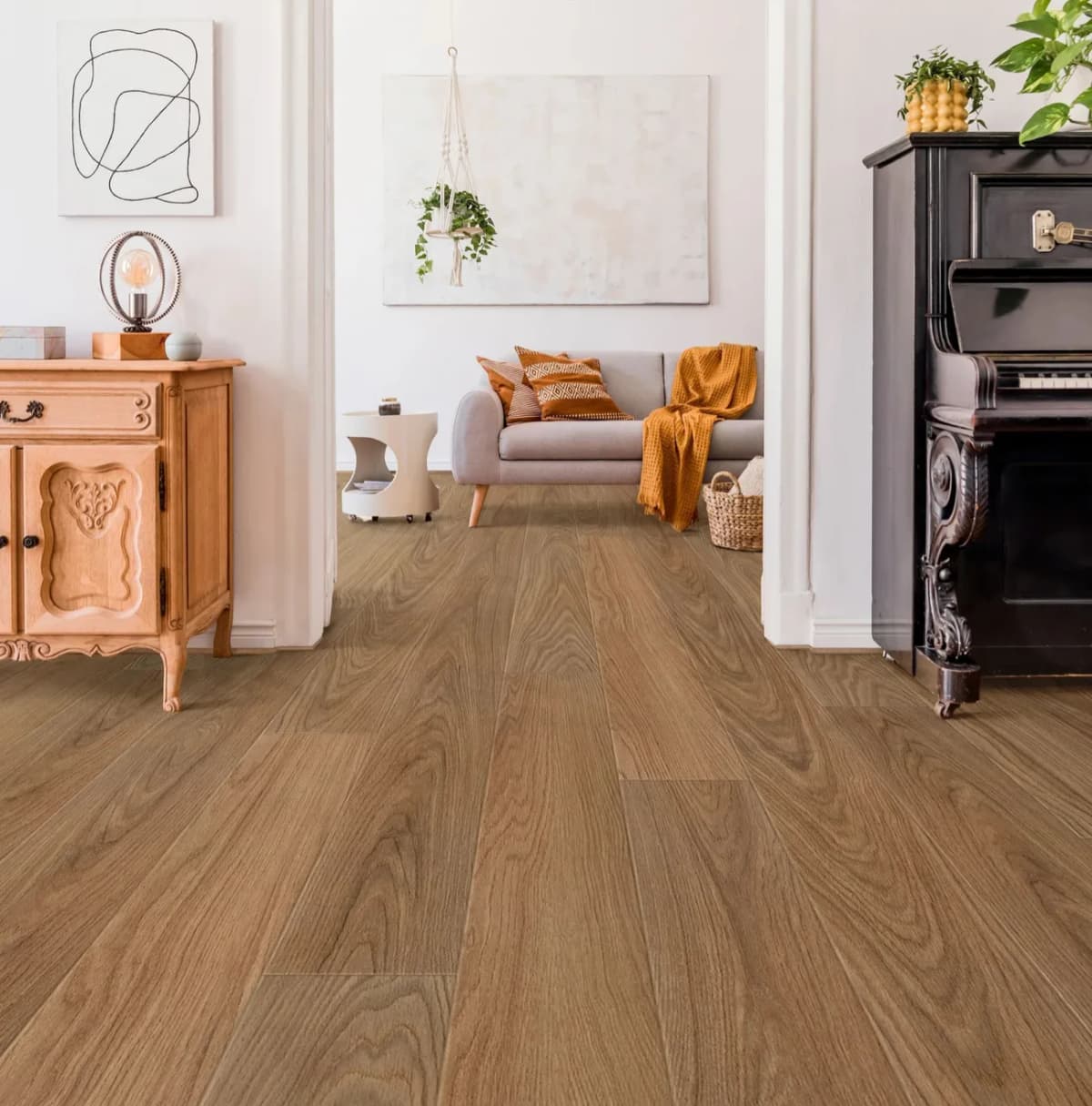
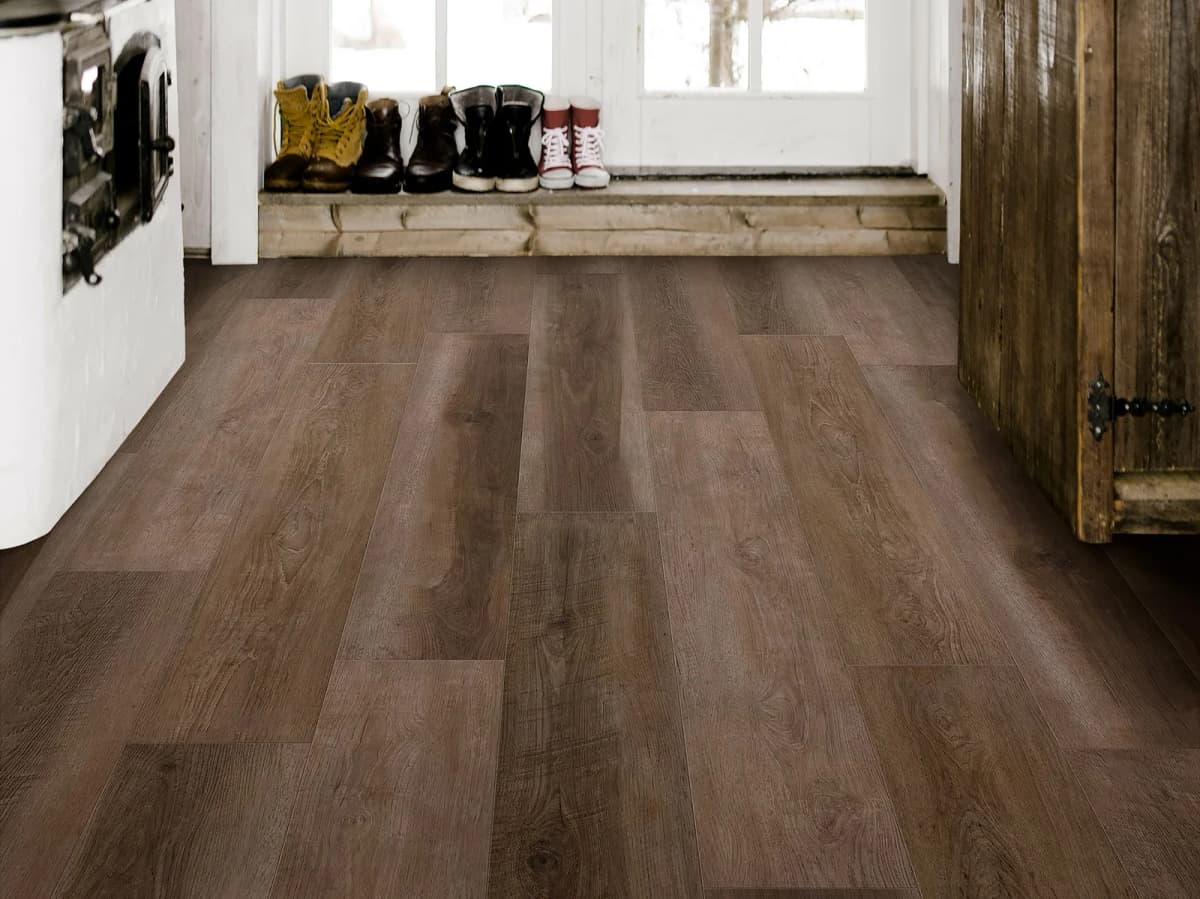
The floor in the photo above is COREtec Lakehouse Luxe in Canyon Oak, a 30-mil WPC plank that measures 0.472" thick.
What's the difference between a static load and a rolling load?
A static load sits still; a rolling load moves while it carries weight, and the industry treats them as separate problems with separate fixes. RFCI's note defines a static load as weight gently placed and left in place, and a dynamic load as weight that is rolled, slid or dragged across the floor. Its example is a hospital bed: parked, it might leave a slight indentation, but moving it under load can cause rips, tears, gouges and delamination. A static-load rating says nothing about how a floor handles those forces.Source 1
The manufacturer documents split the fixes the same way:
- For things that sit: COREtec calls for non-staining, large-surface floor protectors under heavy furniture and appliances.Source 5
- For things that roll: the same instructions say casters must be easy-swiveling, large-surface, non-staining and suitable for resilient floors, and they say "Do NOT use ball type casters."Source 5
- For rolling chairs: Shaw's and COREtec's residential resilient warranties list damage from castor chairs and rolling loads as not covered, with a standing instruction to use chair pads under rolling chairs to help prevent it.Source 2Source 3
- For moving day: COREtec's instructions say furniture should be moved onto a new floor using an appliance hand truck over hardboard runways,Source 5 and both warranties exclude damage from moving heavy appliances.Source 2Source 3
This is why one felt pad doesn't solve everything. A parked refrigerator needs a wide protector. A desk chair needs the right casters and a chair pad. A refrigerator being pulled out for cleaning needs a hand truck and a runway, not a shove.
How do manufacturers test vinyl plank for dents?
The standard method is ASTM F970, a static-load test that measures how much dent is left after a load is removed. As RFCI describes it, a load (175 PSI in its example) sits on the flooring for 24 hours, is removed, and the material gets another 24 hours to recover before the residual indentation is measured. The pass/fail line is a residual indentation of no more than 5 mils.Source 1
Three limits matter when you read any dent claim:
- It's a lab sample, not your floor. ASTM states that because testing is done on uninstalled flooring, results are not an indicator of installed performance.Source 7 RFCI goes further: the same load on an installed floor can give very different results, "generally worse and sometimes much worse."Source 1
- The method stops at 250 PSI. Testing above 250 PSI is outside the scope of ASTM F970,Source 7 and RFCI notes that ASTM's resilient flooring product specifications don't cite a static-load requirement above 250 PSI. RFCI wrote its note because some manufacturers were advertising extremely high PSI ratings that left buyers believing they were better protected against indentation than they really were.Source 1
- Static isn't rolling. As covered above, a static-load result says nothing about dragging or rolling damage.Source 1
You won't find a static-load number on our product pages. The specification rows we show for vinyl plank include thickness, wear layer, core type and attached underlayment, and we haven't found Shaw or COREtec publishing a per-product static-load rating on their product pages either. That's why the smart way to shop for heavy furniture is to read the construction and plan the protectors.
Does a thicker wear layer make vinyl plank more dent-resistant?
Not in any way the dent test documents. The is the clear top layer, rated in , and it's a genuinely important spec for surface wear; our wear layer guide explains what 6, 12, 20 and 30 mil get you. But ASTM F970 measures the residual indentation left in a flooring sample after a long-term load,Source 7 and nothing in RFCI's explanation of static-load testing points to the wear-layer rating as the thing that resists a dent.Source 1
Our own catalog shows why shopping by the biggest mil number can steer you the wrong way for a heavy load. Across our 466 active vinyl plank colorways, no SPC style has a wear layer above 20 mil. Every one of the 90 colorways at 22 or 30 mil is built on a WPC core, which is the construction COREtec describes as softer underfoot.Source 8 Pick the highest wear layer and you have picked WPC, every time.
That's not a knock on 30 mil. It's a reminder that wear layer and core firmness are separate specs, and a heavy, stationary load is a core question.
Is SPC or WPC vinyl plank better under heavy furniture?
For a heavy, stationary load, SPC is the core manufacturers position for dent resistance, and WPC is the one they position for comfort. COREtec says its Pro collection, built on SPC, provides "additional protection against dents and impacts."Source 9 It describes its WPC Originals collection as thicker, and softer, warmer and quieter underfoot.Source 8
The difference starts with what's in the core:
- (stone-polymer composite) is mostly limestone. One SPC flooring maker describes its core as 60 to 70 percent limestone fused with PVC, which makes it denser.Source 10
- (wood-polymer composite) uses added foaming agents in COREtec's original construction, which is where the softer, warmer feel comes from.Source 8
- Thickness follows the core. In our active catalog, the 19 SPC styles measure 0.173" to 0.256" overall (0.202" on average), while the 34 WPC styles run 0.255" to 0.748" (0.365" on average). The thickest plank we sell is COREtec Originals Premium 3/4" (CR500), a WPC plank at 0.748".
- The pad adds to the stack. Most of the floors in the table below carry an attached pad from 1mm to 3mm thick. Our attached underlayment guide covers what those pads do.
Our read, stated as a read and not a lab result: under a narrow foot that never moves, a thin, dense core over a thin pad leaves less material to give than a thick, foamed core over a thicker pad. RFCI's point that installed floors generally test worse than bare samples is a reminder that everything under the surface counts.Source 1
Don't infer the core from the collection name. In our current catalog, every active COREtec Pro style is SPC and every active Originals-branded style is WPC. Shaw's vinyl plank lineup, though, includes both cores (117 SPC and 98 WPC colorways we carry), and a name alone won't always tell you which. Every vinyl plank product page on our site has a Core Type row, taken from the manufacturer's construction data. Read that row. For the full comparison, see our SPC vs WPC guide.
Which of our floors would we put under a refrigerator?
For a kitchen, laundry room or anywhere a heavy appliance parks, we'd choose a thin SPC plank with a thin pad. Here's how the options sort, with specs and prices from our product pages as of September 12, 2026.
| Floor | Core | Price | Wear layer | Thickness | Attached pad |
|---|---|---|---|---|---|
| Shaw Infinite SPC | SPC | $3.89/sq ft | 20 mil | 0.173" | EVA, 1mm |
| COREtec Pro Classics VV017 | SPC | $4.09/sq ft | 20 mil | 0.196" | Cork, 1mm |
| COREtec Pro Plus Enhanced HD 9" VV488 | SPC | $5.39/sq ft | 20 mil | 0.204" | Cork, 1.2mm |
| COREtec Pro Premium VV800 | SPC | $6.29/sq ft | 20 mil | 0.236" | Cork, 1mm |
| COREtec Originals Classics VV023 | WPC | $6.39/sq ft | 20 mil | 0.314" | Cork, 1.5mm |
| Shaw Titan HD Plus Platinum 3302V | WPC | $6.79/sq ft | 30 mil | 0.472" | IXPE |
| COREtec Originals Premium VV457 | WPC | $9.09/sq ft | 30 mil | 0.472" | Cork, 3mm |
Read the table top to bottom and the pattern is plain: the floors with the thickest wear layers and the thickest pads are the WPC comfort floors, and the thinnest stacks are SPC. The $9.09 Originals Premium is a lovely floor, and its 3mm cork pad is a big part of why it feels the way it does. In our read, cushion underfoot and firmness under a narrow load pull in opposite directions, and that's a tradeoff worth choosing on purpose.
Which vinyl plank should you choose for rooms with heavy furniture?
Choose by the room's heaviest, most concentrated load, then protect every foot regardless of the core.
Choose an SPC plank if:
- The room holds a refrigerator, range, washer, dryer or other heavy appliance.
- You want the construction COREtec markets for dent resistance.Source 9
- A firmer feel underfoot doesn't bother you.
Our picks: COREtec Pro Classics VV017 ($4.09/sq ft, 20 mil, 0.196", 1mm cork) is our default for kitchens. COREtec Pro Plus Enhanced HD 9" VV488 ($5.39/sq ft) is the same kind of construction in a 9" plank. Shaw Infinite SPC ($3.89/sq ft, 0.173") is one of the thinnest planks we sell; Shaw's data lists a Lifetime residential warranty on 11 of its 13 colors, while the other two, Shadow and Honeycomb, carry Shaw's Defects, Wear warranty instead.
Choose a WPC plank if:
- The room is a bedroom, living room or office where warmth and quiet matter most.
- The heavy pieces there, like beds, dressers and sofas, can sit on wide protectors.
- You'd rather have the softer, quieter feel COREtec describes for its WPC Originals.Source 8
Our picks: COREtec Originals Premium VV457 ($9.09/sq ft, 30 mil, 3mm cork) or COREtec Originals Classics VV023 ($6.39/sq ft, 20 mil). If a piano is part of the plan, put caster cups under it whichever core you choose.
Choose either if you'll follow the protector rules below. The core shifts the odds, but the protectors do most of the work, and the warranty treats protectors as your job either way.
What should you put under heavy furniture on vinyl plank?
Put the widest non-staining protector that fits under every foot, leg and roller. Shaw's vinyl care guidance recommends felt floor protectors and wide load-bearing leg bases or rollers to reduce indentations and scratches from heavy objects, and gives the simplest rule in this whole article: "the heavier the object, the wider the floor protector."Source 11

Here's how that plays out, piece by piece:
- Refrigerators and heavy appliances: non-staining, large-surface floor protectors under the feet and rollers.Source 5
- Tables, dressers, bookcases and beds: swap narrow or hard feet for the widest protector that fits. A 300-pound dresser on four 1-inch-square feet is 75 PSI per foot; double each foot's area and you halve that.
- Pianos: caster cups under each contact point.Source 6
- Anything on casters: easy-swiveling, large-surface, non-staining casters suitable for resilient floors, and never ball-type casters.Source 5
- Rolling desk chairs: a chair pad. The warranties below list rolling-load damage as not covered and tell owners to use chair pads under rolling chairs.Source 2Source 3
Skip rubber unless it says non-staining. COREtec's instructions say to use non-staining mats because "Rubber may discolor the floor."Source 5 The mechanism is chemical: where rubber and vinyl surfaces meet, plasticizers can migrate to the interface and discolor the flooring, which is why a floor-care supplier's advice is to use non-staining mats and protective materials.Source 12 That goes for appliance mats, rubber-footed furniture cups and the backs of rugs.
Mind the heat around heavy pieces. Vinyl has real temperature limits: COREtec says not to expose its COREtec Plus floors to temperatures above 140°F.Source 5 A heavy piece in a sunroom is a good place for an especially wide, non-staining protector. If you're planning radiant heat, our radiant heat flooring guide covers the specifics.
Can a kitchen island or cabinets sit on a floating vinyl plank floor?
Only in the way that specific product's installation guide allows, and the two guides we checked handle it differently. COREtec's floating installation instructions for COREtec Plus say not to install cabinets or fixed objects on top of the floor, and they require proper expansion space.Source 5 Shaw's Floorté Classic Series guide takes another route: if cabinets or islands are installed on top of the flooring, that area must be fully adhered to the subfloor, including an additional 2 feet beyond the cabinets and islands.Source 13
Notice what this question is really about. A heavy island resting on a continuous cabinet base spreads its weight across its whole footprint, so by the pressure math it's one of the gentler loads in the kitchen. The concern with fixed cabinetry on a is installation, not denting, which is why the answer lives in the installation guide.
If your island is a freestanding piece on legs, ask your installer whether that product's instructions treat it as a fixed object. If not, treat each leg like any other heavy furniture foot. Our LVP installation guide walks through the broader layout questions, and the product's own instructions always govern.
Does the flooring warranty cover dents from furniture?
No, not dents from heavy furniture under the warranties we checked. The COREtec and Shaw versions of the Residential Resilient Limited Warranty (Defects, Wear, Waterproof, Petproof) list residual indentations or gouges from heavy static loads as not covered, and the same section tells owners to use floor protectors under stationary furniture legs to distribute the weight. That list also names damage from moving heavy appliances and from castor chairs and rolling loads as not covered, with a standing instruction to use chair pads under rolling chairs to help prevent it.Source 2Source 3
That lines up with RFCI's own advice. Until better test methods exist, the trade group says, the best way to judge a floor's technical claims is by what its warranty covers and doesn't cover.Source 1
Not every style carries that exact document. Warranty lines vary by collection, and sometimes by color within a style, as with Shaw Infinite SPC above. Check the warranty named on your colorway's product page before you buy, and treat floor protectors as part of the floor.
What should you do if a dent shows up?
Give it time before you judge it. The industry's static-load test waits 24 hours after the load comes off before it measures anything, because part of an indentation can recover once the weight is gone.Source 1 A mark that looks alarming right after you move a sofa may look different a day later.
Whatever remains after that is residual indentation. Before you set the furniture back down, put a wider, non-staining protector under the foot that caused it. Since heavy-load dents are excluded from the warranties above, talk to a flooring installer about repair options for the affected plank. It's worth keeping a few spare planks from your original order for exactly this reason, since planks from a different may not match.
Final word
Heavy furniture on vinyl plank is a manageable problem, and physics does most of the managing.
- Pressure, not weight, makes the dent. A 400-pound fridge on four 1-square-inch feet is about 100 PSI per foot; the same fridge on a 720-square-inch panel is under 1 PSI.
- The lab rating isn't your floor. ASTM F970 tests an uninstalled sample, stops at 250 PSI, and says nothing about rolling or dragging.
- Wear layer isn't the dent spec. In our catalog every 22- and 30-mil plank is WPC, the softer core.
- SPC is the firmer choice under appliances; WPC is the comfort choice for bedrooms and living rooms. Read the Core Type row, not the collection name.
- Protectors are your job. The Shaw and COREtec warranties we checked exclude dents from heavy static loads, damage from moving heavy appliances, and damage from castor chairs and rolling loads.
For the kitchen and the refrigerator alcove, our pick is COREtec Pro Classics VV017: SPC core, 20 mil, 1mm cork, $4.09/sq ft. For bedrooms and living rooms, put the comfort tier where you'll feel it.
How firm or soft a plank feels is the one thing a spec table can't show you. Order samples of an SPC plank and a WPC plank, lay them side by side in the actual room, and stand on them. Then compare the Core Type, Thickness and Attached Underlayment rows across all our luxury vinyl plank, or browse by brand at COREtec LVP and Shaw LVP.
In this article
The floors from this guide

COREtec Floors
COREtec Pro Classics VV017
Roswell Hickory
Samples are $5 each, credited back at checkout when you sign in.

COREtec Floors
COREtec Pro Plus Enhanced HD 9" VV488
Canterbury Elm
Samples are $5 each, credited back at checkout when you sign in.

COREtec Floors
COREtec Originals Premium VV457
Ezra Oak
Samples are $5 each, credited back at checkout when you sign in.

COREtec Floors
Lakehouse Luxe
Canyon Oak
Samples are $5 each, credited back at checkout when you sign in.
Common questions
Frequently Asked Questions
Will a refrigerator dent vinyl plank flooring?
It can. French-door refrigerators average about 317 pounds empty in one compilation of real models, with the heaviest listed models near 390 pounds, and that weight stands on a few small feet or rollers. If each contact point touches about one square inch of floor, a 400-pound stocked fridge presses down at roughly 100 pounds per square inch (PSI) per foot, close to the 125 PSI that the Resilient Floor Covering Institute says few household objects exceed. Put large-surface, non-staining floor protectors under the feet, and never slide the fridge across the floor: COREtec's installation instructions call for an appliance hand truck over hardboard runways, and Shaw and COREtec residential resilient warranties exclude damage from moving heavy appliances.
Are furniture dents in luxury vinyl plank permanent?
Part of a dent can recover, which is why the ASTM F970 static-load test waits 24 hours after the load comes off before measuring. Whatever remains is residual indentation, and a sample passes only if that is 5 mils (0.005 inch) or less. Real floors can do worse than that lab result: the test uses an uninstalled sample, and the Resilient Floor Covering Institute says installed floors generally perform worse, sometimes much worse. Shaw's and COREtec's residential resilient warranties list residual indentations from heavy static loads as not covered, so prevention matters more than any repair plan.
Is SPC or WPC vinyl plank better under heavy furniture?
For a heavy, stationary load, SPC is the construction manufacturers position for dent resistance. COREtec describes its SPC Pro collection as offering additional protection against dents and impacts, and its WPC Originals collection as softer, warmer and quieter underfoot. In our active catalog, SPC planks measure 0.173 to 0.256 inch thick and WPC planks 0.255 to 0.748 inch. We lean SPC for kitchens and appliance rooms and WPC for bedrooms and living rooms. Check the Core Type row on the product page rather than guessing from a collection name.
What should I put under heavy furniture on vinyl plank flooring?
The widest non-staining floor protector that fits. Shaw's vinyl care guidance recommends felt floor protectors and wide load-bearing leg bases or rollers, with the rule that the heavier the object, the wider the protector. COREtec's installation instructions call for non-staining, large-surface floor protectors under heavy furniture and appliances, easy-swiveling large-surface casters on anything that rolls, and no ball-type casters. Use chair pads under rolling desk chairs, as Shaw's and COREtec's residential resilient warranties instruct, and skip rubber products unless they're labeled non-staining, because COREtec warns that rubber may discolor the floor.
Can a kitchen island sit on top of floating vinyl plank flooring?
Only in the way that specific product's installation guide allows, and guides differ. COREtec's floating installation instructions for COREtec Plus say not to install cabinets or fixed objects on top of the floor. Shaw's Floorté Classic Series guide allows cabinets and islands on top only if that area, plus an additional 2 feet beyond them, is fully adhered to the subfloor. The pressure under a continuous cabinet base is low because the weight is spread out, so for islands and cabinet runs the real question is installation, not denting.
Does the flooring warranty cover dents from furniture?
Not dents from heavy furniture under the warranties we checked. The COREtec and Shaw versions of the Residential Resilient Limited Warranty (Defects, Wear, Waterproof, Petproof) exclude residual indentations or gouges from heavy static loads and tell owners to use floor protectors under stationary furniture legs. The same documents list damage from moving heavy appliances and from castor chairs or rolling loads as not covered, with an instruction to use chair pads under rolling chairs to help prevent it. Not every style carries that exact document, so check the warranty named on your colorway's product page.
Referenced in this guide
Sources
Static Load Limit Testing of Resilient Flooring Products
Resilient Floor Covering Institute (RFCI) · Accessed 2026-09-12
https://www.floorreports.com/images/technotes_files/59.pdfResidential Resilient Limited Warranty — Defects, Wear, Waterproof, Petproof (USFloors/COREtec, rev. 06/28/2023)
Shaw Industries, Inc. (USFloors / COREtec) · Accessed 2026-09-12
https://pdmsview.shawinc.com/viewer/document/doc/19721Residential Resilient Limited Warranty — Defects, Wear, Waterproof, Petproof (rev. 06/28/2023)
Shaw Industries, Inc. · Accessed 2026-09-12
https://pdmsview.shawinc.com/viewer/document/doc/28855Average Refrigerator Weight (With 58 Examples)
Prudent Reviews · Accessed 2026-09-12
https://prudentreviews.com/refrigerator-weight/COREtec Plus Angle Tap Floating Installation Instructions
USFloors / COREtec (hosted by BestLaminate) · Accessed 2026-09-12
https://www.bestlaminate.com/media/file-uploads/installation/COREtec-Plus-Angle-Tap-Installation-Instructions.pdfHow Much Does a Piano Weigh? Upright & Grand Weights
MMS Piano Movers · Accessed 2026-09-12
https://mmspianomovers.com/how-much-does-a-piano-weigh/ASTM F970-17: Standard Test Method for Measuring Recovery Properties of Floor Coverings after Static Loading
ASTM International · Accessed 2026-09-12
https://store.astm.org/f0970-17.htmlCOREtec Originals Collection
COREtec · Accessed 2026-09-12
https://coretecfloors.com/en-us/shop-by-collection/coretec-originalsCOREtec Pro Collection
COREtec · Accessed 2026-09-12
https://coretecfloors.com/en-us/shop-by-collection/coretec-proSPC (Stone Plastic Composite) Combines Limestone and Stabilizers
Europine · Accessed 2026-09-12
https://www.europine.com/spc-stone-plastic-composite-combines-limestone-and-stabilizers/Vinyl Floor Care & Maintenance
Shaw Floors · Accessed 2026-09-12
https://shawfloors.com/en-us/care-and-warranties/vinylWhat Causes Discoloration on Resilient Floors?
XL North · Accessed 2026-09-12
https://www.xlnorth.com/2023/02/26/what-causes-discoloration-on-resilient-floors/Shaw Floorté Classic Series Installation Guide
Shaw Industries (hosted by georgiacarpet.com) · Accessed 2026-09-12
https://www.georgiacarpet.com/pages/shaw-luxury-vinyl-installation-guides/shaw-floorte-classic-series-installation-guide.html
Related Posts
Keep Reading
What Flooring Can Go Over a Concrete Slab? Glue-Down vs Floating, Moisture Testing, and What to Buy
14 min read

Is Luxury Vinyl Plank Toxic? VOCs, Off-Gassing, and What Flooring Certifications Actually Mean
15 min read
Will Luxury Vinyl Plank Buckle in a Sunroom? Heat, Sunlight, and What to Choose
12 min read
What Is the Best LVP for Pets? Wear Layers, Scratches and Accidents (2026)
13 min read
Keep browsing