
Attached Underlayment on LVP: What Cork and Foam Pads Actually Do
Floor names link to their product pages in a new tab.
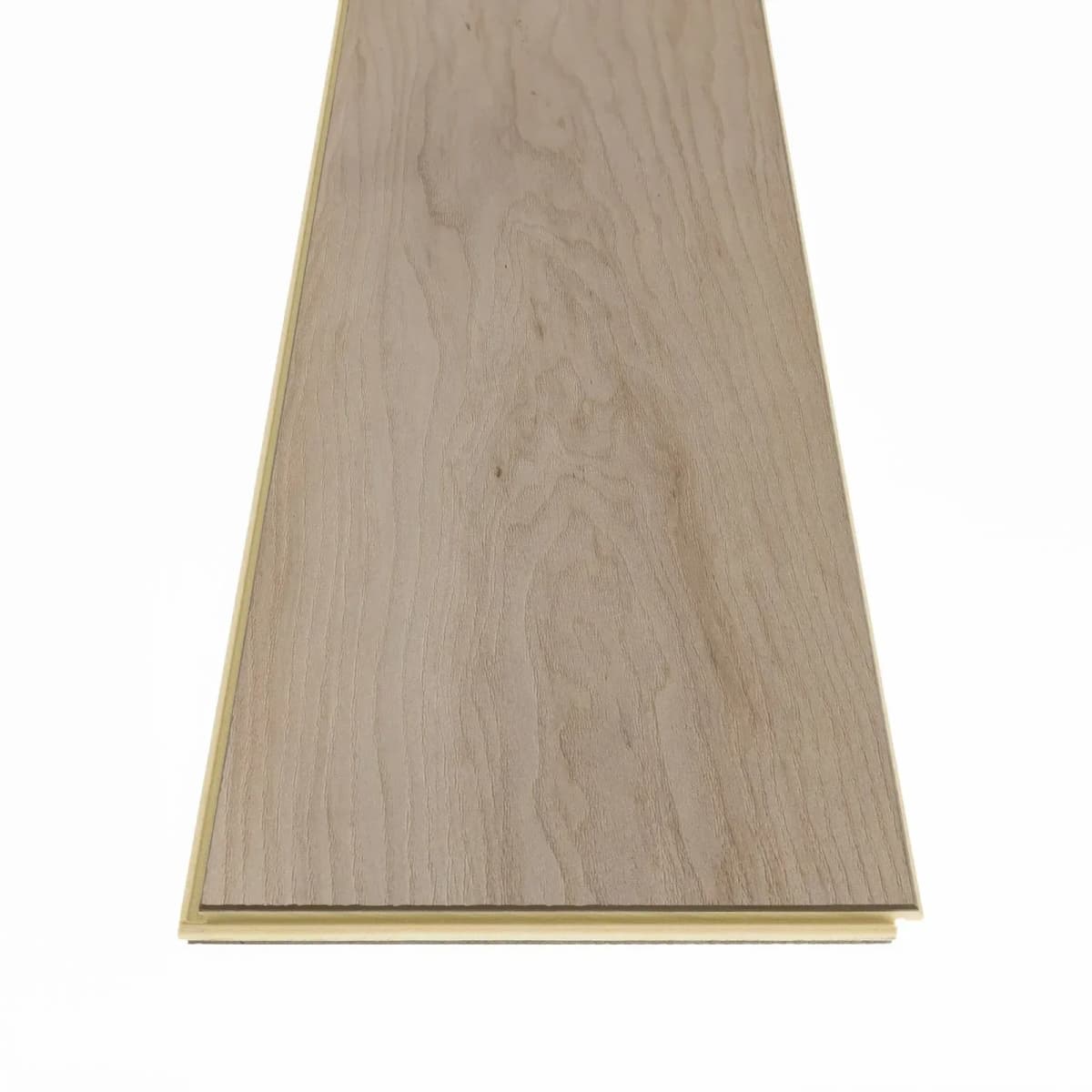
Flip a premium luxury vinyl plank over and you'll usually find a second surprise on the bottom: a thin layer of cork or foam already bonded to the plank. That's the attached underlayment, and it's one of the most useful features on modern LVP — and one of the most misunderstood.
Buyers fixate on the wear layer and plank thickness and skip right past the pad on the back. Fair enough — it's out of sight. But that layer quietly shapes how the floor sounds, how forgiving it is over an imperfect subfloor, and how warm it feels underfoot. It also gets credited with a job it doesn't do. Here's the honest breakdown.
Quick answer: Attached underlayment is a cork or foam pad factory-bonded to the back of each plank. It dampens footstep noise, adds cushion and a little warmth, and helps the plank bridge small subfloor imperfections. Cork is the near-universal choice on COREtec (about 92% of the COREtec colorways we carry); foam pads (EVA and COREtec's premium Soft Step) are common elsewhere. Pads run roughly 1–4mm thick. Important caveat: the pad is a cushion, not a vapor barrier — over a concrete slab you usually still need a separate 6-mil poly sheet.
What attached underlayment actually is
Underlayment is the layer between your subfloor and your finished floor. Traditionally it comes on a roll — you roll out a foam or cork sheet, tape the seams, and install the planks on top. It's a separate material and a separate step, and a common place for installation mistakes (wrong material, overlapping seams, gaps).
Attached underlayment moves that step into the factory. The pad is bonded to the underside of each plank, so when you click the planks together, the underlayment is already there — perfectly aligned, no separate roll, no seams to manage. On our product pages it appears as an Attached Underlayment spec row, listing the pad type (Attached Cork, EVA Pad, Attached Soft Step, and so on).
Not every plank has it. Across our live catalog, attached cork appears on 243 products, EVA pad on 108, a general attached pad on 56, and COREtec's Soft Step on 19 — but a subset of thin, glue-down styles ship bare, because they're bonded directly to the subfloor with adhesive and don't float. So "does it have an attached pad?" is a real question to ask, not a given.
Attached cork vs foam pad: what each layer does
Whether it's cork or foam, the attached pad is doing three jobs. Here's how the two materials compare across them.
| Attached Cork | Foam Pad (EVA / Soft Step) | |
|---|---|---|
| Sound dampening | Very good — absorbs footstep and impact noise | Good to excellent; Soft Step is tuned specifically for acoustics |
| Comfort underfoot | Slight cushion, holds a little warmth | Slight cushion, lighter feel |
| Subfloor forgiveness | Helps bridge minor dips and ridges | Helps bridge minor dips and ridges |
| Material | Natural cork | Engineered foam (EVA; Soft Step is COREtec's premium version) |
| Common on | Nearly every COREtec plank | Many Shaw styles; select COREtec premium lines |
Sound
This is the pad's headline job. Without a cushion between plank and subfloor, a hard floating floor can sound loud and hollow — the "click-clack" you sometimes hear crossing a bare laminate floor. Cork is a natural sound absorber and does this well; it's a big reason COREtec built its reputation on a quiet floor. Foam pads dampen sound too, and COREtec markets its premium Soft Step foam as a step up in acoustics over cork. If footstep noise between floors matters — a bedroom over a living room, an upstairs office — the attached pad is doing quiet, constant work.
Subfloor forgiveness
A floating floor telegraphs whatever is underneath it. The attached pad gives the plank a thin, compressible layer that helps it settle over minor dips and ridges instead of rocking on every high spot. It's not a substitute for proper subfloor prep — you still need the subfloor flat within the manufacturer's tolerance — but it takes the edge off small imperfections a bare plank would announce.
Comfort and warmth
Cork and foam both add a bit of give, so the floor feels softer than a plank glued straight to a slab and a touch warmer to bare feet, because the pad slows heat loss into a cold subfloor. It's subtle — nobody mistakes LVP for carpet — but it's real, and it's part of why WPC-core LVP with attached cork feels warmer and quieter than a thin, bare plank. For how the core itself factors in, see our COREtec LVP buyer's guide.
How thick is it? The 1–3mm reality
Attached pads are thin. Across our catalog they run from about 1mm up to 3mm — the common values are 1mm, 1.2mm, 1.5mm, and 3mm, depending on the product and the pad type. A 3mm cork pad on a premium COREtec plank cushions and quiets a bit more than a 1mm foam pad on an entry style, but we're talking about small differences.
The number that trips people up: pad thickness is not the same as plank thickness, and neither one is the wear layer. The wear layer — the clear protective coating on top, measured in mils — is what determines how long the floor lasts. A thicker pad makes the floor a little quieter and softer; it does nothing for durability. If you have to prioritize, prioritize the wear layer. Our LVP wear layer explainer walks through why that spec matters most.
The COREtec cork story — and where foam fits
COREtec is the reason "attached cork" is a headline LVP feature at all. Nearly every COREtec plank — 231 of the 250 COREtec colorways we carry, about 92% — ships with a cork pad bonded to the back, and it's been part of the brand's identity since it helped define rigid-core LVP. Cork gives their floors the quiet, slightly-warm feel that installers keep recommending. The other 19, about 8%, swap cork for Soft Step, the brand's premium acoustic foam, which COREtec markets as a quieter upgrade over cork on three of their top-tier Originals Premium styles (VV810, VV820, VV880).
So the cork-vs-foam question isn't cork (good) versus foam (a compromise). It's two well-engineered approaches: cork as the natural, do-everything default, and foam — especially Soft Step — as a purpose-built acoustic option. On the Shaw side you'll more often see EVA pads, which cushion and quiet effectively across price points. Small practical difference for most homes: prioritize the wear layer and the look you love, and let the pad be the tiebreaker. For the brand-level view, see what makes COREtec different.
The one job attached underlayment doesn't do
Here's where the attached pad gets over-credited: it is a cushion, not a vapor barrier. Those are two different jobs, and conflating them causes real, expensive problems.
When you float LVP over a concrete slab — on- or below-grade — the slab releases moisture vapor continuously, even one that looks bone dry. Most manufacturers require a separate 6-mil polyethylene sheet laid over the concrete before the planks go down, to manage that vapor. The attached cork or foam pad is not rated to replace it. Skip the poly and you can trap moisture between slab and floor — which is how a genuinely waterproof plank still ends up over a mildewed subfloor.
A few practical rules:
- Over concrete, plan for a 6-mil poly moisture barrier unless the specific product's install guide says otherwise. This is common in basements and slab-on-grade main floors. Our basement flooring guide covers below-grade moisture in depth.
- Be cautious with a second cushioned underlayment. Stacking a thick foam or cork roll under a plank that already has an attached pad can compromise the click-lock joints. Manufacturers cap it rather than ban it outright — COREtec's residential guidelines permit a second underlayment up to 3mm, and note it adds no proven acoustic benefit — so if an HOA mandates an acoustic mat, follow the product's install guide for the thickness limit. Absent a requirement, the attached pad is engineered to be the only cushion you need.
- "Waterproof" refers to the plank, not the whole system. Nearly all of our LVP is waterproof at the core, but the floor system still depends on the right barrier and a sound subfloor. Our waterproof flooring explainer breaks down what the label does and doesn't promise.
Always defer to the manufacturer's installation instructions for the exact product — vapor-barrier requirements vary by style, core type, and install method. For the general walk-through, see our LVP installation guide.
How to read the spec on any product page
You don't have to guess. Every LVP product page on FloorFreight shows an Attached Underlayment row in the specs. When you're comparing planks, read it alongside two neighbors:
- Attached Underlayment — the pad type (Attached Cork, EVA Pad, Attached Soft Step) and, where listed, its thickness. Tells you what the floor will feel and sound like, and confirms whether a pad is included at all.
- Wear Layer — measured in mils; the durability spec. This is the one to prioritize.
- Core — SPC or WPC; affects density, warmth, and dent resistance.
Read those three together and you have the honest shape of the floor: how long it lasts (wear layer), how it feels and sounds (core plus attached pad), and what it looks like (the visual you're actually shopping for).
Final word
Attached underlayment is both a convenience and a performance feature — it quiets the floor, adds comfort and warmth, forgives a slightly imperfect subfloor, and removes an error-prone installation step. Cork or foam, the practical difference for most homes is modest; both do the job well, and Soft Step is an acoustic upgrade, not a downgrade.
Just keep the two things straight. The attached pad cushions and quiets. Over a concrete slab, it does not replace a 6-mil poly vapor barrier. Get that right and the pad earns its keep for the life of the floor.
The best way to judge a floor's feel is to stand on it. Order $5 samples and evaluate them the way you'd live with the floor: lay them flat in the actual room, look in both morning and evening light, step back ten feet, and give it a day or two. Every sample dollar comes back as credit toward your order when you sign in at checkout with the same email you used for samples — the credit applies automatically then, and it never expires (guests checking out anonymously don't get it, so sign in). Samples ship by parcel, usually FedEx; full orders ship freight from Dalton, Georgia, with free shipping when the flooring on your order comes to $1,799 or more, and LTL freight is curbside delivery. Lower prices may be available — request a quote by email using the "Email us for today's best price" form on any product page.
Start by comparing the Attached Underlayment row across a few planks you like: browse all luxury vinyl plank, or by brand at COREtec LVP and Shaw LVP. Then order $5 samples and feel the difference for yourself.
Common questions
Frequently Asked Questions
What is attached underlayment on LVP?
Attached underlayment is a thin pad — cork or foam — bonded to the bottom of each luxury vinyl plank at the factory, so it installs as part of the plank instead of being rolled out separately. It cushions the floor underfoot, dampens footstep noise, adds a little thermal warmth, and helps the plank bridge minor dips and ridges in the subfloor. On our product pages it shows up as an 'Attached Underlayment' spec row. Not every LVP has it — a handful of thin glue-down styles ship bare — so check the spec before you assume.
Attached cork or foam pad — which is better for LVP?
They solve the same problems with slightly different strengths, so 'better' depends on what you're optimizing for. Cork is a natural material that dampens sound well, holds a little warmth underfoot, and is the near-universal choice on COREtec (about 92% of the COREtec colorways we carry). Foam pads — EVA and COREtec's premium Soft Step — are lighter and can be tuned specifically for acoustics; COREtec markets Soft Step as a premium acoustic upgrade over cork. For most homes the difference is modest. Prioritize the wear layer and the visual first; treat the pad type as a tiebreaker, and order samples to feel both.
Do I still need a separate underlayment or moisture barrier if my LVP has an attached pad?
Be careful about adding a second cushioned underlayment: stacking a thick or soft pad under a floating click-lock floor can compromise the joints. Manufacturers set a limit rather than a flat ban — COREtec's own residential guidelines, for example, permit a second underlayment only up to 3mm and note it provides no proven acoustic benefit — so if your building or HOA requires an acoustic mat, follow the specific product's installation guidelines for the thickness cap rather than assuming any pad is fine. But the attached pad is a cushion, not a vapor barrier. When you float LVP over a concrete slab (on- or below-grade), most install guides still require a separate 6-mil polyethylene sheet under the planks, because concrete releases moisture vapor continuously and the attached pad isn't rated to stop it. Cushion and vapor barrier are two different jobs. Always follow the specific product's installation instructions.
How thick is attached underlayment on luxury vinyl plank?
Across our catalog the attached pad runs from about 1mm up to 3mm — common values are 1mm, 1.2mm, 1.5mm, and 3mm depending on the product and pad type. That thickness is separate from the plank's overall thickness and from the wear layer (measured in mils). A thicker pad quiets and cushions a bit more, but it isn't the spec that decides how long your floor lasts — the wear layer is.
Related Posts
Keep Reading

COREtec Tile & Stone Looks: The DIY Alternative to Ceramic and Porcelain (2026)
9 min read

LVP Wear Layer Explained: Why 12 Mil and 20 Mil LVP Overlap on Price and Wear Differently
9 min read

Shaw LVP Buyer's Guide: Classic Series vs Pro Series, and Where 5th and Main Fits (2026)
10 min read
Will Heavy Furniture Dent Vinyl Plank Flooring? What Holds Up (2026)
14 min read
Keep browsing