
Best Waterproof Flooring for Bathrooms (2026): What Actually Survives
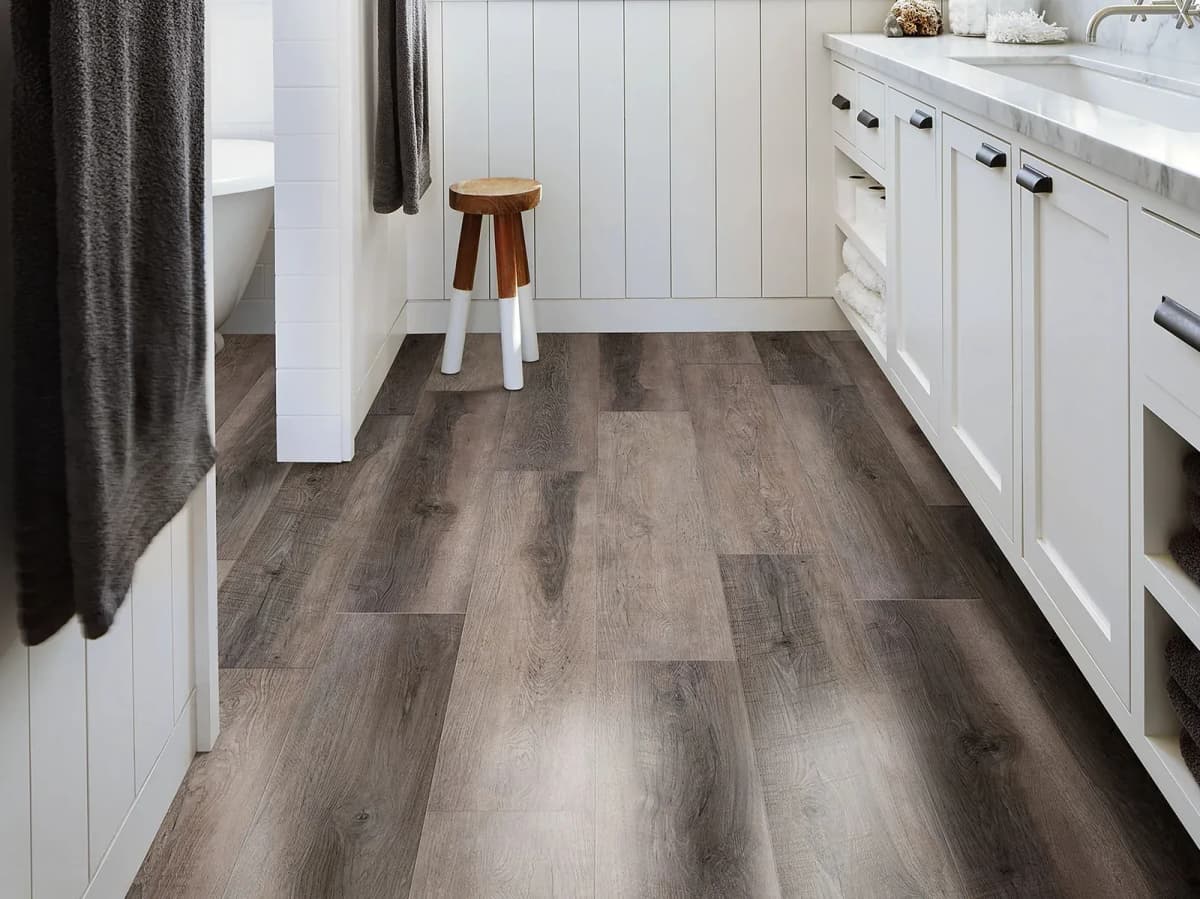
Floor names link to their product pages in a new tab.
Bathrooms are the hardest room in a house on flooring. Constant humidity, splashes from sinks and showers, wet feet, dropped towels left to soak, occasional plumbing failures, and the cleaning chemicals you use to deal with all of it. Most flooring fails in bathrooms. Some flooring is built for it.
This guide covers what "waterproof" actually means in a bathroom context, which LVP and LVT products from our catalog perform best, and the installation details that separate a bathroom floor that holds up from one that fails in its first few years. We sell every product covered here at FloorFreight as an authorized Shaw and COREtec dealer.
Waterproof in a Bathroom: What That Actually Means
If you read our waterproof flooring explainer, you already know: "waterproof" is one of the most overpromised terms in flooring. For most rooms in the house, the distinction between "100% waterproof" and "water-resistant" doesn't matter much. For bathrooms, it matters a lot.
A bathroom waterproof floor needs to handle four things:
1. Surface water and splashes. Daily showers, hand washing, toilet area mopping. Any LVP with a sealed wear layer handles this.
2. Humidity and steam. Hot showers create 90-100% humidity that lingers for hours. Floors that absorb moisture (laminate, engineered hardwood, some thin, flexible vinyl) swell over time even without direct water contact.
3. Standing water from accidents. Toilet overflows, leaking sink supply lines, water heater failures, kids leaving a tub running. A waterproof plank is the right floor to have under one, but this is not a warranty event: Shaw's and COREtec's waterproof warranties exclude flooding and standing water from leaking plumbing, faucets or appliances.Source 1Source 2 The job is to get the water up and find out what reached the subfloor.
4. Long-term moisture migration to the subfloor. This is where most "waterproof" floors fall short. Plank seams allow water through to the subfloor over time. Even with a waterproof core, the subfloor below can rot if water gets through the seams repeatedly.
No floor handles all four on its own. A waterproof plank takes care of the first two. The third is a cleanup job, and the fourth comes down to installation: a dry, tested subfloor and a caulked perimeter, both covered below.
SPC vs WPC for Bathrooms
Both cores are waterproof. Shaw's and COREtec's installation guides say so of each,Source 3Source 4Source 5Source 6 and the waterproof warranty is the same section whichever core a floor has.Source 1Source 2 So the choice between SPC (solid polymer core) and WPC (wood-plastic composite) in a bathroom comes down to three practical differences.
A thinner profile fits under existing fixtures. COREtec's Pro floors and Shaw's Pro Series, the SPC lines we carry, are 4.4mm to 6.5mm thick overall. COREtec Originals and Shaw's Classic Series, the WPC lines, run from 6.5mm to 19mm. A thinner plank fits more easily under toilet flanges and door jambs — important when retrofitting a bathroom without replacing fixtures. A vanity is a different case: COREtec's guides say that where cabinets are installed on top of the flooring, that area must be fully adhered to the subfloor, so set the vanity first and float the floor up to it.Source 3Source 4
Dent resistance. Heavy vanities, toilets, claw-foot tubs — bathroom fixtures concentrate weight on small footprints. COREtec describes its SPC construction as compact and dent-resistant. Neither core is dent-proof: both brands' warranties exclude indentations from heavy static loads, so use floor protectors under anything heavy.
Comfort. COREtec describes its WPC floors as softer, warmer and quieter underfoot. In a bathroom you're usually barefoot for a few minutes at a time, so weigh that against the thinner profile above.
In our catalog, every COREtec Pro floor and every Shaw Pro Series floor has an SPC core, and COREtec Originals and Shaw's Classic Series are WPC. Each product page lists the core type.
Wear Layer for Bathrooms: What We'd Choose
For a family bathroom in daily use, we'd choose 20 mil, our default for a busy household. For a guest bath or a powder room that sees lighter traffic, we'd choose 12 mil, and we'd keep 6 mil for light-use rooms only.
The wear layer is the clear layer over the printed design, measured in mils (thousandths of an inch). The luxury vinyl we sell runs from 6 to 30 mil, and 20 mil is the most common. The picks above are our recommendation, not a manufacturer's: neither Shaw's warranty nor COREtec's assigns a wear layer to a room, a bathroom included, and the waterproof section of each is the same at every thickness.Source 1Source 2
Our LVP wear layer explainer covers what each number comes to and which we'd choose for the rest of the house.
Slip Resistance: What Matters and What Doesn't
Wet bathroom floors are a real safety risk, especially for kids and elderly residents. Most modern LVP comes with textured surfaces and slip-resistant wear layers, but textures vary.
What helps with slip resistance:
- Textured or embossed surface — most LVP has at least mild texturing; the deeper the texture, the better the wet traction. Look for "Embossed in Register" (EIR) products — the texture aligns precisely with the printed grain pattern, providing both visuals and slip resistance.
- Matte or low-gloss finish — glossy LVP is more slippery when wet. All quality bathroom LVP should be matte or low-sheen.
- Tile-format LVP with grout lines — the grout-line gaps in tile-format LVT products break up the slip surface, improving traction. Worth considering for primary bathrooms.
What doesn't matter much:
- Specific COF (coefficient of friction) ratings — most LVP products in this category don't publish COF ratings. The general principle (texture + matte = traction) is what matters in practice.
- "Pet-friendly" or "kid-friendly" branding — these labels often imply slip resistance but aren't standardized claims. The textured surface and matte finish are what actually create traction.
For bathrooms with elderly residents or anyone with balance concerns, prioritize tile-format LVT with deep texture and matte finish. The smaller tile sizes and grout lines provide additional traction over wood-look plank LVP.
Tile-Format LVP for Bathrooms
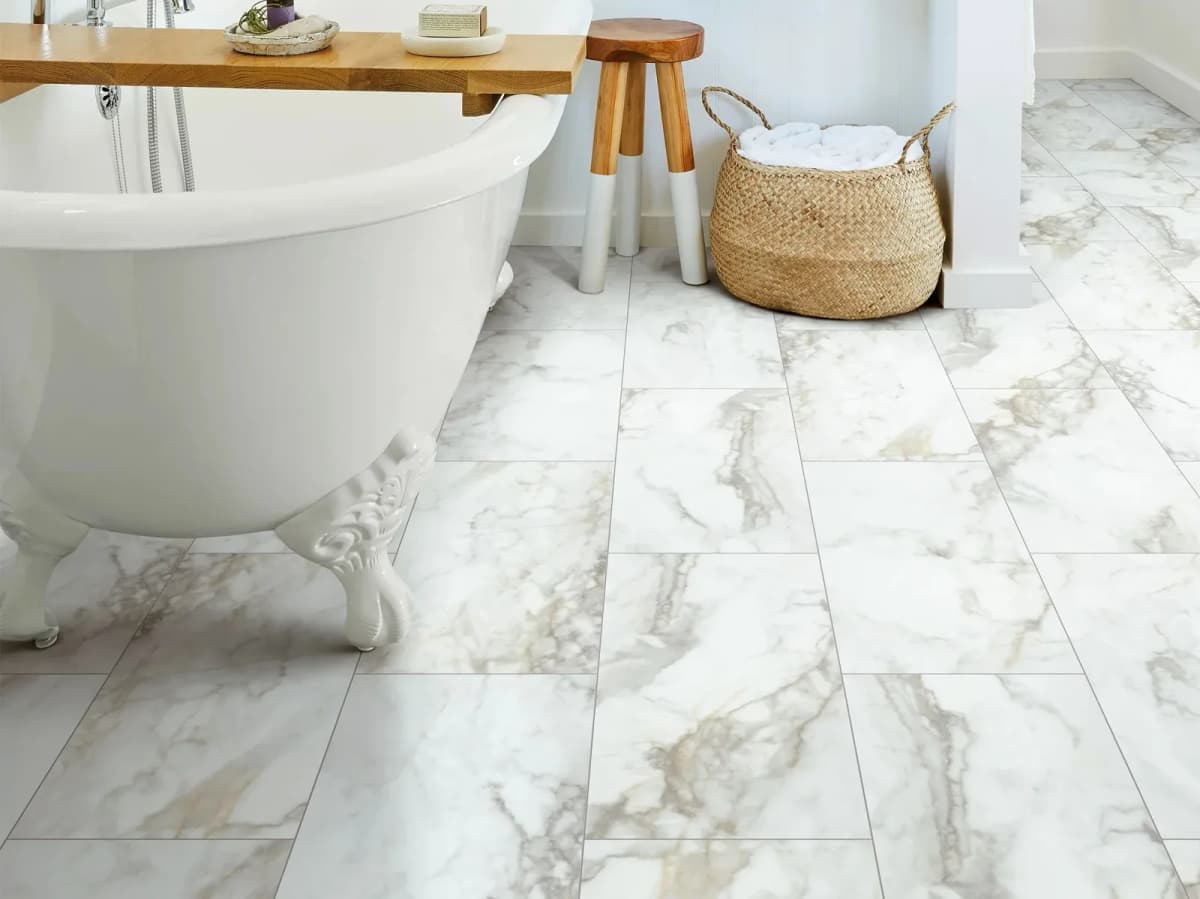
Most LVP buyers think of plank products. For bathrooms, tile-format LVT (luxury vinyl tile) offers genuine advantages worth considering.
Why tile-format works better in bathrooms:
- Stone and marble visuals that look more "bathroom" than wood-look planks
- Smaller pieces mean more grout lines, better slip resistance
- Smaller pieces also fit better around toilet flanges and tight spaces
- Tile-format matches conventional bathroom aesthetics if you ever sell the home
In our catalog, the standout tile-format LVT products are:
COREtec CT Tile SPC 18 ($8.19/sq ft) — 18" × 36" large-format tiles with stone visuals. The largest tile format we stock. Reads as a real natural-stone slab. Five colors with names like Dolomi Limestone, Eterna Marble, Raw Terra Cotta.
COREtec CT Plus Tile ($7.59/sq ft) — 12" × 24" tiles, 8mm thick. Nine colors. The most popular bathroom format size — proportions match standard ceramic bathroom tile.
COREtec Pro Plus Enhanced Tile ($5.99/sq ft) — 12" × 24" tiles, 5mm thick, SPC core, 20 mil wear layer. Five colors.
Shaw Paragon Tile Plus ($6.29/sq ft) — 12" × 24" tiles, 20 mil wear layer, attached pad. Fourteen colors with names like Ash, Bianco, Bone. The Shaw equivalent to COREtec CT Plus Tile at similar pricing.
For most bathroom installations, CT Plus Tile or Paragon Tile Plus is the right starting point. Both deliver the bathroom-appropriate aesthetics without breaking the budget.
Plank LVP for Bathrooms
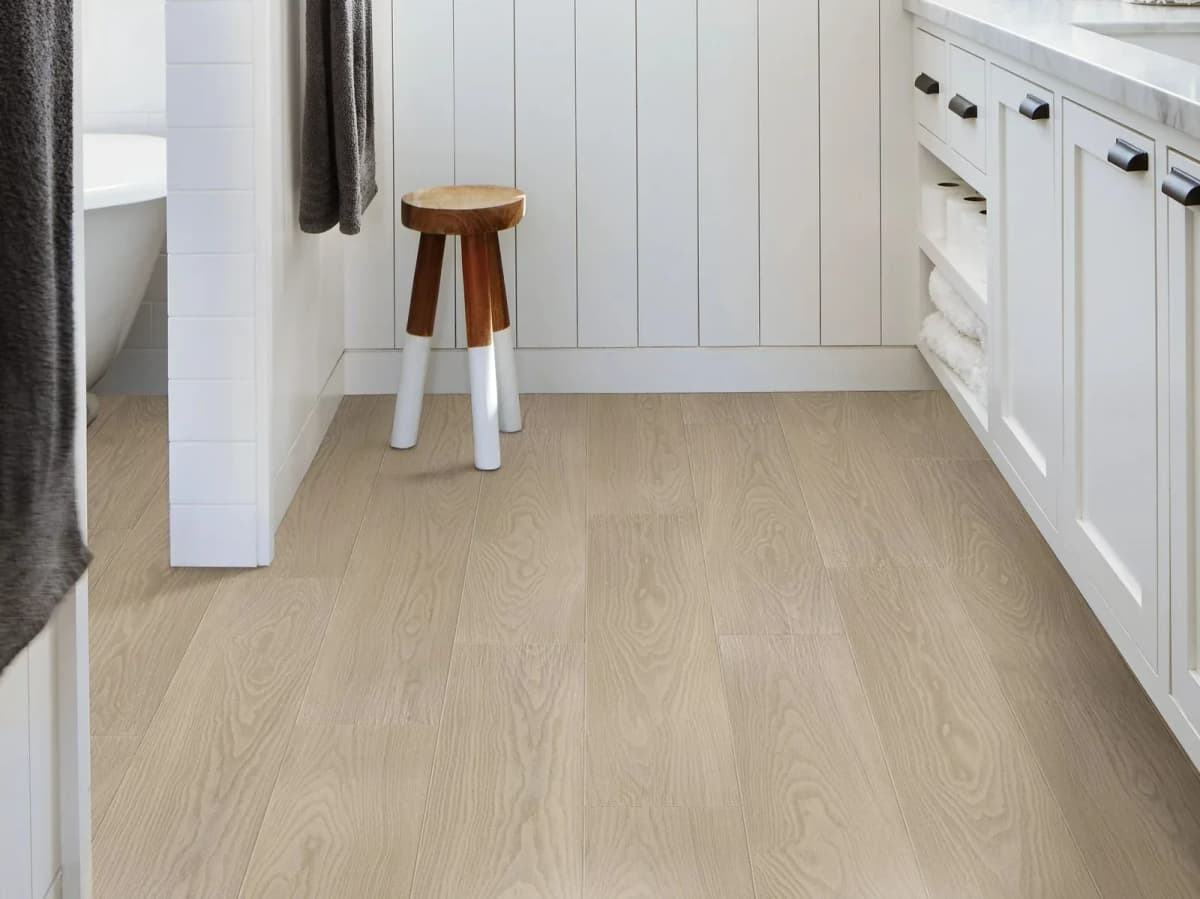
If you want wood-look LVP in your bathroom (popular for primary bathrooms, often paired with floating vanities and contemporary fixtures), here's what to choose:
Top picks for bathroom plank LVP:
COREtec Pro Classics VV017 ($4.09/sq ft) — 7" × 48" planks, 5mm SPC core, 20 mil wear layer, attached cork, with COREtec's pet-stain warranty. If you're flooring multiple rooms including a bathroom, Pro Classics is the right "whole-house" pick.
COREtec Pro Plus Enhanced HD 9" VV488 ($5.39/sq ft) — 9" × 72" planks, SPC core, 20 mil wear layer. Same construction profile as Pro Classics, wider planks for a more contemporary look.
Shaw Infinite SPC ($3.89/sq ft) — 7" × 48" planks, SPC core, 20 mil wear layer, EVA pad, 13 colors. The Shaw SPC plank on this list. Check the warranty panel on the color you pick: ten of the 13 are on Shaw's warranty with the Waterproof section, and three (Shadow, Honeycomb and Boheme Brown) are on Shaw's defects-and-wear document, which has none.Source 7
For premium bathroom installations:
Shaw Titan HD Plus Platinum ($6.79/sq ft) — 30 mil wear layer, 9" × 72" planks, WPC, attached IXPE. The thickest wear layer Shaw offers in our catalog, on a 12mm plank.
COREtec Originals Premium 3/4" CR500 ($10.69/sq ft) — 8.74" × 72" planks, 19mm thick, WPC, 30 mil wear layer. The thickest plank we carry. At 19mm, check its height against your toilet flange, door jambs and vanity before you choose it for a retrofit.
Installation Details That Make or Break a Bathroom Floor
The waterproof construction is only half the equation. Installation matters more in bathrooms than any other room. Get these details right:
Subfloor preparation matters most.
Any LVP, even SPC-core LVP, fails if the subfloor moves. Bathrooms typically have subfloors that deal with more moisture over time than other rooms. Before installing LVP:
- Test concrete subfloors for moisture: COREtec's installation guides require it and set the maximum at 8 lbs by calcium chloride or 90% in-slab relative humiditySource 3Source 4
- Confirm wood subfloors are stable, level, and dry (under 12% moisture content)
- Install a moisture barrier over concrete subfloors below grade
- Allow new construction subfloors to fully cure before installation
Around the toilet:
The toilet flange is the most vulnerable point in a bathroom LVP installation. Two right ways to handle it:
- Pull the toilet, install the floor, reset the toilet on top of the new floor. Adds work but creates the strongest seal. The floor goes under the toilet base, meaning no water can creep around the toilet's perimeter.
- Install the floor up to the toilet, with a tight cut around the flange. Saves work but requires precise cutting and proper sealing. The flange height must be maintained — sometimes requires shimming the toilet to seat correctly.
The wrong way: cutting around the existing toilet without lifting it. Leaves gaps where water inevitably penetrates.
Silicone the perimeter.
After installation, apply a continuous bead of 100% silicone caulk where the floor meets:
- The tub or shower base
- The base of the toilet (if you installed up to the flange)
- The base of the vanity
- The base of any plumbing fixtures (towel rod walls, etc.)
This is the single most important detail for long-term moisture protection, and it is in the installation guide: for wet areas such as bathrooms, COREtec's guides say to caulk the perimeter of the floor with a flexible silicone caulk.Source 3Source 4
Expansion gaps.
Vinyl plank moves with temperature: COREtec's guides warn that excess temperature from direct sunlight can result in thermal expansion. Leave a 1/4" expansion space at every wall, covered by baseboard or quarter-round trim. Don't skip it: COREtec's installation guides state that space as a requirement.Source 3Source 4
Acclimation — not required for a floating vinyl floor.
Shaw's and COREtec's floating installation guides, SPC and WPC alike, say acclimation of the material before installation is not required, and ask instead for a climate-controlled room at 55–85°F when the floor goes down.Source 3Source 4Source 5Source 6 Until install day, keep the cartons flat and indoors, in the room where the floor is going. Always verify with your specific product's installation guide.
For our complete LVP installation walkthrough, see our LVP flooring installation guide.
What to Avoid in Bathrooms
A few categories we steer customers away from for bathroom floors:
Engineered hardwood, even "waterproof" engineered hardwood. No engineered hardwood handles bathroom humidity reliably long-term. The marketing of "waterproof hardwood" is misleading — they handle splashes, not the conditions of an actual bathroom. Real hardwood in bathrooms is asking for problems.
Standard laminate. Laminate is not waterproof, full stop. Even "water-resistant" laminate has a fibreboard core that swells once water gets past the seams. Don't put any laminate in a bathroom.
Glossy or high-shine finishes. Slippery when wet. Matte or low-sheen only.
Wood-look LVP in bathrooms where stone-look would fit better. This is preference, not safety. But many primary bathrooms read better with stone or tile-format LVT than with wood-look plank.
Cost Analysis
For a typical 8' × 10' bathroom (80 sq ft):
Budget option: Shaw Infinite SPC at $3.89/sq ft = $311 material. Add $200-400 installation labor for total of $511-711.
Mid-tier: COREtec Pro Plus Enhanced HD 9" VV488 at $5.39/sq ft = $431 material. Total with installation $631-831.
Premium: Shaw Titan HD Plus Platinum at $6.79/sq ft = $543 material. Total with installation $743-943.
Thickest plank: COREtec Originals Premium 3/4" CR500 at $10.69/sq ft = $855 material. Total with installation $1,055-1,255.
For full bathroom remodel projects (where you're also replacing the vanity, toilet, and shower fixtures), the floor cost difference is a small percentage of total project cost. Don't underspend on flooring to shave $200 off a $15,000 bathroom remodel.
Final Word
The bathroom flooring decision has gotten simpler in the last 10 years. Waterproof LVP has matured to the point where it is a real bathroom floor: a waterproof plank, a slip-friendly surface, and a floating installation.
For most bathroom installations, the right path is:
- Wood-look plank: COREtec Pro Classics VV017 ($4.09/sq ft) or Shaw Infinite SPC ($3.89/sq ft) — both SPC, both 20 mil
- Stone or tile-look: COREtec CT Plus Tile ($7.59/sq ft) or Shaw Paragon Tile Plus ($6.29/sq ft) — for bathrooms that want the traditional tile aesthetic
- Thickest wear layer: Shaw Titan HD Plus Platinum ($6.79/sq ft) — 30 mil, on a 12mm WPC plank
Choose a waterproof plank with the wear layer for how hard the room is used (we'd pick 20 mil for a family bathroom), install it with proper subfloor prep and a silicone caulk perimeter, and the floor stops being the thing you worry about in that room. For broader LVP shopping context, see our Shaw LVP buyer's guide and COREtec LVP buyer's guide.
Order a $5 sample before you commit. Bathroom floors read very differently in your home's natural light and against your specific vanity, toilet, and fixture colors than they do on a screen.
In this article
The floors from this guide

Shaw Floors
Titan HD Plus Platinum
Imperial Beech
Samples are $5 each, credited back at checkout when you sign in.

Shaw Floors
Infinite SPC
Pampas
Samples are $5 each, credited back at checkout when you sign in.

COREtec Floors
COREtec Plus Tile VV872
Avesta Quartz
Samples are $5 each, credited back at checkout when you sign in.

Shaw Floors
Paragon Tile Plus
Charcoal
Samples are $5 each, credited back at checkout when you sign in.
Referenced in this guide
Sources
Residential Resilient Limited Warranty — Defects, Wear, Waterproof, Petproof (rev. 06/28/2023)
Shaw Industries, Inc. · Accessed 2026-10-10
https://pdmsview.shawinc.com/viewer/document/doc/28855Residential Resilient Limited Warranty — Defects, Wear, Waterproof, Petproof (USFloors/COREtec, rev. 06/28/2023)
Shaw Industries, Inc. (USFloors / COREtec) · Accessed 2026-10-10
https://pdmsview.shawinc.com/viewer/document/doc/19721COREtec Pro SPC Installation Guidelines (Resilient Installation Guidelines for SPC Products, rev. 11/05/2024)
Shaw Industries · Accessed 2026-10-10
https://pdmsview.shawinc.com/viewer/document/doc/10195Resilient Installation Guidelines for WPC Products (rev. 03/01/2022)
Shaw Industries (USFloors / COREtec) · Accessed 2026-10-10
https://pdmsview.shawinc.com/viewer/document/doc/11746Luxury Vinyl Angle/Angle SPC Installation Guidelines (rev. 09/18/2024)
Shaw Floors (Shaw Industries) · Accessed 2026-10-10
https://pdmsview.shawinc.com/viewer/document/doc/7273Floorté and Floorté Plus WPC Installation Guidelines (rev. 03/18/2021)
Shaw Floors (Shaw Industries) · Accessed 2026-10-10
https://pdmsview.shawinc.com/viewer/document/doc/3881Residential Resilient Limited Warranty — Defects, Wear (rev. 06/28/2023)
Shaw Industries, Inc. · Accessed 2026-10-10
https://pdmsview.shawinc.com/viewer/document/doc/28854
Related Posts
Keep Reading
How Long Does Luxury Vinyl Plank Last? A Dealer's Answer
9 min read
Most Durable Flooring for Homes: LVP vs Engineered Hardwood (2026)
12 min read
Best Flooring for Condos: Meeting Your HOA's Sound (IIC) Requirement (2026)
11 min read

Vinyl Plank Flooring Separating? Why It Happens and How to Fix It
12 min read
Keep browsing