
Hickory vs Oak Flooring: Hardness, Grain and Which One Fits Your Home
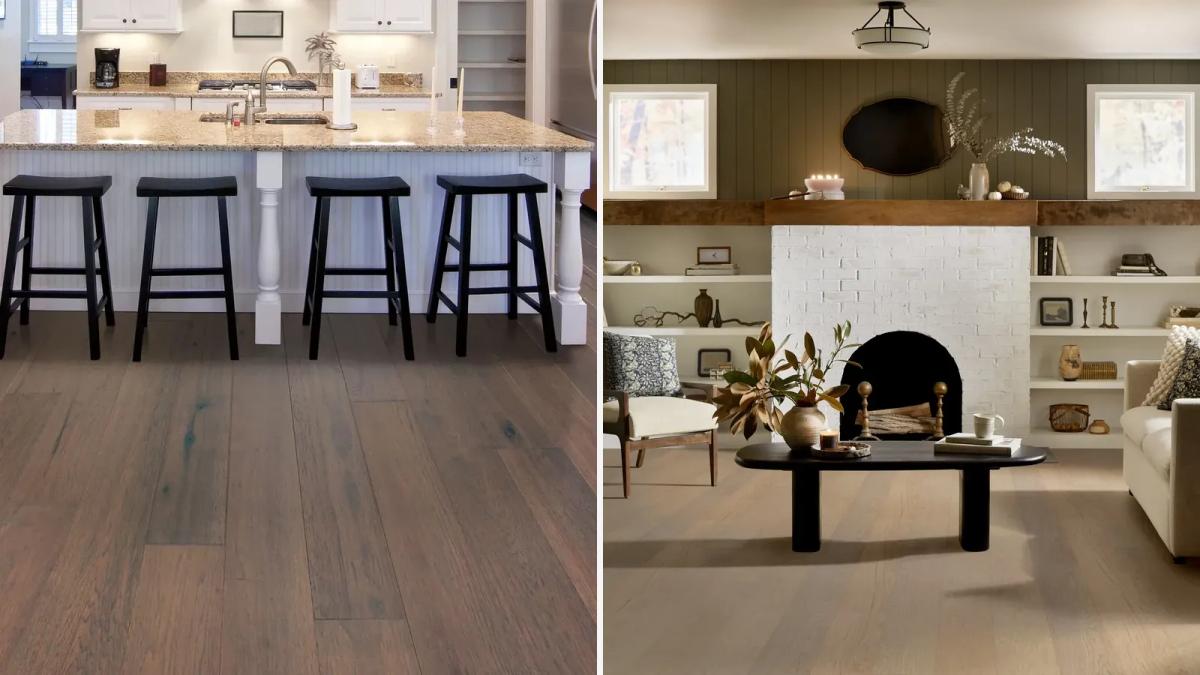
Floor names link to their product pages in a new tab.
Quick answer: Hickory vs oak flooring comes down to how much character you want. Hickory is the harder wood, at 1,820 lbf of side hardness for pecan hickory against 1,360 for white oak and 1,290 for northern red oak,Source 1 and its big swings between light and dark boards hide wear well. Oak is calmer and more consistent, and it fits more styles of room. On price, species barely matters in our catalog: matched hickory and oak floors from the same Shaw collections are within 30 cents a square foot of each other. Choose hickory for a busy, rustic-leaning home; choose oak, especially white oak, for a quieter floor that works almost anywhere.
Hickory vs oak flooring is one of the most common choices we see people stuck on, and for good reason. Both are real American hardwoods, both come in every shade from pale to espresso, and both make a beautiful floor. They just do it in very different ways.
The good news is that this is an easy decision once you know what actually separates them: how hard the wood is, how much the color and grain move from board to board, and what kind of room you're putting it in. Price, refinishing and installation barely differ between the two species, which surprises most people.
Below, we compare the two using floors we sell: matched hickory and oak versions of the same Shaw collections, and the hickory and white oak styles from Anderson Tuftex.
Hickory vs oak flooring at a glance
| Hickory | Oak | |
|---|---|---|
| Side hardness (Wood Handbook) | 1,820 lbf (pecan hickory) | 1,360 lbf (white oak), 1,290 lbf (northern red oak) |
| Dent resistance | Higher | Good |
| Look | Bold grain, strong light-to-dark variation | Even, recognizable grain, more consistent color |
| Hides wear | Very well, especially textured | Well when textured, less so smooth |
| Styles of room | Rustic, farmhouse, cabin, casual family homes | Nearly any: traditional, transitional, modern |
| Price in our matched Shaw pairs | Within 30 cents a sq ft of oak | Within 30 cents a sq ft of hickory |
| Choice in our catalog | Mostly Shaw Repel, plus Anderson Tuftex hickory and pecan | Shaw red oak, oak and white oak, plus several Anderson Tuftex white oaks |
The hardness figures are side hardness at 12% moisture content from Table 5-3b of the USDA Forest Products Laboratory's Wood Handbook.Source 1 That's the same number the flooring industry calls a Janka rating. Hickory flooring is cut from several closely related species, and the Handbook's pecan hickory figure is the one we use for all of them here.
Hardness: how much harder is hickory than oak?
Hickory wins this one clearly. Pecan hickory's side hardness of 1,820 lbf is about 34% higher than white oak's 1,360 and about 41% higher than northern red oak's 1,290.Source 1 Red oak has long been the benchmark flooring species, so hickory sits well above the standard most people are comparing against.
Two things are worth knowing before you let that number decide for you.
Janka measures dents, not scratches. The test pushes a steel ball into the wood, so it tells you how well a species resists a dropped pan, a chair leg or a high heel. Everyday scratches from grit and pet nails happen first in the factory finish on top of the wood, and the finish, not the species, takes most of that. A harder species helps; it doesn't make a floor scratch-proof.
On engineered hardwood, hardness lives in the wear layer. Every hardwood floor we sell is engineered: a real hardwood top layer bonded to a stable core. The species you pick is the species of that top layer, so a hickory engineered floor has a hickory surface. A thin veneer over a softer core can still dent under a heavy point load, so treat Janka as a comparison between species, not a promise about a specific floor. Our wear layer guide explains how veneer thickness changes what a floor can take.
Shaw sells its Repel hardwood, which includes every Shaw hickory and oak pair below, on "superior dent resistance" and a ScufResist Platinum finish.Source 2 That claim is made for the line as a whole, hickory and oak alike, so it doesn't change the gap between the two species.
Grain and color: the real deciding factor
Hardness is the reason people search this question. The look is usually the reason they decide.
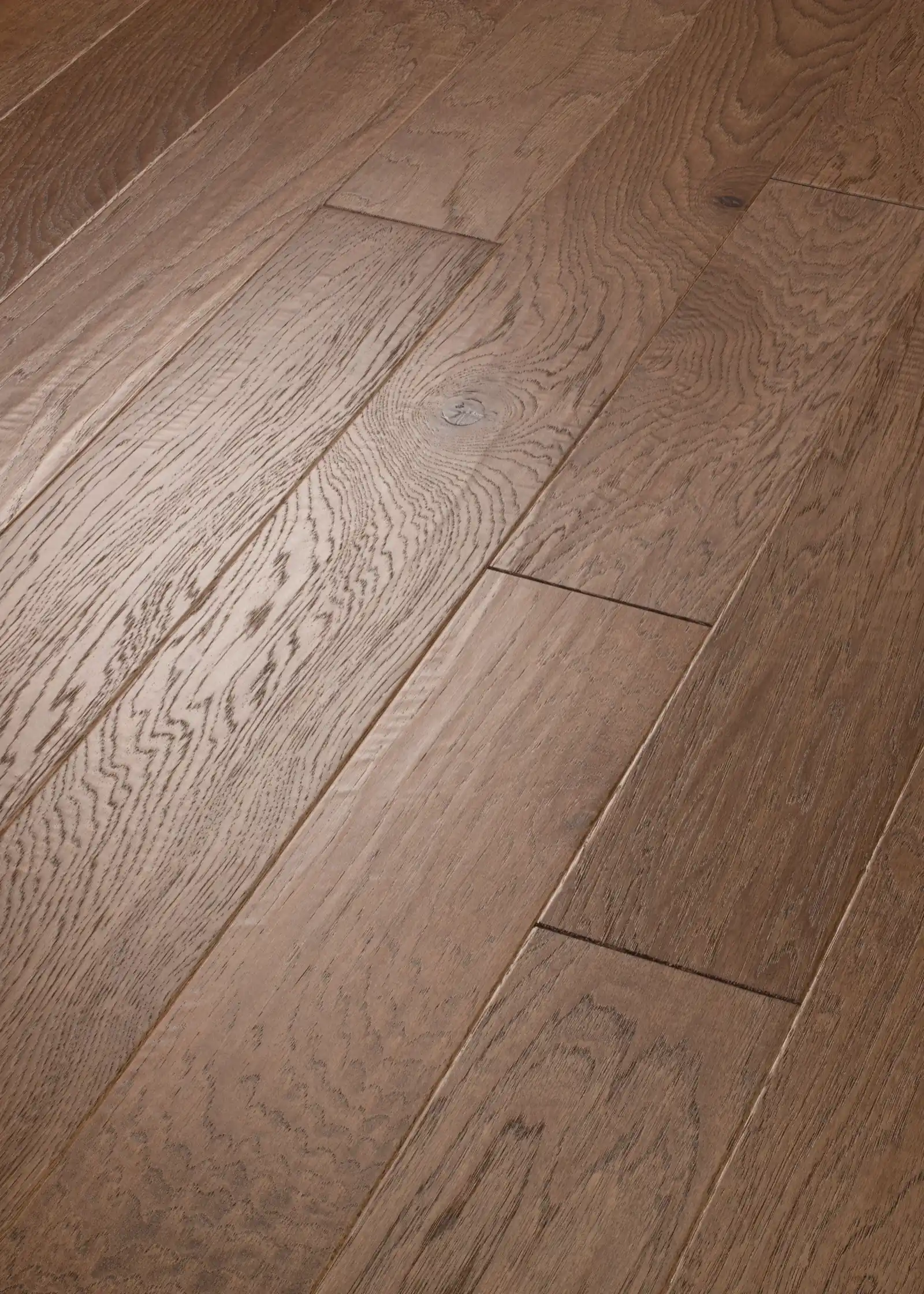
Hickory is high-contrast. A hickory floor mixes pale sapwood and darker heartwood, often in the same board, so one plank can run from cream to caramel to brown. The grain is bold and irregular, with swirls and streaks, and many styles keep small knots and mineral marks. Even a single-color hickory floor reads as a mix of tones from across the room. Look at the Sanctuary Hickory kitchen at the top of this post: the stain is one color, but the boards are anything but uniform.
Oak is consistent. Oak has a familiar, open grain, often with the arched "cathedral" pattern on flat-sawn boards straight, linear grain on rift-sawn boards and ray fleck on quarter-sawn ones. Board to board, the color stays much more even. Red oak leans warm, with a pink or reddish undertone that shows through lighter stains. White oak leans cooler and more tan, which is a big reason it took over in light, natural and modern looks. The Sanctuary Oak living room beside the hickory shows that calm, even read.
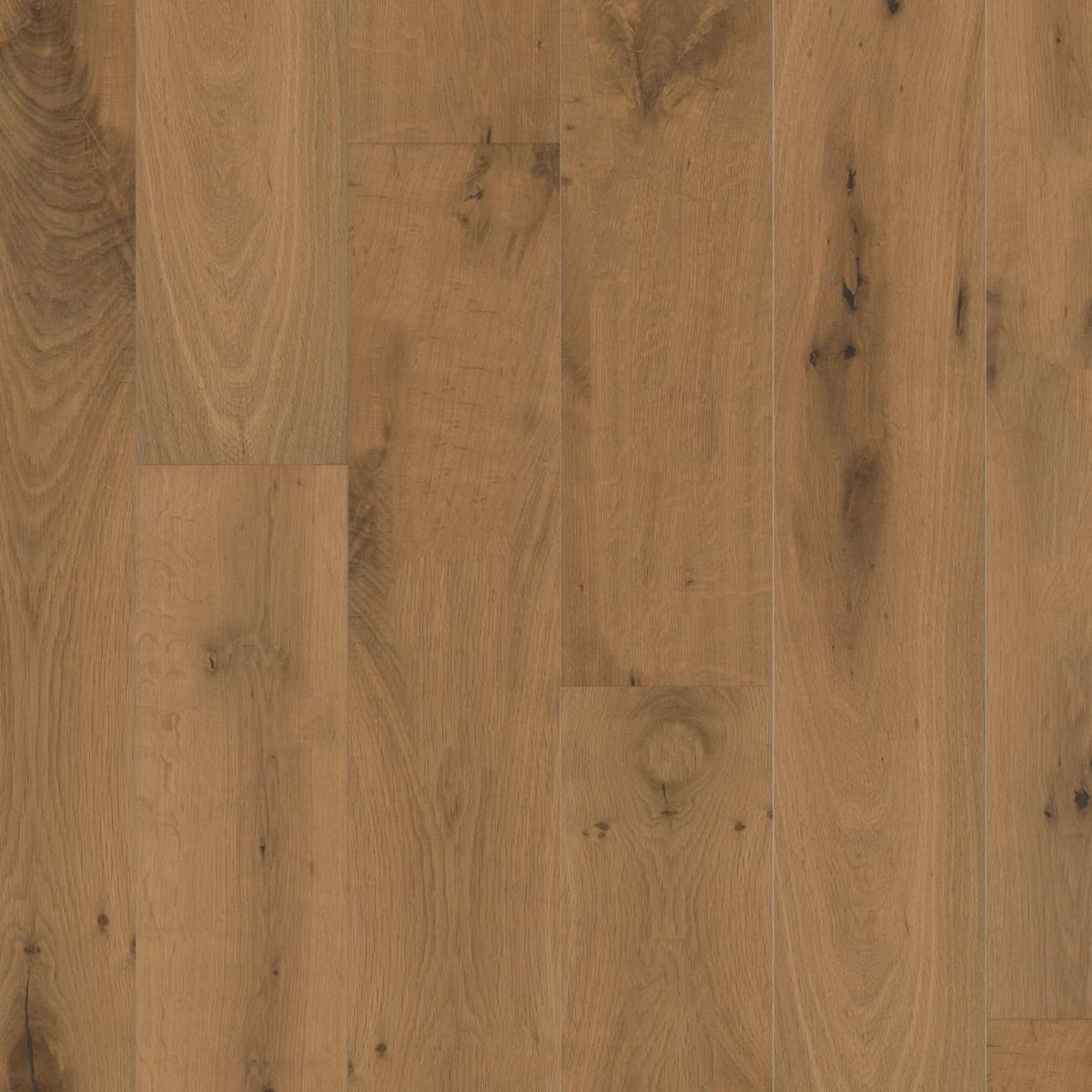
Oak isn't automatically plain, either. A character-grade white oak like Anderson Tuftex Artisan Oak, with knots and a distressed surface, can be every bit as rustic as hickory. The difference is that oak lets you choose how much character you want, while hickory brings plenty of it by default.
What this means in your room:
- If you want the floor to be the statement, or you love farmhouse, lodge or cabin interiors, hickory does that on its own.
- If you want the floor to sit back and let furniture, rugs and cabinets lead, oak is the easier partner.
- If you're matching existing cabinets, trim or another floor, oak's consistency makes it more predictable. Our guide to matching hardwood covers what to compare.
Hickory or oak for pets and kids
For busy households, hickory has a real edge. It's the harder wood, so it shrugs off more dents from dropped toys and chair legs, and its mixed color hides the small scratches and scuffs that a family puts on any floor. Most hickory we carry comes wire-brushed or scraped, and that texture hides wear too.
Oak is still a good family floor, especially textured white oak. Where oak tends to show wear sooner is a smooth, even-toned floor, where a scratch has nothing to hide behind.
A few things hold for both species:
- No hardwood is scratch-proof. The Shaw Repel and Anderson Tuftex residential hardwood warranties treat scratches and dents in the finish as outside their wear coverage, and list pet claws and dropped objects among their exclusions.Source 3Source 4
- Spills are a finish question, not a species question. Every Shaw hickory and oak pair in this guide has Shaw's Repel water-resistance treatment, which Shaw says "guards against splashes and spills 2x better than untreated hardwood."Source 2 Shaw's Repel warranty says the floor will resist damage from moisture due to everyday household spills, and still asks you to dry spills right away.Source 3
- Big dogs and standing water change the answer. If you're dealing with pet accidents, long nails on a large dog or water that can sit on the floor, look at waterproof vinyl plank instead of any wood. Our post on when a dog ruins a hardwood floor walks through that switch.
Our guide to the best hardwood for high-traffic homes goes deeper on finishes and wear layers for active households.
Engineered vs solid: does it change the choice?
Not much. Every hickory and oak floor we sell is engineered hardwood, and the species question works much the same way for engineered as for solid: the look and the species' hardness come from the top layer you walk on, though veneer thickness and the core affect how a floor takes a heavy point load. What engineered construction changes is stability and installation. The plywood or cross-ply core resists the seasonal swelling and shrinking that solid planks go through, which is why every engineered hickory and oak style in this guide lists nail, staple, glue and floating installation on its product page.
If you're weighing solid hardwood for its own sake, our solid vs engineered hardwood guide lays out when each makes sense.
Refinishing: wear layer matters more than species
People sometimes hear that oak refinishes better than hickory. In practice, on an engineered floor, the wear layer and the texture decide whether you can sand at all, long before the species comes into it.
The National Wood Flooring Association's guidelines say a floor generally shouldn't be sanded if the wear layer is under 3/32 inch (about 2.5 mm), and that wire-brushed, scraped and distressed floors are extremely difficult to sand and often can't be.Source 5Source 6 That puts most of the hickory and oak we sell in the same camp:
- Shaw hickory and oak (1.2 mm veneer): recoat floors, not sanding floors, whichever species you pick.
- Anderson Tuftex Coast to Coast white oak (2 mm) and Bernina Hickory (1.8 mm): also under that line, so plan on recoating them too.
- Anderson Tuftex Transcendence hickory (3 mm) and Chateau Oak white oak (3 mm): thick enough on paper, but both are wire-brushed, and the NWFA measures a textured floor at the lowest point of its texture, so have a flooring professional assess them before you count on sanding.
- Anderson Tuftex Artisan Oak (4 mm): the thickest veneer in this guide, also with a distressed surface, so have it assessed before you plan on sanding too.
If you expect to refinish down the road, choose by veneer thickness and surface first, then pick the species you like.
Matched hickory and oak floors in our catalog
The fairest way to compare two species is to hold everything else equal. Shaw makes that easy: three of its Repel collections come in both hickory and oak, with the same width, thickness, 1.2 mm veneer, wire-brushed texture and Repel finish. Anderson Tuftex has a close pair too.
| Collection | Hickory | Oak | Shared specs |
|---|---|---|---|
| Shaw Exploration | Exploration Hickory, $6.79/sq ft | Exploration Oak, $6.49/sq ft | 6.38" wide, 3/8" thick, 1.2 mm, wire-brushed, Repel |
| Shaw Sanctuary | Sanctuary Hickory, $8.59/sq ft | Sanctuary Oak, $8.29/sq ft | 6.38" wide, 1/2" thick, 1.2 mm, wire-brushed, Repel |
| Shaw Reflections | Reflections Hickory, $8.99/sq ft | Reflections White Oak, $9.09/sq ft | 7" wide, 1/2" thick, 1.2 mm, wire-brushed, Repel |
| Anderson Tuftex | Transcendence (hickory), $10.79/sq ft | Coast to Coast (white oak), $10.79/sq ft | 7.48" wide, wire-brushed, UV aluminum oxide |
Prices are the manufacturer's advertised price (MAP) per square foot shown on our product pages on November 22, 2026; the product page always has the current figure. The Anderson Tuftex pair isn't identical underneath: Transcendence is 9/16" thick with a 3 mm veneer, and Coast to Coast is 1/2" thick with a 2 mm veneer. Shaw lists the species for Exploration Oak and Sanctuary Oak simply as oak.Source 2
What the pairs say about cost: species barely moves the price. In the three Shaw pairs the gap is 10 to 30 cents a square foot, and it runs both ways. What moves price is the style itself: plank thickness, width and brand tier. Sanctuary and Exploration share a width and veneer, and Sanctuary's thicker plank costs about $1.80 a square foot more.
A few more hickory and oak floors worth a look:
- Classic narrow hickory: Shaw Pebble Hill Hickory 5 and Fremont Hickory are scraped 5" hickory in the Repel line, and Anderson Tuftex Bernina Hickory is a scraped 5" hickory with a 1.8 mm veneer.
- Classic red oak: Shaw Albright Oak 5 is a smooth 5" red oak, the traditional American floor in a 3/8" engineered plank.
- Wide white oak: Anderson Tuftex Chateau Oak runs 8.66" wide with a UV oil finish, and Shaw Cornerstone II is a wire-brushed 7.48" white oak.
Browse every style in our hardwood collection, go straight to our hickory floors or white oak floors, or see how the two brands differ in our Shaw hardwood guide and Anderson Tuftex hardwood guide.
Which look suits which home
There's no wrong answer here, but some pairings come easier than others.
Hickory feels at home in:
- Farmhouse, rustic, lodge and cabin interiors
- Open kitchens and family rooms where a lively floor hides daily life
- Homes with simple, solid-color cabinets and walls that let the floor carry the texture
Oak feels at home in:
- Modern, Scandinavian and coastal rooms, usually in light to natural white oak
- Traditional and transitional homes, where red oak and medium stains have been the standard for generations
- Homes where the same floor runs through many rooms and needs to stay quiet
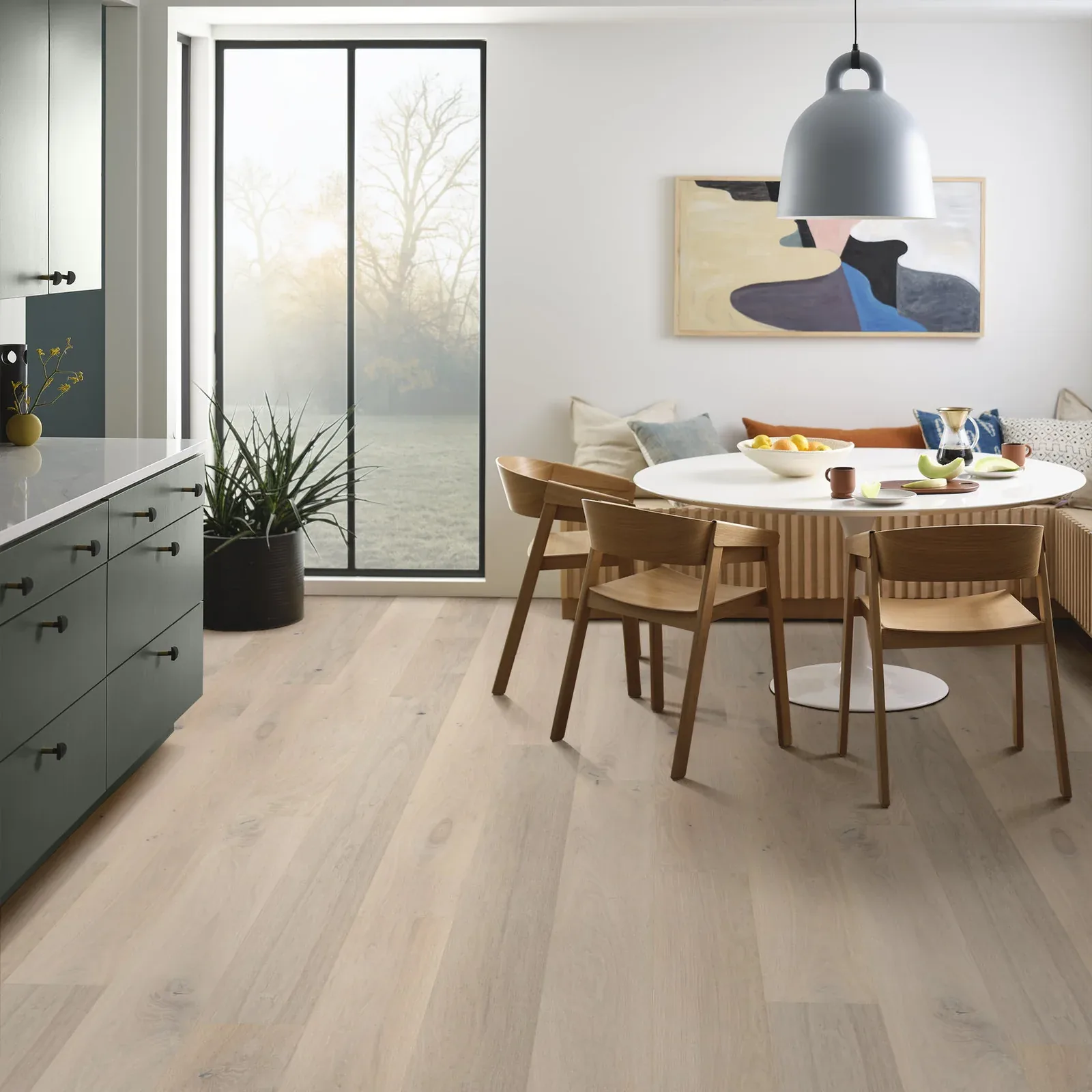
The lighter and more modern you go, the more oak tends to win. Pale hickory is lovely, but its contrast gets louder as the stain gets lighter, while white oak stays soft and even. Go darker and more rustic, and hickory starts to pull ahead.
How to decide
- Rank what matters most: dent resistance and hiding wear point to hickory; a calm, consistent look points to oak.
- Look at your room: busy, casual and rustic leans hickory; modern, light or traditional leans oak.
- Pick the veneer and texture next: they decide refinishing and how wear shows more than species does.
- Compare a matched pair: Exploration, Sanctuary or Reflections from Shaw, where species is the only real difference, or Transcendence and Coast to Coast from Anderson Tuftex, a close pair with a thicker veneer on Transcendence.
- Order samples of both and look at them in your room, in daylight and at night. Our guide to comparing flooring samples walks through it.
Final Word
Hickory vs oak flooring isn't really a question of better or worse. Hickory is the harder wood and the louder look, and it's hard to beat in a busy, casual home that wants a floor with personality. Oak is the steadier choice: softer, far more consistent, and at home in almost any style of room. In our catalog, matched hickory and oak floors cost nearly the same, and the wear layer and texture, not the species, decide whether a floor can be refinished.
If you're still torn, put a hickory and an oak sample from the same collection side by side on your floor. Order $5 samples; every sample dollar comes back as credit toward your order when you sign in at checkout with the same email you used for samples. For a larger project, use the "Email us for today's best price" button on any product page.
In this article
The floors from this guide

Shaw Hardwood
Sanctuary Hickory
Reunion
Samples are $5 each, credited back at checkout when you sign in.

Shaw Hardwood
Sanctuary Oak
Serenity
Samples are $5 each, credited back at checkout when you sign in.

Anderson Tuftex
Transcendence
Absolute
Samples are $5 each, credited back at checkout when you sign in.

Anderson Tuftex
Coast to Coast
Cabana
Samples are $5 each, credited back at checkout when you sign in.
Next steps
Planning a new floor? Get our Flooring Buyer’s Guide.
Measuring, how much to order, a subfloor checklist, LVP vs. engineered hardwood, and how to read the specs — in one short PDF.
Get the Free GuideWhere to look next
Common questions
Frequently Asked Questions
Is hickory harder than oak?
Yes. In the USDA Forest Products Laboratory's Wood Handbook, pecan hickory has a side hardness of 1,820 lbf at 12% moisture, against 1,360 lbf for white oak and 1,290 lbf for northern red oak. That makes hickory about a third harder than white oak and about 40% harder than northern red oak at resisting dents. Hardness measures denting, not scratching: on a prefinished floor, everyday scratches land in the factory finish, and the species underneath doesn't change that much.
Is hickory or oak better for dogs and kids?
Hickory, by a margin, if dents are your worry: it is the harder wood, and its strong color variation and the wire-brushed or scraped textures it usually comes in hide marks well. Oak is still a good family floor, especially white oak with a textured surface. Neither species is scratch-proof, and the Shaw and Anderson Tuftex residential hardwood warranties don't cover scratches and dents, including those from pet claws. If you have large dogs or standing water is a real risk, look at waterproof vinyl plank instead.
Is hickory flooring more expensive than oak?
Not in our catalog when you compare like for like. In the three Shaw collections we carry in both species, with the same width, thickness, veneer, texture and finish, the hickory and oak versions are within 30 cents a square foot of each other, and the gap goes both ways: Exploration and Sanctuary hickory cost 30 cents more than their oak twins, and Reflections Hickory costs 10 cents less than Reflections White Oak. What moves the price is the style itself, such as plank thickness, width and brand tier, far more than species.
Does hickory or oak hide scratches better?
Hickory usually does, because its light and dark boards and busy grain break up what your eye sees. Oak's more even color shows a scratch sooner, especially in a smooth, low-gloss finish. Texture matters as much as species: a wire-brushed or scraped surface hides wear better than a smooth one in either wood.
Can engineered hickory or oak be refinished?
That depends on the wear layer, not the species. The National Wood Flooring Association says a floor generally shouldn't be sanded if the wear layer is less than 3/32 inch (about 2.5 mm), and that wire-brushed, scraped and distressed floors are extremely difficult to sand and often can't be. A 1.2 mm Shaw Repel floor, hickory or oak, is a recoat floor, not a sanding floor. If refinishing matters to you, look at a thicker veneer and have a professional assess it before you count on sanding.
Should I choose white oak or hickory?
Choose hickory if you want the harder wood and a lively, rustic look with big swings in color. Choose white oak if you want a calmer, more consistent floor that suits modern, transitional and traditional rooms alike. In our catalog, Anderson Tuftex's Transcendence hickory and Coast to Coast white oak are a close pair: both 7.48 inches wide, wire-brushed and the same price per square foot. Transcendence has the thicker 3 mm veneer; Coast to Coast's 2 mm is under the National Wood Flooring Association's sanding line.
Referenced in this guide
Sources
Wood Handbook: Wood as an Engineering Material — Chapter 5, Mechanical Properties of Wood (Table 5-3b, side hardness)
USDA Forest Service, Forest Products Laboratory (FPL-GTR-282) · Accessed 2026-08-03
https://www.fpl.fs.usda.gov/documnts/fplgtr/fplgtr282/chapter_05_fpl_gtr282.pdfSanctuary Oak (SW714) product page
Shaw Floors · Accessed 2026-11-22
https://shawfloors.com/en-us/hardwood/sanctuary-oak-hearth-6-38-in-12-mm-oak-wirebrushed-25-4-sq-ft-carton-/sw714-05093Residential Repel Hardwood Limited Warranty (rev. 05/31/2024)
Shaw Industries, Inc. · Accessed 2026-10-10
https://pdmsview.shawinc.com/viewer/document/doc/9128Hardwood Limited Residential Warranty (Anderson Tuftex, rev. 06/14/2024)
Shaw Industries, Inc. (Anderson Tuftex) · Accessed 2026-10-10
https://pdmsview.shawinc.com/viewer/document/doc/22123Wood Flooring Sand and Finish Guidelines (2016), pp. 19 and 25
National Wood Flooring Association · Accessed 2026-10-10
https://www.oldewoodltd.com/uploads/nwfa-sand-finish-wood-floors-2016.pdfNWFA Launches Engineered Wood Flooring Refinishable Program (Hardwood Floors magazine, Aug/Sept 2022)
National Wood Flooring Association · Accessed 2026-10-10
https://nwfa.org/wp-content/uploads/2022/09/HFM_AugSept22_final_refinishable_small.pdf
Related Posts
Keep Reading
How to Match New Hardwood to an Existing Floor (Even If It's Discontinued)
10 min read
Shaw Hardwood Buying Guide: Repel, The Gallery and Expressions (2026)
9 min read
What Is the Best Flooring for Stairs? Hardwood, LVP and the Stair Nose (2026)
13 min read
Herringbone Flooring Guide: What Makes the Pattern Premium (2026)
8 min read
Keep browsing