
Best Flooring for Condos: Meeting Your HOA's Sound (IIC) Requirement (2026)
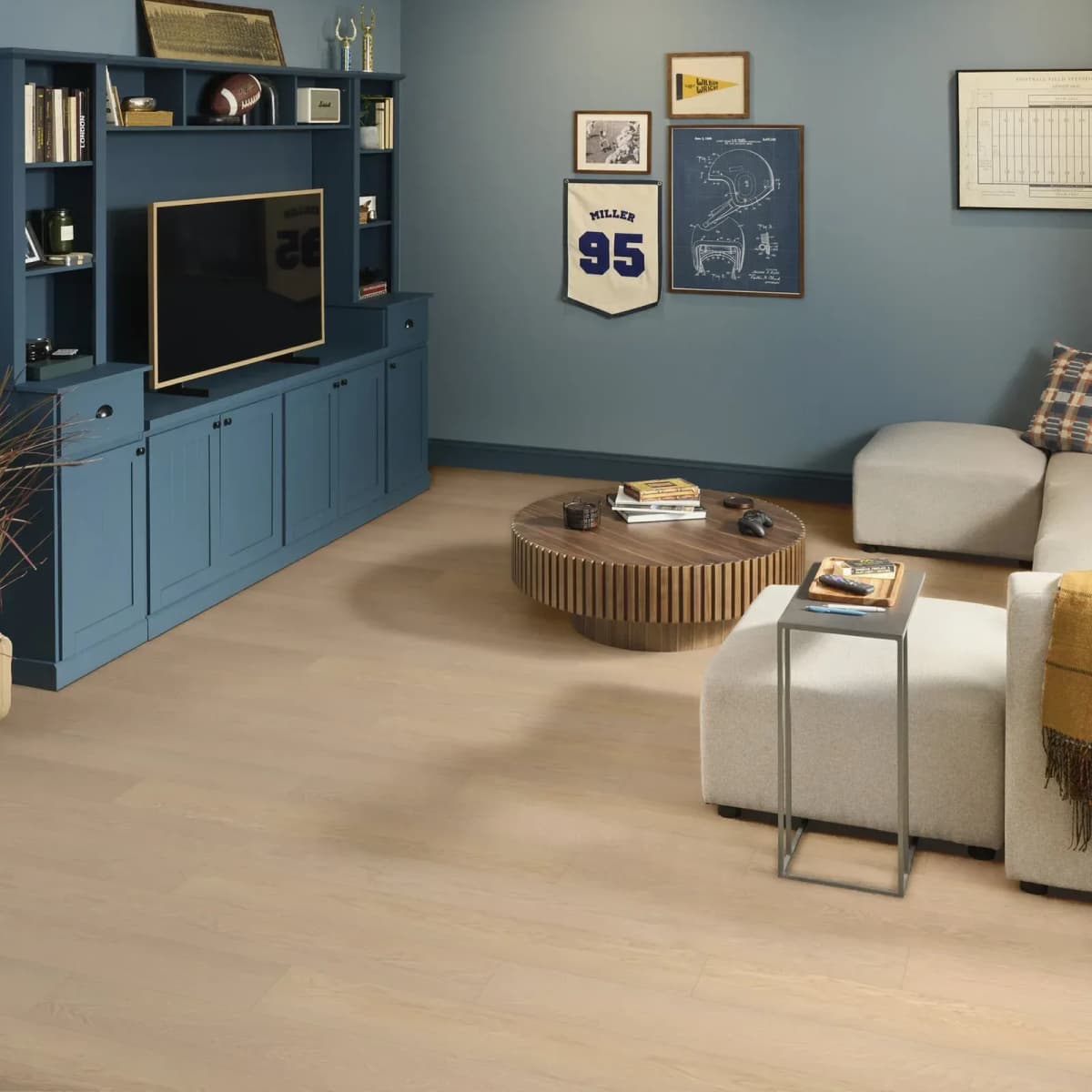
Floor names link to their product pages in a new tab.
The best flooring for condos has to clear a test most houses never set: someone else has to approve it. You found the floor. Then the property manager emailed back one sentence: any hard-surface flooring installed above the ground floor must achieve a minimum IIC rating of 70.
So you go looking for a plank with an IIC of 70, and the search falls apart. Some product pages print an IIC, many say nothing about sound, and none can tell you what your floor will score in your building. Meanwhile the board wants documentation before it approves the job, and you can't order a freight shipment on a guess.
Here's the part that changes the search: you're not looking for the wrong plank — you're looking for the wrong kind of number. IIC doesn't describe a plank. It describes a slab or joists, the ceiling below, any underlayment, and the floor, tested as one sandwich — and your building is its own sandwich. Once that clicks, the approval gets easier to win.
Quick answer: IIC (Impact Insulation Class) rates how well a whole floor-ceiling assembly — slab or joists, ceiling, underlayment and floor, tested together — keeps footstep noise out of the unit below. No plank has one of its own, and our product pages print none. Get your HOA's requirement in writing first: the number, lab or field test, and any mandated underlayment. On a concrete slab, shortlist floors with an attached pad: on a bare slab in Shaw's lab tests, padded vinyl floors outscored an unpadded one, while SPC and WPC planks tested a point apart. Over wood joists with a sound mat and a finished ceiling, padded and unpadded floors tested within a point, so ask about the ceiling and subfloor first. If your number is 70, no hard floor in Shaw's published lab data reached it (the best, 66, had a drop ceiling below); carpet on a bare slab tested 85. Choose the core for feel — our WPC shortlist includes COREtec Originals Enhanced CR501 and Shaw's Titan HD Plus Platinum — then submit the manufacturer's documentation for approval before you order.
Why a condo floor is a paperwork problem before it's a shopping problem
In a single-family house, flooring is a taste decision with a budget attached. In most condos and co-ops there's a second gate: someone else approves what you install, because the thing under your floor is somebody's ceiling. That gate lives in the association's rules or a hard-surface flooring policy — a required sound rating, sometimes a mandated underlayment, a submittal before work starts. Get approval after the floor is down and you're negotiating from the worst possible position: floor installed, neighbor complaining, freight order you can't casually send back.
IIC and STC in plain English
IIC — Impact Insulation Class. Structure-borne noise: footsteps, dropped keys, a chair scraped back, dog nails. The energy goes into the floor and radiates out of the ceiling below. Higher numbers mean less noise reaches the neighbor. The International Building Code sets a minimum for floors between dwelling units of IIC 50 in a lab test, or 45 in a field test;Source 1 an association can require more.
STC — Sound Transmission Class. Airborne noise: conversation, television, music, a barking dog. Same direction of travel, different mechanism — through the air first, then into the assembly. Also higher-is-better.
Hard-surface rules center on IIC because impact is the noise a floor changes. On the same bare 6-inch concrete slab — no ceiling below — in Shaw's lab data, carpet and a padded vinyl plank tested two points apart on STC (53 and 51) and 33 points apart on IIC (85 and 52).Source 2Source 3
You'll also see field ratings such as FIIC and FSTC, measured in a finished building rather than a lab and expected to run lower on the same construction. The code's own field-test minimum is 45, against IIC 50 in the lab.
IIC belongs to the assembly, not the plank
An IIC test doesn't put a plank on a machine. The method is ASTM E492 — Standard Test Method for Laboratory Measurement of Impact Sound Transmission Through Floor-Ceiling Assemblies Using the Tapping Machine — and the title is the whole lesson.Source 4 A lab builds an assembly: a structural deck, whatever ceiling hangs below it, if any, any underlayment, and the finish floor on top. Then a standardized machine taps the floor with metal hammers while a receiver in the room below measures what gets through.Source 5
Change a layer and the number can move, sometimes a lot. The plank is one variable in an assembly of four or more. In Shaw's lab data, the same 2 mm glue-down vinyl on the same underlayment and 6-inch slab tested IIC 52 with nothing below and 66 with a drop ceiling under it.Source 6Source 7
Shaw hosts an Intertek acoustical test report covering "5 mm Luxury Vinyl Tile with 1 mm Integrated Foam" — a generic construction, not a style name you could order — glued over a poly sheet on a bare 203 mm (8-inch) concrete slab, reporting STC 56 and IIC 59 for that specimen in that condition.Source 4 The lab's own fine print: the results are relevant only to the sample tested, and the report is not a certification of the product.
So when a flooring page advertises "IIC 71," ask for the report behind it and compare its slab and ceiling with yours. The number isn't necessarily false. It just isn't portable.
There's a second measurement worth knowing: the improvement a covering adds over the same concrete slab left bare, reported as delta-IIC (ΔIIC) under ASTM E2179.Source 6 It's a concrete-floor test: on a slab it isolates the flooring's contribution — the fairer question to put to a manufacturer — but it doesn't carry over to a wood-frame floor.
What our product pages tell you — and what they don't
What our LVP product pages publish: wear layer in mils, core type (SPC or WPC) from the manufacturer's per-style spec data, the attached pad — named by type on most styles, with its thickness where the manufacturer states it — plus plank dimensions, overall thickness, finish, and warranty.
What they don't publish: any sound rating. The manufacturer data behind these pages carries none — its test results cover areas like static load, slip resistance, and flammability — so we leave the row off rather than invent one, the same way we leave the Core Type row off when we can't confirm the core. A number we can't source is worse than no number here: you'd take it to your board, and your board would take it seriously.
What we can do is pull the manufacturer's documentation for the exact style — spec sheet, installation instructions, warranty, and whatever acoustic documentation exists. Open the "Email us for today's best price" form on that style's product page — it fills in the style and color — and ask for the acoustic documentation in its Project notes box.
What to get from your HOA before you shop
Ask for all of it in one email, before you fall in love with a color.
- The exact requirement, quoted from the governing documents. Not "around 60" — the number, and the section it comes from.
- Lab rating or field test? If a field test after installation is required, ask who arranges it, who pays, and what happens if it comes in short.
- Is a specific underlayment mandated? If so, get the brand, model, and thickness — not just "an acoustic mat."
- What counts as proof? A spec sheet, a test report naming the assembly, or a full submittal with product data and a sample? This decides what you have to gather.
- Are there restrictions beyond the rating? Some documents also require rugs over a percentage of the floor, or prohibit hard surface in certain rooms entirely.
- Who approves, and how long does it take? A board that meets monthly is a schedule constraint on the whole project.
- How will approval be issued? Ask for it in writing, naming the specific style — "Approved: COREtec Originals Classics VV024, Foxbury Oak" protects you in a way "approved for LVP" does not.
Best flooring for condos: where your choice moves the needle
None of that means your choice doesn't matter. Two specs printed on our product pages count here — one for the unit below, if your building is concrete, and one for how the floor feels to you.
The attached pad. A cork or foam pad factory-bonded to the back of the plank puts a resilient layer between the plank and the subfloor. On a bare concrete slab, padded floors outscored an unpadded one: on the same 6-inch slab, two 5 mm glue-down vinyl floors — one with no pad, one with a foam pad built into its backing — tested IIC 43 and 56; floated SPC and WPC planks with attached foam pads tested 51 and 52 on that slab.Source 8Source 9Source 10Source 3 Over wood joists it's a different story: Shaw tested a 5 mm glue-down vinyl without a pad and one with a foam pad built in over three wood-frame floors, each with a gypsum topping on a sound mat and a finished ceiling below; the pairs came out 57 and 58, 58 and 58, 55 and 55.Source 11 Thicker pads add cushion; how many points each millimeter buys is a question for the manufacturer's acoustic testing, if any. On a concrete slab, the pad is the first spec to read (Shaw's slab tests had no ceiling below; a ceiling or sound mat can narrow the gap, as it did over joists). Over joists with a sound mat and a finished ceiling, where the pairs tested within a point, ask about the ceiling and subfloor first.
The core. A foamed WPC core has air pockets by design, so it flexes slightly and feels softer underfoot than dense SPC. When a WPC floor is sold as "quieter," check what was measured: for the unit below, Shaw's tests put the two cores a point apart — the floated 5 mm SPC and 8 mm WPC planks above.Source 10Source 3 SPC wins on dent resistance and thinness; WPC wins on comfort underfoot. Our SPC vs WPC guide maps both cores onto the floors we carry. Choose the core for how you want the floor to feel.
In the COREtec floors we carry, the two travel together. The pad is a floor-by-floor spec, not a tier one, but in those floors every pad thicker than 1.2mm is on a WPC floor:
| Floors | Core | Attached pad |
|---|---|---|
| VV017, VV492, VV800, VV840, VV870 | SPC | 1mm cork |
| VV491, VV488 | SPC | 1.2mm cork |
| VV585, CR502, VV704, VV735 | WPC | 1mm cork |
| CR501, VV012, VV023, VV024, VV034, VV035, VV845, VV872 | WPC | 1.5mm cork |
| CR504 | WPC | 2mm cork |
| CR500, CR506, CR507, VV457, VV458, VV662, VV855 | WPC | 3mm cork |
| VV810, VV820, VV880 | WPC | 3.5–3.75mm Soft Step pad |
| Shaw LVP (varies by style) | SPC or WPC | Attached pad: EVA, IXPE, XPO or foam where Shaw names the type |
The comfort-core shortlist
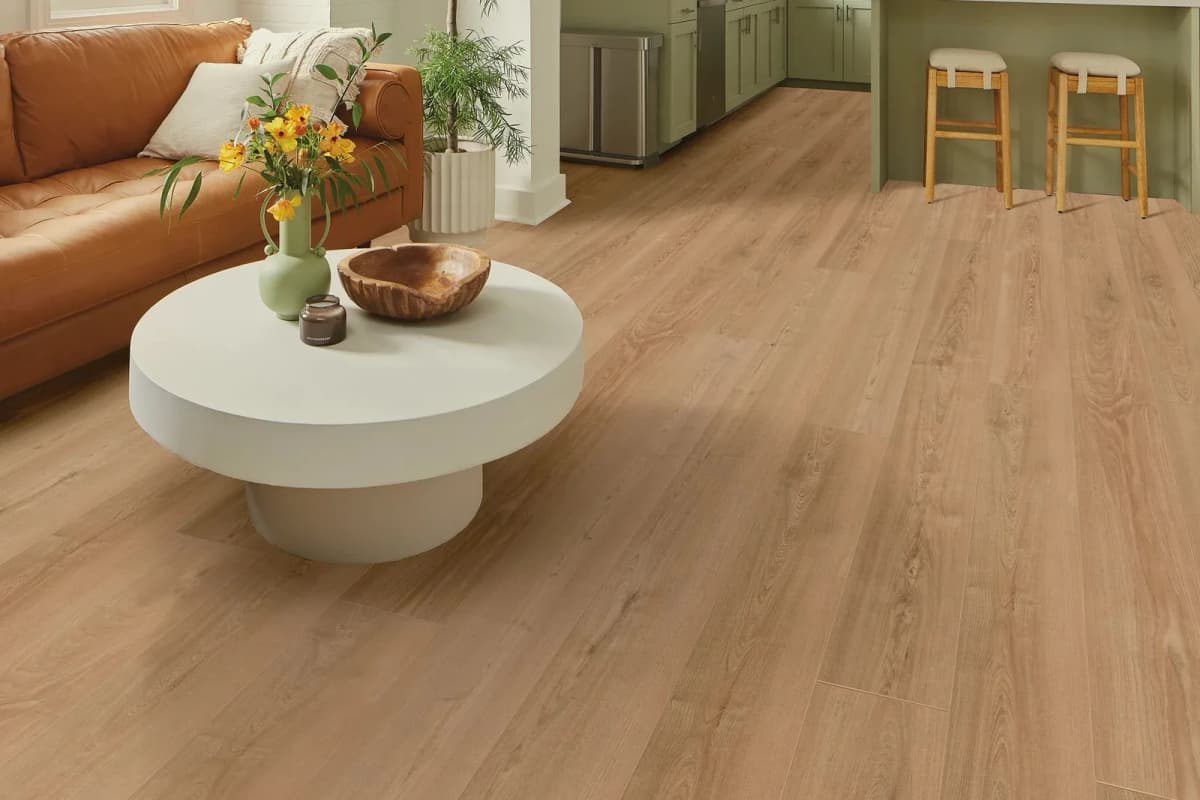
We carry 32 styles that are WPC with an attached pad and at least a 20 mil wear layer; these five are a starting point, not the only ones, and the least expensive style that clears that bar is Shaw Ignite at $4.19. Prices are the manufacturer's advertised price (MAP) per square foot. Lower prices may be available — request a quote by email using the "Email us for today's best price" form on any product page.
| Style | Price | Core | Attached pad | Wear layer |
|---|---|---|---|---|
| COREtec Originals Enhanced CR501 | $5.89/sq ft | WPC | 1.5mm cork | 22 mil |
| COREtec Originals Classics VV024 | $6.29/sq ft | WPC | 1.5mm cork | 20 mil |
| COREtec Originals Classics VV023 | $6.39/sq ft | WPC | 1.5mm cork | 20 mil |
| Shaw Titan HD Plus Platinum | $6.79/sq ft | WPC | Attached IXPE | 30 mil |
| COREtec Originals Premium VV457 | $9.09/sq ft | WPC | 3mm cork | 30 mil |
Where each one fits. CR501 is the least expensive of these five. The two Originals Classics styles are one construction in two widths — VV023 a 5-inch plank, VV024 a 7-inch — so pick by proportion. Titan HD Plus Platinum pairs a 30 mil wear layer with a WPC build at $6.79; its IXPE pad's thickness isn't in Shaw's spec data, so ask. VV457 pairs the thickest attached cork we carry, 3mm, with 30 mil.
On a concrete slab, if you'd rather shop the pad itself, CR504 carries 2mm of cork at $5.39, and CR506 and CR507 match VV457's 3mm cork and 30 mil at $8.19. The Soft Step floors we carry — VV810, VV820 and VV880, $8.69–$8.89 — have a 3.5–3.75mm pad that COREtec calls "70% quieter than other wood-look floors"; on those floors' own pages it reads "70% higher absorption."Source 12Source 13 Absorption describes sound in the room you're standing in, not the impact sound IIC measures below you,Source 14Source 5 so if your HOA needs a rating, ask us for any test report behind it.
When carpet — or a mandated underlayment — changes the answer
Two situations where the answer isn't only a plank.
When carpet is the better tool. If your bedroom sits over a neighbor's bedroom, carpet with a good pad is in a different league. On the same bare 6-inch slab in Shaw's lab data, cut-pile carpet over a rebond pad tested IIC 85; the padded vinyl planks above tested 51 and 52, and engineered hardwood landed in the same range — 50 glued down, 53 floated over a 2 mm foam underlayment.Source 2Source 15Source 16 If your number is 70, no hard floor in Shaw's lab data reached it; the closest, 66, had a drop ceiling below.Source 11 We don't sell carpet, so there's nothing in it for us to say so: where the association is strict and it's a quiet-hours room, carpet is the low-conflict answer. You can also split it — hard surface in the living areas, carpet in the bedrooms.
When the HOA mandates a separate acoustic underlayment. The caution in our attached underlayment guide stands — COREtec's own guide warns that soft underlayment "will compromise the product's locking ability."Source 17 But the installation instructions set a limit rather than a ban. The guides for every floor on the shortlist — COREtec's Originals WPC guide and Shaw's Floorté WPC guide — state that a second underlayment is allowed under any currently sold resilient product with attached underlayment in a residential application, provided it's no more than 3 mm thick.Source 17Source 18
Read the next sentence of that same paragraph before you buy an acoustic mat, though: IIC and STC lab testing on certain resilient products, with and without a second layer of underlayment, does not to date indicate that a second underlayment provides additional acoustic benefit.Source 17 If your association requires one anyway, treat it as a compliance item, not an upgrade. That finding is also why we don't sell a second pad for attached-pad floors: over a concrete slab, the one extra layer we pair with them is a 6-mil poly film — moisture protection, not cushion — which COREtec's SPC guide requires for floating over concrete and its WPC guide provides for.Source 19Source 17
So if your HOA names an underlayment:
- Get the exact product name and thickness, and check it against that 3 mm ceiling.
- Check the installation instructions for the exact style — not the collection, the style — and confirm the paragraph above is in them; COREtec's Soft Step guide, for one, doesn't include it.Source 20
- Get the answer in writing before anyone opens a carton.
- If the documents conflict — a mandated 6 mm mat under a product capped at 3 mm — tell your association before you order. A requirement that puts the install outside the manufacturer's instructions isn't one to quietly comply with.
Four mistakes that cost condo owners real money
- Ordering before approval. Flooring ships freight; it is not a casual return.
- Treating "has cork" as compliance. Padded floors scored higher on a bare slab in Shaw's tests, but a pad isn't a rating. Don't present it as one; submit what your association says counts as proof.
- Borrowing someone else's ceiling. A published IIC comes with its lab's slab and ceiling; compare them with yours.
- Skipping the expansion gap. A floating floor pinched at the walls can buckle — a repair, not a return. Follow the manufacturer's gap spec at every wall and fixed object; COREtec's is 1/4 inch in areas under 2,500 sq ft.Source 17
The approval workflow, in order
- Email your HOA or property manager and get the seven answers above in writing.
- Shortlist two or three styles — on a concrete slab, read the attached pad first; choose the core for feel.
- Order $5 samples of the shortlist and live with them in the room for a day or two.
- Ask us for the documentation on your pick: spec sheet, installation instructions, warranty, and any acoustic documentation the manufacturer publishes.
- Submit the package — with a sample, if your association asks for one — and get written approval naming the style.
- Order the floor, and hand your installer the installation instructions along with the HOA's rules — underlayment, gaps, and install method all have to match what you submitted.
Final word
The condo sound requirement feels impossible mostly because it's phrased as a question about a product when it's really a question about an assembly. No plank has an IIC. Your floor-ceiling assembly has one, and your flooring is one layer in it: the layer you control, never the whole rating. On a bare slab in Shaw's tests, the padded floors scored higher.
Get the requirement in writing, get the manufacturer's documentation for the exact style, and get the approval — before you order. We'll pull the paperwork for any style we carry; we'd much rather send you a spec sheet than a return authorization.
When you order $5 samples, the full $5 per sample comes back as credit toward your order when you sign in at checkout with the same email you used for samples — the credit applies automatically then, and it never expires (guests checking out anonymously don't get it, so sign in). Samples ship by parcel, usually FedEx; full orders ship freight from Dalton, Georgia, with free shipping when the flooring on your order comes to $1,799 or more. LTL freight is curbside delivery, and the carrier calls ahead to schedule a delivery window.
Start with the shortlist above, or browse COREtec LVP, Shaw LVP, or the full luxury vinyl plank catalog, order $5 samples, and ask for the documentation in the quote form's Project notes box so it's moving while they ship.
In this article
The floors from this guide

COREtec Floors
COREtec Originals Enhanced 9x72 CR501
Saffron Pecan
Samples are $5 each, credited back at checkout when you sign in.

COREtec Floors
COREtec Originals Classics VV024
Foxbury Oak
Samples are $5 each, credited back at checkout when you sign in.

COREtec Floors
COREtec Originals Classics VV023
Gold Coast Acacia
Samples are $5 each, credited back at checkout when you sign in.

COREtec Floors
COREtec Originals Premium VV457
Grandure Oak
Samples are $5 each, credited back at checkout when you sign in.
Common questions
Frequently Asked Questions
What IIC rating do I need for a condo?
Whatever number your HOA's governing documents state — there is no universal answer. The International Building Code sets a minimum for floors between dwelling units — IIC 50 in a lab test, or 45 in a field test — and an association can write a stricter number into its rules, so the requirement varies by building. The more important half: IIC is an assembly rating. It describes a whole floor-ceiling sandwich — the structural slab or joists, the ceiling below, any underlayment, and the finish floor — tested together, not a plank on its own. So 'I need IIC 70' really means an assembly like yours — same slab or joists, same ceiling — has to reach 70 on the rating your HOA names, either a lab report or a field test of your finished floor. Get the requirement from your HOA in writing, including whether they want a lab rating or a field test, and whether a specific underlayment is mandated.
Does luxury vinyl plank meet condo sound requirements?
It can — but the plank alone never decides it, because the rating belongs to the assembly. On the same bare 6-inch slab in Shaw's lab data, two 5 mm glue-down vinyl floors — one with no pad, one with a foam pad built into its backing — tested IIC 43 and 56, and floated SPC and WPC planks with attached foam pads tested 51 and 52. Over three wood-joist floors with a sound mat and a finished ceiling, a padded and an unpadded 5 mm glue-down vinyl tested within a point of each other. Whether your floor meets your building's number also depends on the slab or joists and the ceiling in the unit below — and under a floor that already has an attached pad, COREtec's and Shaw's guides report that lab testing on certain products to date doesn't indicate an added acoustic benefit from a second underlayment. Ask us for the manufacturer's spec sheet and any acoustic documentation for the exact style, submit it to your HOA, and get written approval before you order.
Is attached cork underlayment enough to satisfy an HOA?
Sometimes — it depends on what your association accepts as proof, and no one can tell you in advance without knowing your building. Attached cork is a resilient layer between the plank and the subfloor. In Shaw's tests, padded vinyl floors (foam pads; no cork-backed floor is in that data) outscored an unpadded one on a bare concrete slab, while over wood joists with a sound mat and a finished ceiling, padded and unpadded floors tested within a point — but 'has cork' is not a rating. Your association decides what counts: a manufacturer spec sheet showing the pad, a test report naming the assembly, a specific separate underlayment by brand and model, or a field test after installation. The question isn't whether cork helps; it's what your association will accept as proof. Ask them that question first, in writing.
Can I add an acoustic underlayment under LVP that already has an attached pad?
Often yes, within a limit — and the installation instructions for your exact style are the authority, not a rule of thumb. COREtec's Originals WPC guide and Shaw's Floorté WPC guide allow a second underlayment under any currently sold resilient product with attached underlayment in a residential application, as long as it's no more than 3 mm thick; COREtec's Soft Step guide doesn't include that allowance. The same paragraph is the part worth knowing before you spend the money: it states that IIC and STC lab testing on certain resilient products, tested with and without a second layer of underlayment, does not to date indicate that a second underlayment provides additional acoustic benefit. So if your HOA mandates a mat, treat it as a compliance item, not an upgrade — and if the mandated product is thicker than the instructions allow, raise the conflict with your association before you order.
Referenced in this guide
Sources
International Building Code 2021 — Section 1206.3 Structure-borne sound
International Code Council · Accessed 2026-09-26
https://codes.iccsafe.org/content/IBC2021P2/chapter-12-interior-environment#IBC2021P2_Ch12_Sec1206.3Acoustical Performance Test Report — ASTM E90, E492 and E2179 on 25 oz Cut Pile Carpet on 183PD Rebond Carpet Pad over a 152 mm (6-inch) concrete slab (Report No. G5871.17-113-11-R1)
Intertek Building & Construction (issued to Shaw Industries, Inc.) · Accessed 2026-09-26
https://shawfloors.widen.net/s/8ttbzrb9wc/g5871.17-113-11-r1-25-oz-cut-pile-carpet-on-rebond-pad-6-inch-slabAcoustical Performance Test Report — ASTM E90 and E492 on 8 mm WPC with Integrated Foam Underlayment over a 152 mm (6-inch) concrete slab (Report No. H6836.83-113-11-R0)
Intertek Building & Construction (issued to Shaw Industries, Inc.) · Accessed 2026-09-26
https://shawfloors.widen.net/s/kjktqcprmj/h6836.83-113-11-r0Shaw Industries Inc. Acoustical Performance Test Report — ASTM E90 and ASTM E492 on 5 mm Luxury Vinyl Tile with 1 mm Integrated Foam (Report No. J6394.27-113-11-R1, rev. 10/13/2020)
Intertek Building & Construction (issued to Shaw Industries, Inc.) · Accessed 2026-08-19
https://shawfloors.widen.net/s/csvxqtrnb2/j6394.27-113-11-r1Sound Solutions — impact sound, IIC, and the Sound Advisor floor-assembly tool
Shaw Industries (Shaw Property Solutions) · Accessed 2026-08-19
https://shawpropertysolutions.com/c/solutions-sound-solutionsAcoustical Performance Test Report — ASTM E90, E492 and E2179 on 2 mm LVP Direct Glue on Shaw 157VS GroundWorks Underlayment over a 152 mm (6-inch) concrete slab (Report No. G5871.16-113-11-R1)
Intertek Building & Construction (issued to Shaw Industries, Inc.) · Accessed 2026-09-26
https://shawfloors.widen.net/s/cbktlzssqv/g5871.16-113-11-r1-2mm-lvp-diret-glue-on-groundworks-6-inch-slabAcoustical Performance Test Report — ASTM E90 and E492 on 2 mm LVP Direct Glue on Shaw 157VS GroundWorks Underlayment over a 152 mm (6-inch) concrete slab with drop ceiling (Report No. G5872.16-113-11-R0)
Architectural Testing, Inc., an Intertek company (issued to Shaw Industries, Inc.) · Accessed 2026-09-26
https://p.widencdn.net/ixys9h/Intertek-g5872.16-113-11-r0-2mm-LVP-Direct-Glue-with-Groundworks---6-in.-slab-drop-ceilingAcoustical Performance Test Report — ASTM E90, E492 and E2179 on 5 mm LVP Direct Glue over a 152 mm (6-inch) concrete slab (Report No. G5871.23-113-11-R1)
Intertek Building & Construction (issued to Shaw Industries, Inc.) · Accessed 2026-09-26
https://shawfloors.widen.net/s/xtwlqjpmrr/g5871.23-113-11-r1-5mm-lvp-direct-glue-6-inch-slabAcoustical Performance Test Report — ASTM E90, E492 and E2179 on 5.0 mm LVT with Integrated Underlayment, Direct Glue, over a 152 mm (6-inch) concrete slab (Report No. P6879.15-113-11-R0)
Intertek Building & Construction (issued to Shaw Industries, Inc.) · Accessed 2026-09-26
https://shawfloors.widen.net/s/nc2hlnj7v7/p6879.15-113-11-r0Acoustical Performance Test Report — ASTM E90 and E492 on 5 mm SPC with Integrated Foam Underlayment over a 152 mm (6-inch) concrete slab (Report No. H6836.81-113-11-R0)
Intertek Building & Construction (issued to Shaw Industries, Inc.) · Accessed 2026-09-26
https://shawfloors.widen.net/s/mwjhrhvkmc/h6836.81-113-11-r0Sound Advisor — lab IIC and STC results by floor assembly and flooring
Shaw Industries Group, Inc. · Accessed 2026-09-26
https://multifamily.soundadvisor.com/Say Hello To Soft Step
COREtec (Shaw Industries, Inc.) · Accessed 2026-09-26
https://www.coretecfloors.com/en-us/soft-stepConch Ash LVP Flooring — COREtec Originals Premium VV810
COREtec (Shaw Industries, Inc.) · Accessed 2026-09-26
https://coretecfloors.com/en-us/products/coretec-originals-premium/conch-ash-vv810-01024Sound Absorption — SAA, Sound within the room: Absorbed vs Reflected (technical bulletin)
Shaw Industries, Inc. · Accessed 2026-09-26
https://pdmsview.shawinc.com/viewer/doc/16551Acoustical Performance Test Report — ASTM E90, E492 and E2179 on 0.5-inch Ply Core Engineered Hardwood, glued, over a 152 mm (6-inch) concrete slab (Report No. J5587.07-113-11-R2)
Intertek Building & Construction (issued to Shaw Industries, Inc.) · Accessed 2026-09-26
https://shawfloors.widen.net/s/vzmkjctvm5/j5587.07-113-11-r2Acoustical Performance Test Report — ASTM E90, E492 and E2179 on 0.5-inch Ply Core Hardwood over 2 mm Polyolefin Foam Underlayment over a 152 mm (6-inch) concrete slab (Report No. Q7827.66-113-11-R0)
Intertek Building & Construction (issued to Shaw Industries, Inc.) · Accessed 2026-09-26
https://shawfloors.widen.net/s/grgk5plvh9/q7827.66-113-11-r0Resilient Installation Guidelines for WPC Products (COREtec Originals, rev. 03/01/2022)
Shaw Industries, Inc. (USFloors / COREtec) · Accessed 2026-09-26
https://pdmsview.shawinc.com/viewer/document/doc/11746Resilient Installation Guidelines for WPC Products — Floorté and Floorté Plus (Shaw, rev. 03/18/2021)
Shaw Industries, Inc. · Accessed 2026-09-26
https://pdmsview.shawinc.com/viewer/document/doc/3881Resilient Installation Guidelines for SPC Products (COREtec Pro, rev. 11/05/2024)
Shaw Industries, Inc. (USFloors / COREtec) · Accessed 2026-09-26
https://pdmsview.shawinc.com/USFloors/COREtec-Pro/Installation/Residential-Installation-Guidelines-for-SPC-ProducResilient Installation Guidelines for WPC Products with 5G Fold (COREtec Soft Step, rev. 08/09/2023)
Shaw Industries, Inc. (USFloors / COREtec) · Accessed 2026-09-26
https://pdmsview.shawinc.com/viewer/document/doc/30056
Related Posts
Keep Reading

Vinyl Plank Flooring Separating? Why It Happens and How to Fix It
12 min read
Can You Put Vinyl Plank Over Tile? What COREtec's and Shaw's Install Guides Say
11 min read
My Dog Ruined the Hardwood: Repair It, or Switch to Waterproof LVP?
13 min read

COREtec Tile & Stone Looks: The DIY Alternative to Ceramic and Porcelain (2026)
9 min read
Keep browsing