
Anderson Tuftex Tiers Compared: Entry vs Mid vs Premium (2026)
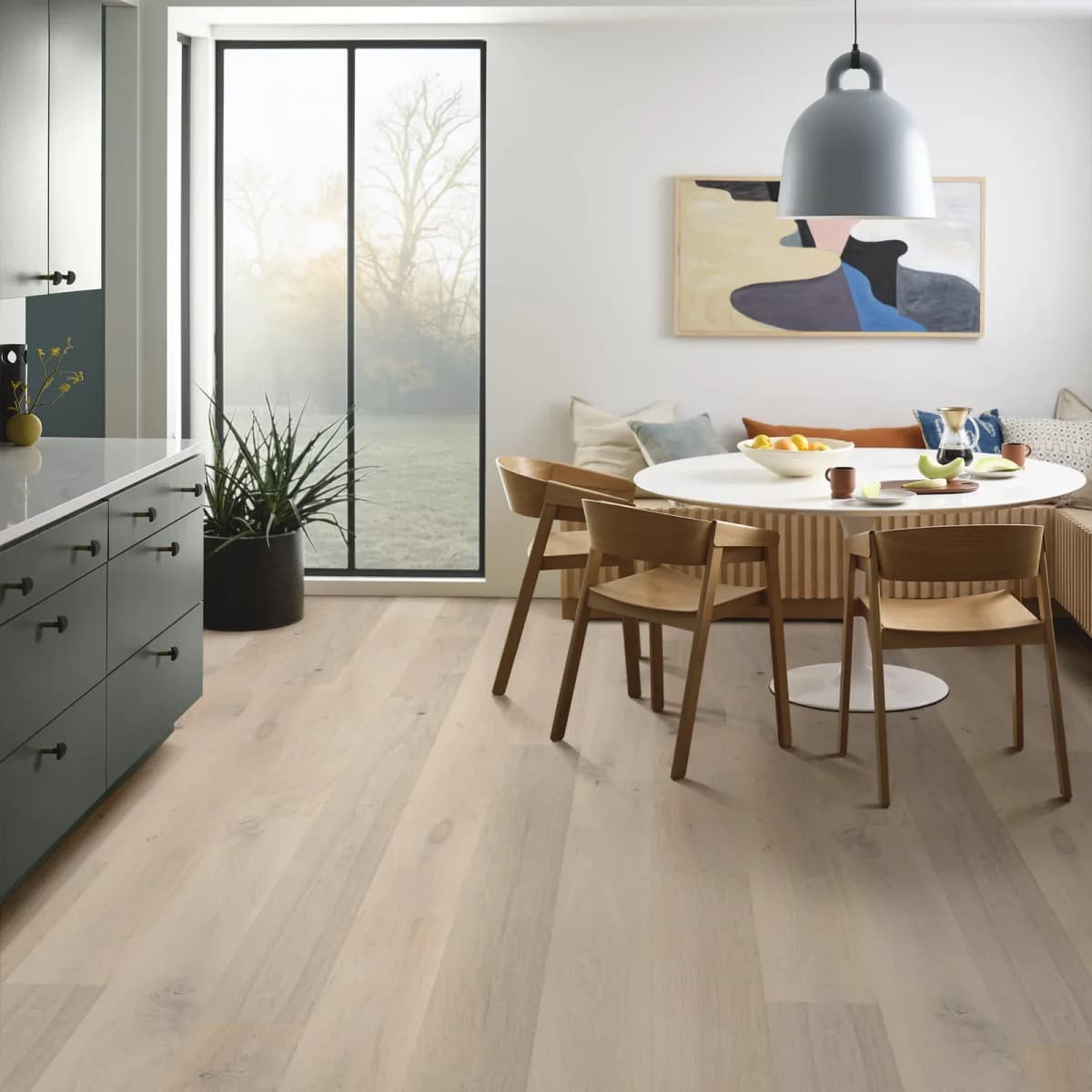
Floor names link to their product pages in a new tab.
Quick answer: No single tier wins — they win at different jobs. Entry ($7.79–$9.29/sq ft) is the budget wide-plank play, with refinishing only on Brasilia. Mid ($10.79–$12.19) has the most choices and the first 4mm styles. Upper-Mid ($12.59–$14.29) buys walnut, herringbone, and statement looks. Premium ($15.09–$21.99) is the forever-floor. Match the tier to how long you'll stay, not to the biggest number you can afford.
Anderson Tuftex sells 21 engineered hardwood styles across a $14-per-square-foot range. That spread is the whole problem: Confection starts at $7.79/sq ft and Provincial Parquet tops out at $21.99, and nothing on the page tells you which end of that ladder your home actually needs.
The catalog sorts into four tiers — Entry, Mid, Upper-Mid, and Premium — and each one is engineered for a different buyer, not just a different budget. Buy up-tier for a room you already plan to redo and you overspent. Buy down-tier for a floor you want to hand to the next owner and you'll regret it the first time a wear pattern appears in a hallway you can't refinish.
Full transparency: we're an authorized Anderson Tuftex dealer and we carry every style in all four tiers, so we have no reason to push you up or down the ladder — only onto the right rung. This is the tier-selection guide. If your question is the more basic one — whether Anderson Tuftex is worth its premium at all versus a standard-tier brand — that's answered separately in our Anderson Tuftex hardwood review. For the full per-style walkthrough, see the Anderson Tuftex buyer's guide. This post is about choosing between the tiers.
The Short Version: How the Four Tiers Compare
Every price below is the manufacturer's advertised price (MAP) per square foot; each product page shows that figure next to the full per-carton (box) total, so you can budget the whole room before you buy.
| Entry | Mid | Upper-Mid | Premium | |
|---|---|---|---|---|
| Price band (MAP) | $7.79–$9.29/sq ft ✓ | $10.79–$12.19/sq ft | $12.59–$14.29/sq ft | $15.09–$21.99/sq ft |
| Wear layer | 1.2–3mm | 1.8–4mm | 3–4.5mm | 4–6mm ✓ |
| Styles at 2.5mm or thicker (NWFA's refinishable minimum) | 1 of 5 | 5 of 8 | 6 of 6 ✓ | 2 of 2 ✓ |
| Species choice | oak, pecan, Brazilian oak | oak, hickory, walnut, ash ✓ | oak, ash, walnut | white oak only |
| Widest plank | 8.66" | 8.66" | 8.66" | 10.25" (Grand Estate) ✓ |
| Best value at 2.5mm or thicker | Brasilia $9.29/sq ft (smooth) | Artisan Oak $11.69/sq ft ✓ | Provincial Plank $12.89/sq ft | Grand Estate $15.09/sq ft |
| Thickest wear layer under $15 | 3mm | 4mm | 4.5mm (Revival Walnut) ✓ | — |
| Styles to choose from | 5 | 8 ✓ | 6 | 2 |
| Best fit | short stay · tight budget | most households | design-led · long-term | forever-floor |
The single most important line in that table is the 2.5mm row. Below 3/32 inch (2.5mm) of wear layer, the National Wood Flooring Association's guidelines say a floor should not be sanded,Source 1 so you're buying the factory finish for the life of the floor; at or above it, the floor can be sanded and refinished, though on a wire-brushed or distressed floor NWFA measures that line at the lowest point of the texture.Source 2 That line first appears at $9.29/sq ft (Brasilia), not at some luxury price point, and every Upper-Mid and Premium style has a face veneer above it. The second number worth circling: Grand Estate's 6mm wear layer at $15.09/sq ft is the thickest and widest plank Anderson Tuftex makes, which is why it, and not the $21.99 Provincial Parquet, is the tier's long-term value pick.
Four Specs That Decide Which Tier You Need
Anderson Tuftex's pricing isn't random. Four variables move a style up the ladder — understand them and the whole catalog becomes navigable.
1. Wear Layer and Refinishability
This is the master variable. The wear layer is the depth of real wood above the tongue-and-groove, and it dictates whether a floor can be sanded at all, and how much wood is left for future refinishes before you reach the engineered core.
Below 2.5mm, you're buying the factory finish for the life of the floor — Entry-tier styles like Imperial Pecan and Noble Hall (1.2mm) look beautiful on day one, but when the finish wears through in a traffic lane, the fix is replacement, not refinishing. At 2.5mm and up, measured at the lowest point on a textured floor, the National Wood Flooring Association counts a factory-finished floor as refinishable:Source 2 Brasilia (3mm) in the Entry tier, then Transcendence, Provincial Herringbone (both 3mm), Valencia Walnut (2.5mm), Artisan Oak and European Ash (both 4mm) in the Mid tier. Upper-Mid reaches 4.5mm (Revival Walnut), and Premium's Grand Estate tops out at 6mm. Most of those styles are textured: Transcendence, Provincial Herringbone, European Ash and Grand Estate are wire-brushed, and Artisan Oak is distressed. NWFA measures a textured floor's 2.5mm at the lowest point of the texture, and sanding it flat removes the texture,Source 1 so have a flooring professional measure the 3mm wire-brushed styles before you count on refinishing them. A thicker wear layer leaves more wood for future refinishes, but none comes with a fixed count: NWFA ties that to the wear layer left, the floor's flatness and the skill of the person sanding it.Source 1
The line that matters is 2.5mm. Below it you're choosing a color; at or above it you're choosing a floor that can be renewed. If you want that option, don't shop below it, and go to 4mm or more for the most wood to work with.
2. Plank Width and Thickness
Width is aesthetic; thickness is structural. Entry styles run 1/2"–9/16" thick and 7"–8.66" wide, with Natural Timbers Smooth at 8.66". The Mid tier thickens toward 5/8", and Ravenwood matches that 8.66" width. Upper-Mid runs 9/16"–5/8" thick and reaches 8.66" too, on Chateau Oak. Those three share the widest plank AT makes below Grand Estate. Premium's Grand Estate is the outlier at 3/4" thick and 10.25" wide on 11-ply construction.
Thicker, wider planks feel more substantial underfoot and generally handle radiant heat and subfloor movement better — but they're also more demanding to install, and the widest boards should be glued or nailed rather than floated. If a broad, seamless, gallery-floor look is the point of the project, an 8.66" board is available from the Entry tier up, and only Grand Estate goes wider.
Where the jump pays off: Premium. A 10.25" plank changes how a room reads in a way no color choice can.
3. Species
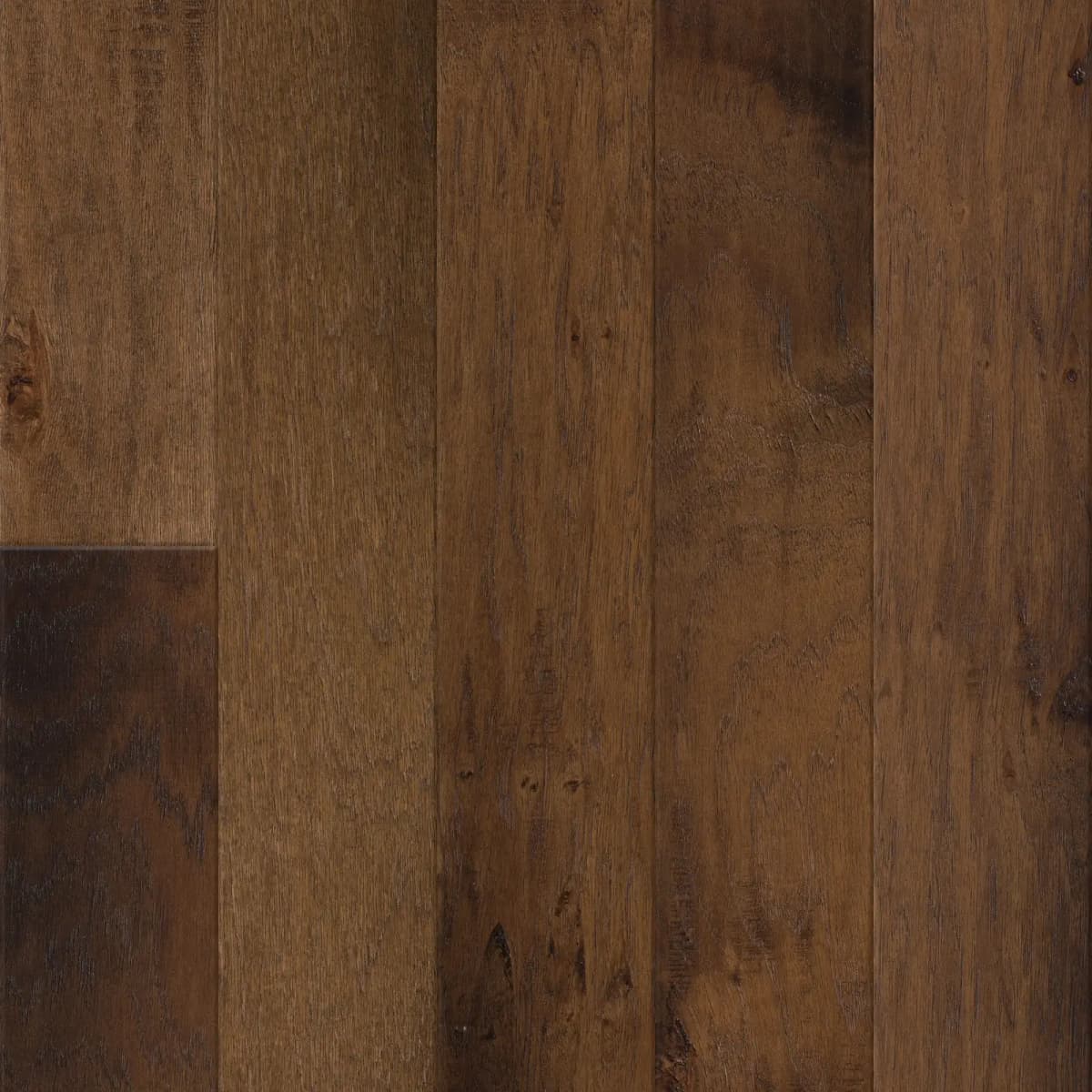
Entry and Premium are oak-centric — Premium is all white oak, and Entry adds pecan (the unusual Imperial Pecan) and Brazilian oak (Brasilia). The Mid tier is where the catalog opens up: hickory (Transcendence, Bernina Hickory — hickory is the hardest species AT offers, at 1,820 lbf side hardness in the USDA Forest Products Laboratory's Wood HandbookSource 3), European walnut (Valencia), and European ash (European Ash). Upper-Mid adds American walnut (Revival — the same table puts black walnut at 1,010 lbf, noticeably softer, but visually strikingSource 3).
If you want anything other than white oak — a harder hickory for a busy household, a formal walnut, a lighter ash for a minimalist room — the widest menu is in the Mid tier.
The tier that owns this: Mid. Eight styles and four species make it the most flexible rung on the ladder.
4. Warranty and Finish
Most Anderson Tuftex styles carry a 5-year light-commercial warranty,Source 4 but the details vary in ways worth reading before you buy up-tier. Revival Walnut (Upper-Mid) is one example: a 50-year residential warranty but no commercial coverage, because walnut is softer and AT positions it for formal residential rooms only. Finish varies too: three styles, Artisan Oak (Mid), Chateau Oak (Upper-Mid) and Grand Estate (Premium), have UV oil finishes that require Anderson Tuftex's own maintenance products — generic hardwood cleaners can strip the oil and void coverage. Every other style has a UV aluminum oxide finish.
Read the fine print on the exact style, whatever the tier. The warranty and finish rules are where a wrong assumption gets expensive.
Head-to-Head at Each Tier
Entry ($7.79–$9.29/sq ft): Real Wood, Short Horizon
Five styles, 1.2–3mm wear layers, and no refinishing on four of them. This is a genuine wide-plank engineered floor at the entry point of the AT catalog — Confection ($7.79/sq ft) is where a 7"-plus white oak floor starts, and Imperial Pecan ($7.89) and Noble Hall ($7.89) deliver species and looks the pricier tiers don't. The catch is permanence: these live and die by the factory finish.
If you can stretch a dollar-fifty, Brasilia ($9.29/sq ft) is the value move within the tier — its 3mm Brazilian-oak wear layer is the tier's only one above NWFA's 2.5mm minimum, so it's the one Entry style you can sand and refinish.
Best fit: rentals, starter homes, spaces you'll redo within 15 years, or a room where budget is the hard constraint and refinishing isn't the plan.
Mid ($10.79–$12.19/sq ft): Where Most Households Should Land
Eight styles — the broadest tier and the one most buyers should look at first. It spans the widest species range in the catalog and, critically, five of its eight styles have a face veneer at or above NWFA's 2.5mm line: Transcendence and Provincial Herringbone (3mm, both wire-brushed, so have the lowest point measured before planning a sanding), Valencia Walnut (2.5mm), and at the top the tier's first 4mm styles. Artisan Oak ($11.69/sq ft, 5/8", 4mm) and European Ash ($12.19/sq ft) are the 4mm standouts; below them, Transcendence hickory ($10.79) is the dent-resistance pick for busy homes.
The honest read: Artisan Oak at $11.69/sq ft is the surprise of the whole lineup — a 4mm floor at the bottom of the Mid price band, when 4mm usually costs more. It is distressed, so a sanding takes that texture off.
Best fit: the default recommendation for most homeowners — enough species choice to find your look, and a refinishable option available without crossing $13.
Upper-Mid ($12.59–$14.29/sq ft): Specific Looks, Long-Term Spec
Six styles, every one with a face veneer of 3mm or more (Chateau Oak's 3mm is the thinnest, and it's wire-brushed, so have its lowest point measured before planning a sanding), and this is where you pay for a particular aesthetic rather than a spec upgrade. Provincial Plank ($12.89/sq ft, 7.5", 4mm) is the flagship straight-lay white oak — the safe, timeless call. Around it sit Metallics II's finish accents ($12.59), a glue-down European Ash Herringbone ($12.89), the 8.66"-wide Chateau Oak ($13.59), and Revival Walnut ($13.59, with a herringbone at $14.29) carrying the tier's thickest 4.5mm wear layer.
You're not buying more durability than the top of the Mid tier so much as buying a specific, considered look at durable spec.
Best fit: design-led projects — walnut, herringbone, wide plank, or metallic finishes — where you want the look and plan to keep the floor for decades.
Premium ($15.09–$21.99/sq ft): Forever-Floors and Focal Points
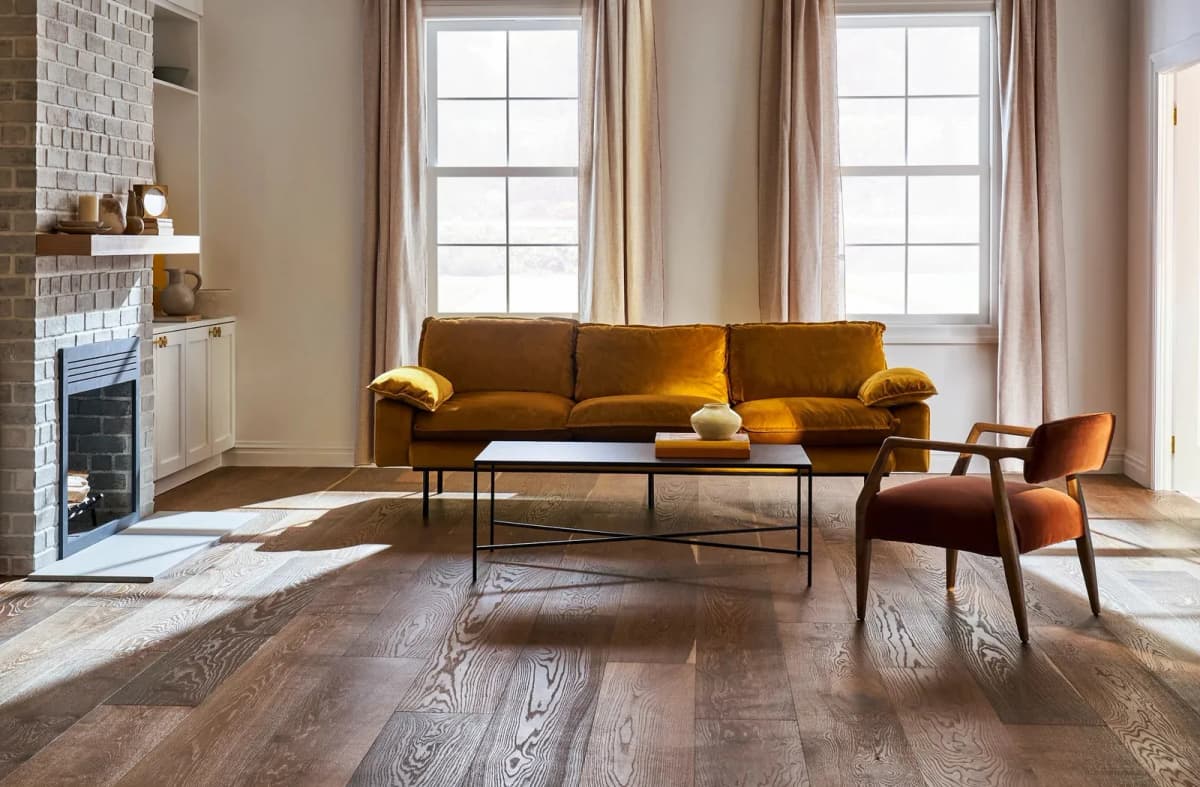
Two styles, both white oak, both wire-brushed, both well clear of NWFA's 2.5mm line — Grand Estate at 6mm, Provincial Parquet at 4mm — on a texture a sanding removes. Wear layer is not what puts both of them here: Provincial Parquet's 4mm is a hair less wood above the core than Upper-Mid's Revival Walnut at 4.5mm. What the tier really buys is Grand Estate's 6mm at one end and a pre-assembled herringbone at the other. Grand Estate ($15.09/sq ft) is the flagship: 10.25" wide, 3/4" thick, 6mm wear layer, 11-ply, UV oil finish, attached pad, made in Vietnam. It's the widest plank and thickest wear layer AT makes, which leaves it the most wood to refinish of anything in the catalog. Provincial Parquet ($21.99/sq ft) is a different animal — 5/8", 4mm, glue-down-only white oak in pre-assembled 31.5" herringbone modules, priced for projects where the floor is the room's focal point.
Best fit: Grand Estate for anyone staying put who wants a true forever-floor; Provincial Parquet only when the pattern itself is the design centerpiece and budget follows the vision.
Which Tier Is Right for You
Buy Entry if:
- You'll likely move or remodel within 10–15 years and refinishing isn't part of the plan.
- Budget is the hard constraint and you still want a real wide-plank wood floor.
- The room is low-traffic — a guest bedroom, a formal space that sees light use.
- If you go Entry, make it Brasilia ($9.29/sq ft) for the one refinishable option in the tier.
Buy Mid if:
- You want the widest choice of species and looks in one tier.
- You're staying long enough that the wear layer matters — target Artisan Oak ($11.69/sq ft) or European Ash ($12.19), both 4mm and both textured.
- You have a busy household and want a harder species (hickory Transcendence, $10.79).
Buy Upper-Mid if:
- You want a specific look the lower tiers can't give you — American walnut, ash herringbone, or a metallic finish.
- You're committed to the floor for decades and want long-term spec behind the aesthetic.
- You're comfortable with the UV oil maintenance Chateau Oak needs and, for walnut, a residential-only warranty.
Buy Premium if:
- This is a floor you intend to keep for life and hand to the next owner.
- You want the widest, thickest plank AT makes — Grand Estate's 10.25" × 6mm construction.
- The floor is a design centerpiece and the pattern itself is the point (Provincial Parquet).
The honest pick for most households: if you're staying more than a decade and want the best balance of choice, look, and renewability, Artisan Oak at $11.69/sq ft is the sweet spot — a 4mm white oak floor at the low end of the Mid tier. If you're staying for good and can fund it, Grand Estate at $15.09/sq ft has more wood to refinish than anything else in the lineup. Both are textured, so plan on either coming back smooth from a sanding. Between those two sits the answer for the large majority of buyers.
What You're NOT Getting at Every Tier
Refinishing, at the Entry tier. The 1.2–2mm styles (Imperial Pecan, Noble Hall, Confection) are not refinishable — the factory finish is the whole of the surface, and when it wears, replacement is the path. That's not a defect; it's the trade you're making for the price. Just don't buy Entry expecting to sand it later.
Solid hardwood, at any tier. Anderson Tuftex is engineered hardwood, top to bottom — a real wood wear layer over a stable multi-ply core. That's a feature for humidity resistance and radiant-heat rooms, but if you specifically want a solid 3/4" board, we don't sell solid hardwood, and you'd be better served by a specialty hardwood retailer than by talking yourself into engineered from us.
Waterproof performance. No tier is rated for standing water. Engineered hardwood handles humidity far better than solid, but it isn't for full bathrooms or frequently-splashed kitchens. For those rooms a waterproof rigid-core floor is the right category — see our COREtec LVP buyer's guide — regardless of how much you love the wood elsewhere. Basements are possible, since engineered hardwood can go below grade, but only over a slab that passes the moisture test first (how to test a concrete slab).
U.S. manufacturing, at the top. Grand Estate is made in Vietnam. If domestic manufacturing is a priority, that's worth weighing against Shaw's standard hardwood lines covered in our Shaw hardwood buying guide.
The Refinishability Question
If you strip away species, width, and finish, tier selection reduces to one question: will this floor ever be refinished? That single decision splits the catalog cleanly in two.
If the answer is no — a short stay, a rental, a room you'll redo before it wears out — you can shop the Entry tier honestly and spend $7.79–$9.29/sq ft without leaving value on the table. If the answer is yes, don't shop below 2.5mm, which means Brasilia ($9.29/sq ft) at a minimum, 4mm (Artisan Oak, $11.69/sq ft) for more wood to work with, and Grand Estate's 6mm ($15.09/sq ft) if you want the most. Brasilia is the smooth one of those three; Artisan Oak and Grand Estate are textured, so NWFA's lowest-point measurement and the loss of the texture both apply,Source 1 and a flooring professional should assess either before you count on sanding it. No one can promise a number of refinishes at purchase; NWFA leaves that to the wear layer left, the floor's flatness and the skill of the person sanding it.Source 1 Everything else — color, plank width, whether you want walnut or ash — is a preference you layer on top of that structural choice. For the full mechanics of how wear layer translates to floor life, our engineered hardwood wear layer explainer goes deeper, and how wood holds up in busy homes covers the traffic side.
Prices here are the manufacturer's advertised price (MAP). Lower prices may be available — request a quote by email using the "Email for today's best price" form on any product page.
Final Word
Anderson Tuftex's four tiers aren't a good-better-best ladder where more money is always the right answer. They're four different tools, and the right one depends almost entirely on how long the floor needs to last.
The scenarios where the tier is clear:
- Short stay or tight budget, no refinishing planned: Entry — and make it Brasilia ($9.29/sq ft) for the one refinishable option.
- Most households, staying a decade-plus: Mid — Artisan Oak ($11.69/sq ft) for the 4mm sweet spot.
- A forever-floor you'll keep for life: Premium — Grand Estate ($15.09/sq ft) for the thickest wear layer in the lineup.
The scenario where it's genuinely close: you're staying long-term and torn between the top of the Mid tier and Upper-Mid. Artisan Oak (4mm, $11.69) and Provincial Plank (4mm, $12.89) are within a dollar-twenty per square foot and carry the same 4mm — the difference is look and plank refinement, not durability. Both are textured, distressed on Artisan Oak and wire-brushed on Provincial Plank, so a sanding returns either to smooth. If white oak in a clean straight lay is your aesthetic, the extra $1.20 for Provincial's marquee styling is a coin-flip worth deciding by sample, not spec sheet.
Browse the full lineup on the Anderson Tuftex catalog or the wider hardwood collection, and when you've narrowed it to two or three, order a $5 sample of each before you commit. The $5 comes back as credit when you sign in at checkout with the same email you used for samples (guests get $0), and Anderson Tuftex finishes, especially the UV oil styles, read very differently in your own light than they do on a screen — the tier you choose on paper isn't always the one your living room agrees with.
In this article
The floors from this guide

Anderson Tuftex
Artisan Oak
Canvas
Samples are $5 each, credited back at checkout when you sign in.

Anderson Tuftex
Grand Estate
Thorndon Hall
Samples are $5 each, credited back at checkout when you sign in.

Anderson Tuftex
Provincial Plank
Parchment
Samples are $5 each, credited back at checkout when you sign in.

Anderson Tuftex
Brasilia
Campo
Samples are $5 each, credited back at checkout when you sign in.
Common questions
Frequently Asked Questions
Which Anderson Tuftex tier is right for me?
It comes down to how long you plan to keep the floor and how the room will be used. The Entry tier ($7.79–$9.29/sq ft) suits short stays and tight budgets — a real wide-plank floor that, apart from Brasilia, you won't sand. The Mid tier ($10.79–$12.19/sq ft) is where most households land, and it's the first tier with a 4mm style (Artisan Oak, $11.69/sq ft). The Upper-Mid tier ($12.59–$14.29/sq ft) buys specific looks — walnut, herringbone, metallic finishes — at long-term spec. The Premium tier ($15.09–$21.99/sq ft) is for forever-floors: Grand Estate's 6mm face veneer is the most wood above the core AT makes, and its other style, Provincial Parquet, is a 4mm herringbone module you buy for the pattern. Both are wire-brushed white oak that a sanding brings back smooth. Every one of those is a per-square-foot manufacturer's advertised price (MAP); each product page shows it beside the full per-carton total.
What's the entry point for a refinishable Anderson Tuftex floor?
Brasilia at $9.29/sq ft (MAP), in the Entry tier. Its 3mm Brazilian-oak wear layer is above 2.5mm, the National Wood Flooring Association's minimum for a factory-finished floor to count as refinishable. In the Mid tier, Transcendence and Provincial Herringbone ($10.79/sq ft) are also 3mm but wire-brushed, so NWFA measures their minimum at the lowest point of the texture and a flooring professional should measure one before you count on sanding it; Valencia Walnut ($11.69/sq ft) sits right at 2.5mm, and Artisan Oak ($11.69/sq ft, a 5/8" white oak plank) is the first 4mm style. How many times any of them can be refinished isn't a fixed number; NWFA ties it to the wear layer left, the floor's flatness and the skill of the person sanding it. Everything under 2.5mm — Imperial Pecan, Noble Hall, Bernina Hickory, Confection, Natural Timbers Smooth, Coast to Coast and Ravenwood — is below the line where NWFA says a floor should not be sanded, and relies on its factory finish for the life of the floor.
Is Grand Estate worth the jump to the Premium tier?
For a floor you intend to keep for decades, it has the most wood to refinish of any floor Anderson Tuftex makes. Grand Estate ($15.09/sq ft, MAP) is a 10.25" wide, 3/4" thick white oak plank with a 6mm wear layer — the widest plank and thickest wear layer in the lineup — built on 11-ply construction with a UV oil finish and attached pad. How many refinishes that 6mm supports isn't a fixed number, but it's the thickest wear layer we carry. Grand Estate is wire-brushed, and the National Wood Flooring Association measures a textured floor at the lowest point of its texture, where sanding also removes the texture — so a sanded Grand Estate comes back smooth, and a flooring professional should assess it before you plan on one. If you're staying put and want a true forever-floor, it earns the premium. If you'll likely move within 10–15 years, a Mid-tier style at 2.5mm or more captures most of that at a lower price per square foot.
Can I mix Anderson Tuftex tiers in the same house?
Yes, and it's often the smartest way to spend. Run a Premium or Upper-Mid style in the rooms guests see first — the entry, the main living space — and a Mid or Entry style in bedrooms and secondary rooms where the finish gets less scrutiny. Because the tiers share the same brand, species families, and finishing language, complementary colors read as one cohesive floor rather than a patchwork. Order a $5 sample of each candidate before you commit — the $5 comes back as credit when you sign in at checkout with the same email you used for samples (guests get $0), and Anderson Tuftex finishes, especially the UV oil styles, read very differently in your own light than on a screen.
Referenced in this guide
Sources
Wood Flooring Sand and Finish Guidelines (2016), pp. 19 and 25
National Wood Flooring Association · Accessed 2026-09-15
https://www.oldewoodltd.com/uploads/nwfa-sand-finish-wood-floors-2016.pdfNWFA Launches Engineered Wood Flooring Refinishable Program (Hardwood Floors magazine, Aug/Sept 2022)
National Wood Flooring Association · Accessed 2026-09-15
https://nwfa.org/wp-content/uploads/2022/09/HFM_AugSept22_final_refinishable_small.pdfWood Handbook: Wood as an Engineering Material — Chapter 4, Mechanical Properties of Wood (Table 4-3b, side hardness)
USDA Forest Service, Forest Products Laboratory (FPL-GTR-113) · Accessed 2026-08-03
https://www.fpl.fs.usda.gov/documnts/fplgtr/fplgtr113/ch04.pdfHardwood - 5 Year Light Commercial Limited Warranty
Anderson Tuftex (Shaw Industries) · Accessed 2026-09-15
https://pdmsview.shawinc.com/viewer/document/doc/22134
Related Posts
Keep Reading
Anderson Tuftex vs Shaw Hardwood: Is the Premium Tier Worth the Price Jump? (2026)
11 min read
How to Match New Hardwood to an Existing Floor (Even If It's Discontinued)
10 min read
Shaw Hardwood Buying Guide: Repel, The Gallery and Expressions (2026)
9 min read
What Is the Best Flooring for Stairs? Hardwood, LVP and the Stair Nose (2026)
13 min read
Keep browsing