
Anderson Tuftex Hardwood Review: Is the Premium Price Worth It?
Floor names link to their product pages in a new tab.
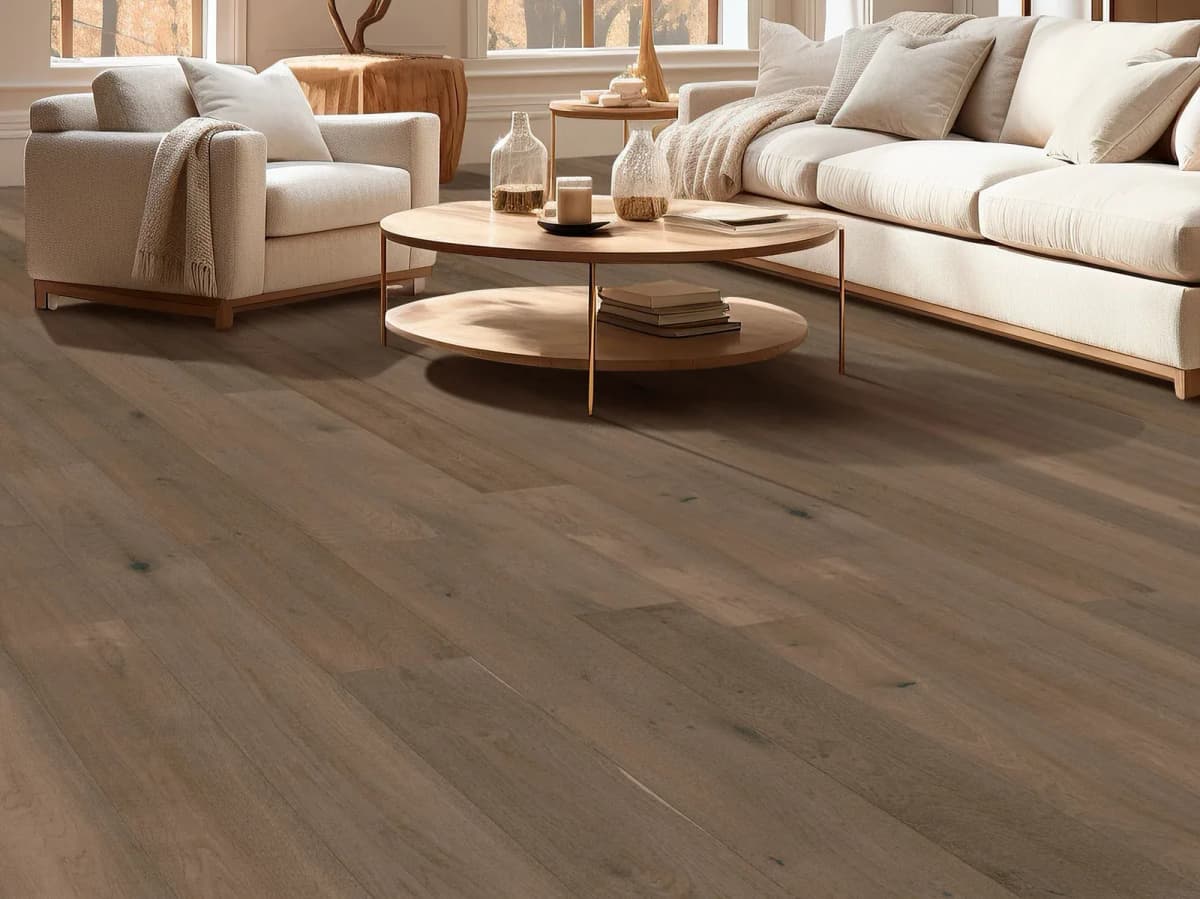
Anderson Tuftex is the brand you find when you search for hardwood that looks like it belongs in an architect's portfolio. The hand-scraped textures, the deep wire-brushed grain, the colors that feel pulled from a restored farmhouse in Provence. It's beautiful flooring. It's also expensive flooring. Here's an honest look at whether the premium price is justified — and for whom.
Review at a Glance
| Dimension | Verdict |
|---|---|
| Aesthetics | Character wood, hand-scraped and wire-brushed textures |
| Construction | Engineered; most styles carry a thick 2.5–6mm veneer — Shaw's top hardwood tier |
| Durability | Heavy aluminum-oxide finish; ages gracefully under traffic |
| Refinishability | Yes on most styles — a 2.5mm or thicker veneer meets NWFA's refinishable minimum, measured at the lowest point on textured styles (about a third of styles run 1.2–2mm) |
| Warranty | 50-year residential, handled directly by Shaw |
| Price range | $7.79–$21.99 / sqft (most styles $8–$14) |
| Recommended for | Homeowners who want character, texture, real-wood warmth |
| Skip if | You want a sleek, modern, uniform look — or budget is tight |
What Anderson Tuftex Actually Is
Anderson Tuftex is Shaw Industries' premium hardwood brand. Shaw is the parent company, founded in 1967 and headquartered in Dalton, Georgia. Anderson Tuftex operates as a distinct brand within Shaw's portfolio, focused exclusively on higher-end engineered hardwood and carpet.
The brand traces its lineage to Anderson Hardwood Floors, which Shaw acquired in 2007.Source 1 Rather than fold it into the Shaw name, they preserved the brand identity and elevated it into their luxury tier. Today Anderson Tuftex is Shaw's premium hardwood tier: wider planks, thicker face veneers, and hand-scraped and wire-brushed finishes.
This matters because you're not paying a premium for marketing alone. Anderson Tuftex sits in Shaw's premium hardwood tier. The construction is engineered hardwood with cross-ply cores for dimensional stability, but the veneers are thicker and the finishing processes are more labor-intensive than Shaw's standard hardwood lines.
Where Anderson Tuftex Excels
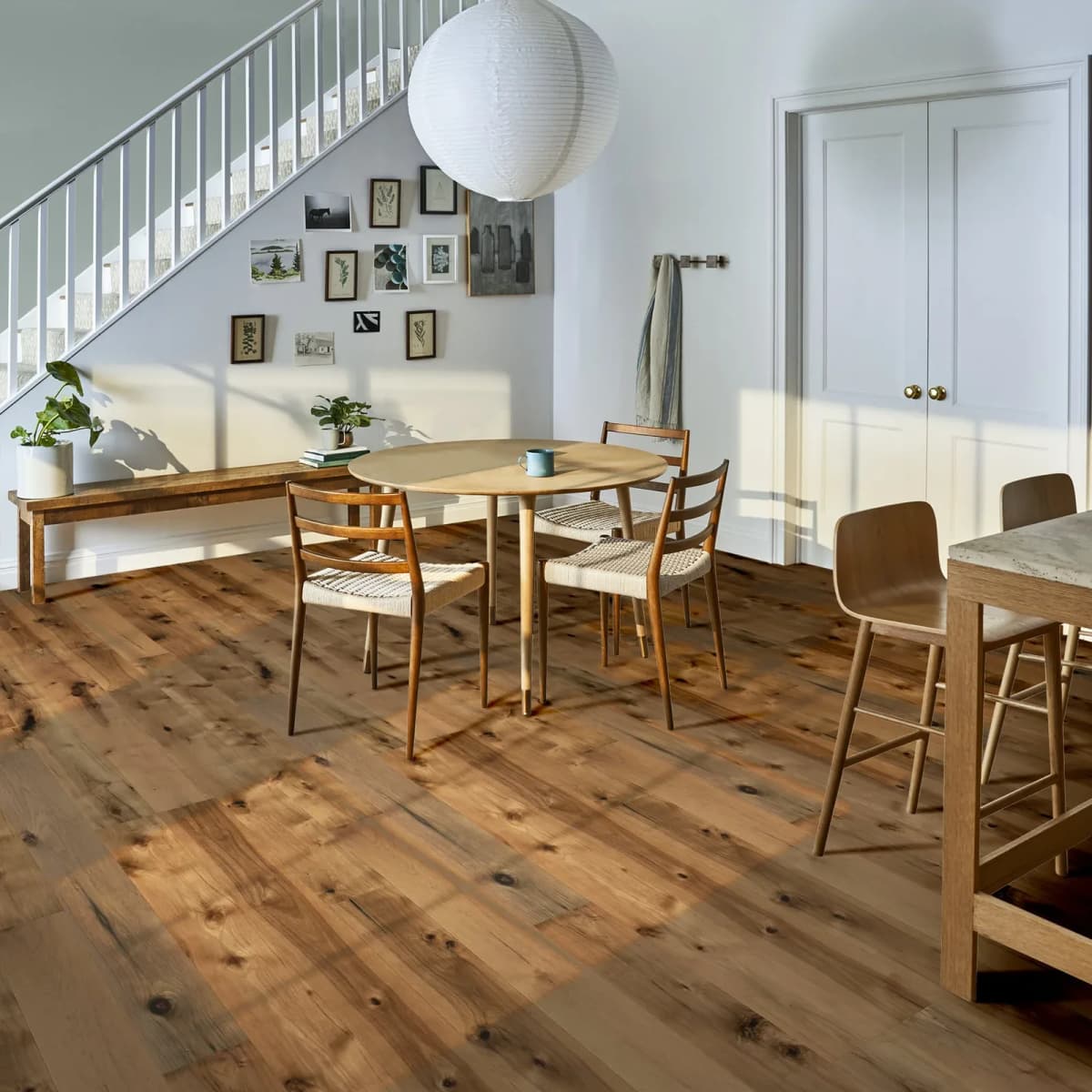
Character wood. If you want a floor with personality — visible knots, natural color variation, mineral streaks, hand-scraped edges — Anderson Tuftex does this better than almost anyone. Their collections like Bernina Hickory and Artisan Oak lean into the natural imperfections of real wood rather than hiding them. Each plank looks slightly different, which creates the organic, lived-in aesthetic that makes a room feel warm and established.
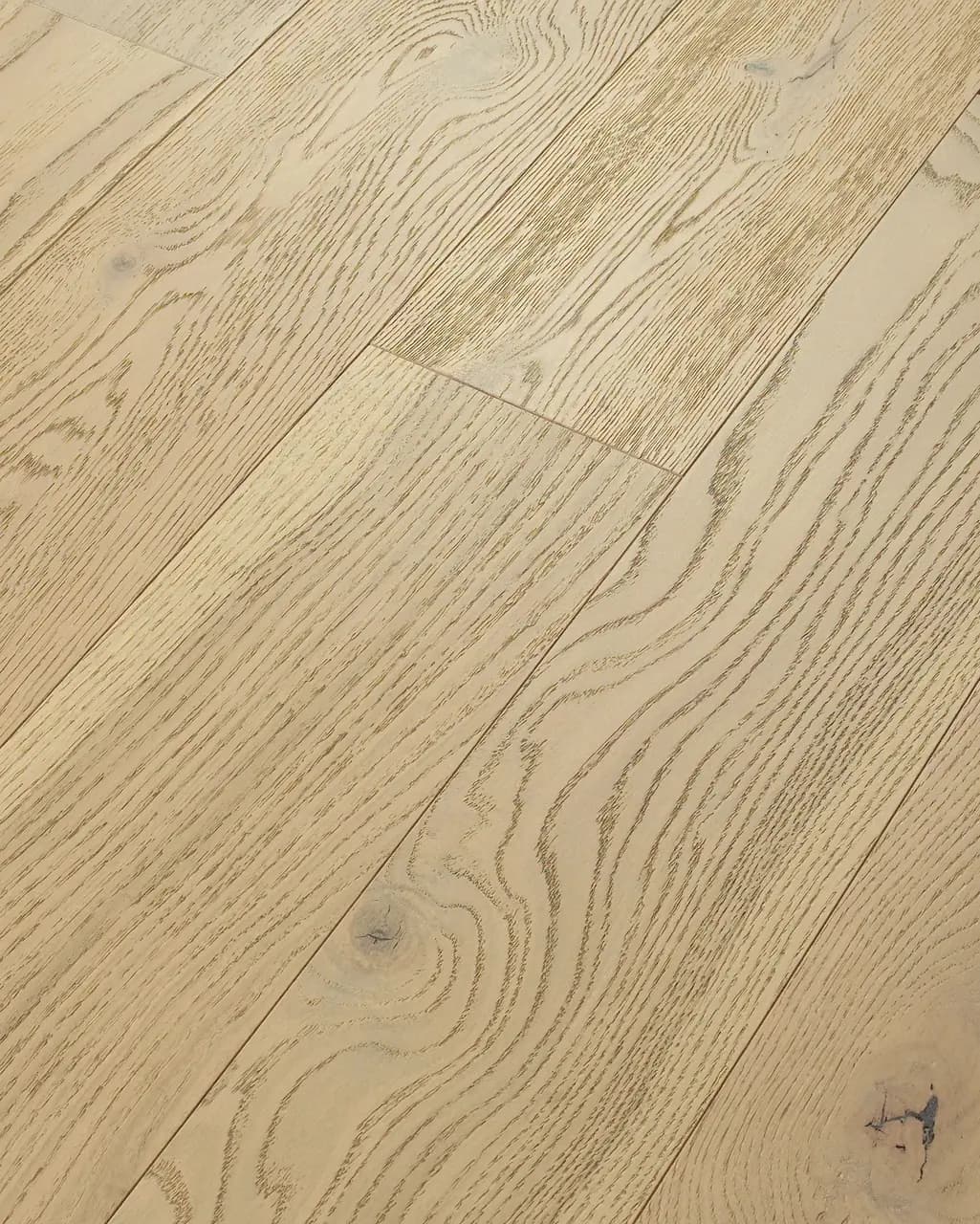
Wire-brushed and hand-scraped textures. This is Anderson Tuftex's signature. Wire brushing removes the softer grain of the wood, leaving the harder grain raised and tactile. The result is a floor you can feel under bare feet — textured, dimensional, and distinctly real. Hand-scraped finishes add subtle undulations that mimic antique floors. These techniques are time-consuming and drive up cost, but they produce a surface that LVP and laminate simply cannot replicate convincingly.
Floors that age well. One of the underappreciated advantages of a premium engineered hardwood is how it looks after five, ten, and fifteen years of life. Anderson Tuftex's heavy-duty aluminum-oxide finishes resist wear patterns in high-traffic zones. And because the underlying wood has so much natural character to begin with, the minor scuffs and patina that develop over time add to the floor's story rather than detracting from it. A well-chosen Anderson Tuftex floor looks better at year ten than it did on installation day.
Thick veneer layers. Across the Anderson Tuftex line, most styles carry veneers (the real wood top layer) of 2.5mm or thicker, reaching 6mm on the thickest styles — its Chateau Oak Garden white oak, for instance, publishes a veneer thickness of 3 mm.Source 2 A veneer that thick is what makes it possible to sand and refinish the floor: 2.5mm is the National Wood Flooring Association's minimum for a factory-finished floor to count as refinishable, and on a wire-brushed style like Chateau Oak, NWFA measures it at the lowest point of the texture.Source 3 Sanding also takes that texture off,Source 4 so have a flooring professional measure a textured floor before you plan on refinishing it. About a third of styles run 1.2mm to 2mm, so check the veneer spec on the style you're considering if refinishing matters to you. Not every homeowner will refinish, but having the option is a meaningful value proposition on a premium product.
Where Anderson Tuftex Is Not the Right Choice
If you want a clean, uniform, modern look. Anderson Tuftex's strength is character and variation. If your design vision is sleek, consistent, light-gray European oak with virtually no grain variation — the kind of floor you see in minimalist Scandinavian interiors — Anderson Tuftex isn't the best match. Their aesthetic leans rustic and warm, not cool and minimal.
For that modern uniform look, Shaw's standard hardwood lines (like Shaw's Repel collection) offer cleaner, more consistent options at a lower price point. You're not sacrificing quality — you're choosing a different aesthetic that happens to cost less because the finishing process is less labor-intensive.
If budget is the primary concern. Most Anderson Tuftex engineered hardwood runs $8 to $14 per square foot for materials, with premium collections up to about $22. Shaw's standard hardwood lines run $5 to $11 per square foot, and most styles sit between $5 and $9. Across the typical tiers in a 1,000-square-foot installation, that's a difference of $3,000-$5,000. If you're flooring your entire home and the budget is tight, allocating the Anderson Tuftex premium to every room may not make sense.
A smart compromise: Use Anderson Tuftex in the rooms where it matters most — the living room, the entryway, the space guests see first — and run Shaw standard hardwood in bedrooms and secondary spaces. Same species, complementary tones, but Shaw's lower per-square-foot price in the rooms where the premium finish won't be as noticed.
If the room has high moisture exposure. Anderson Tuftex is engineered hardwood, not waterproof. It handles humidity better than solid hardwood, but for bathrooms and kitchens with frequent water splashes, a quality LVP like COREtec is the safer call regardless of budget. Basements are possible: engineered hardwood can go below grade, but the slab has to test within Anderson Tuftex's moisture limit first (how to test a concrete slab).
The Price in Context
Most Anderson Tuftex runs about $8-$14 per square foot, with premium collections reaching around $22 — the upper tier of engineered hardwood pricing. Is that expensive? Compared to Shaw's standard line, yes. Solid hardwood runs about $10-$20/sq ft, plus higher installation costs, so the mid-tier overlaps that range. And its top collections sit right alongside the premium European oak brands that run $15-$25/sq ft.
The real question is what happens when the floor wears. A $4/sq ft budget floor with a paper-thin veneer gets pulled up and replaced, with all the disruption and expense of a second installation. An Anderson Tuftex floor at 2.5mm or more can be sanded and refinished instead, on a smooth surface — the price difference buys that option, not a number of years.
Premium flooring is one of the few home investments where buying better actually costs less over time.
The Verdict
Anderson Tuftex is worth the premium if you value character, texture, and the warmth of real wood that ages gracefully. It's built for homeowners who see their floor as a design element — not just a surface to walk on. The construction quality justifies the price, and the aesthetic is genuinely difficult to replicate at any price point.
If your style leans modern and minimal, or if budget trumps everything else, Shaw's standard hardwood lines offer excellent quality without the artisan price tag. No shame in that — it's a different product for a different goal.
Explore the full Anderson Tuftex collection at FloorFreight to see every style with transparent pricing. Order samples to feel the wire-brushed texture and see the character wood in your own space — it's the kind of floor that photographs well but impresses even more in person.
In this article
The floors from this guide

Anderson Tuftex
Chateau Oak
Garden
Samples are $5 each, credited back at checkout when you sign in.

Anderson Tuftex
Bernina Hickory
Fora
Samples are $5 each, credited back at checkout when you sign in.
Common questions
Frequently Asked Questions
Who makes Anderson Tuftex flooring?
Anderson Tuftex is Shaw Industries' premium hardwood brand. Shaw was founded in 1967 and is headquartered in Dalton, Georgia. Shaw acquired Anderson Hardwood Floors in 2007 and, rather than absorb it into the Shaw name, preserved the brand identity and elevated it into their luxury hardwood tier. Anderson Tuftex sits in Shaw's premium hardwood tier, with thicker face veneers and wider planks than Shaw's mainstream hardwood lines.
Can Anderson Tuftex hardwood be refinished?
Yes, on most styles. Most Anderson Tuftex styles carry face veneers of 2.5mm to 6mm, though about a third of styles run 1.2mm to 2mm. A veneer of 2.5mm or more is what makes sanding and refinishing possible: 2.5mm is the National Wood Flooring Association's minimum for a factory-finished floor to count as refinishable, and NWFA's guidelines say a floor with less than 3/32 inch (2.5mm) of wear layer should not be sanded. Most of the line is wire-brushed, scraped or distressed; on a textured floor NWFA measures that 2.5mm at the lowest point of the texture, and sanding removes the texture, so have a flooring professional measure the floor before you plan on refinishing it. How many times a floor can be refinished isn't a fixed number; it depends on the wear layer left, the floor's flatness and the skill of the person sanding it. Not every homeowner will sand a floor, but having the option is a meaningful value on a product that runs from about $8 to $22 per square foot.
Is Anderson Tuftex worth the premium price?
For homeowners who want character, texture, and real-wood warmth that ages gracefully, yes. Anderson Tuftex's wire-brushed and hand-scraped finishes produce a tactile, dimensional surface that LVP and laminate cannot replicate convincingly. Their heavy-duty aluminum-oxide finish resists wear patterns in high-traffic zones, and the natural character of the wood means minor scuffs and patina add to the floor's story over time. Most Anderson Tuftex runs about $8–$14/sq ft, and only its premium collections climb toward $22.
How does Anderson Tuftex compare to Shaw's standard hardwood lines?
Both come from Shaw's manufacturing infrastructure, but they target different aesthetics and price points. Anderson Tuftex focuses on character wood, visible knots, natural color variation, wire-brushed and hand-scraped textures — a rustic, warm look. Shaw's standard hardwood lines (such as the Repel collection) offer cleaner, more uniform appearances, mostly at $5–$9 per square foot and topping out around $11, versus most Anderson Tuftex at $8–$14. In a 1,000-square-foot installation, that difference is $3,000–$5,000 — meaningful when flooring multiple rooms.
Referenced in this guide
Sources
Our Company — History
Shaw Industries Group, Inc. · Accessed 2026-08-03
https://shawinc.com/Our-Company/HistoryChateau Oak — Garden (Style AA847-11094) product specifications
Anderson Tuftex (Shaw Industries) · Accessed 2026-09-15
https://andersontuftex.com/en-us/hardwood/chateau-oak-garden-8-66-in-9-16-white-oak-wirebrushed-41-68-sq-ft-carton-/aa847-11094NWFA Launches Engineered Wood Flooring Refinishable Program (Hardwood Floors magazine, Aug/Sept 2022)
National Wood Flooring Association · Accessed 2026-09-15
https://nwfa.org/wp-content/uploads/2022/09/HFM_AugSept22_final_refinishable_small.pdfWood Flooring Sand and Finish Guidelines (2016), p. 25
National Wood Flooring Association · Accessed 2026-09-15
https://www.oldewoodltd.com/uploads/nwfa-sand-finish-wood-floors-2016.pdf
Related Posts
Keep Reading
How to Match New Hardwood to an Existing Floor (Even If It's Discontinued)
10 min read
Shaw Hardwood Buying Guide: Repel, The Gallery and Expressions (2026)
9 min read
What Is the Best Flooring for Stairs? Hardwood, LVP and the Stair Nose (2026)
13 min read
Herringbone Flooring Guide: What Makes the Pattern Premium (2026)
8 min read
Keep browsing