
LVP vs Laminate: Which Should You Buy? (2026)
Floor names link to their product pages in a new tab.
Quick answer: LVP wins where water and comfort matter — nearly all of it is 100% waterproof, and it's softer, warmer, and quieter underfoot. Laminate wins on surface hardness and scratch resistance in dry rooms and often on a crisp, realistic wood look, sometimes at a lower entry price. The deciding question is almost always the room: put waterproof LVP in anything moisture-prone, and laminate earns a real look only in dry, above-grade spaces.
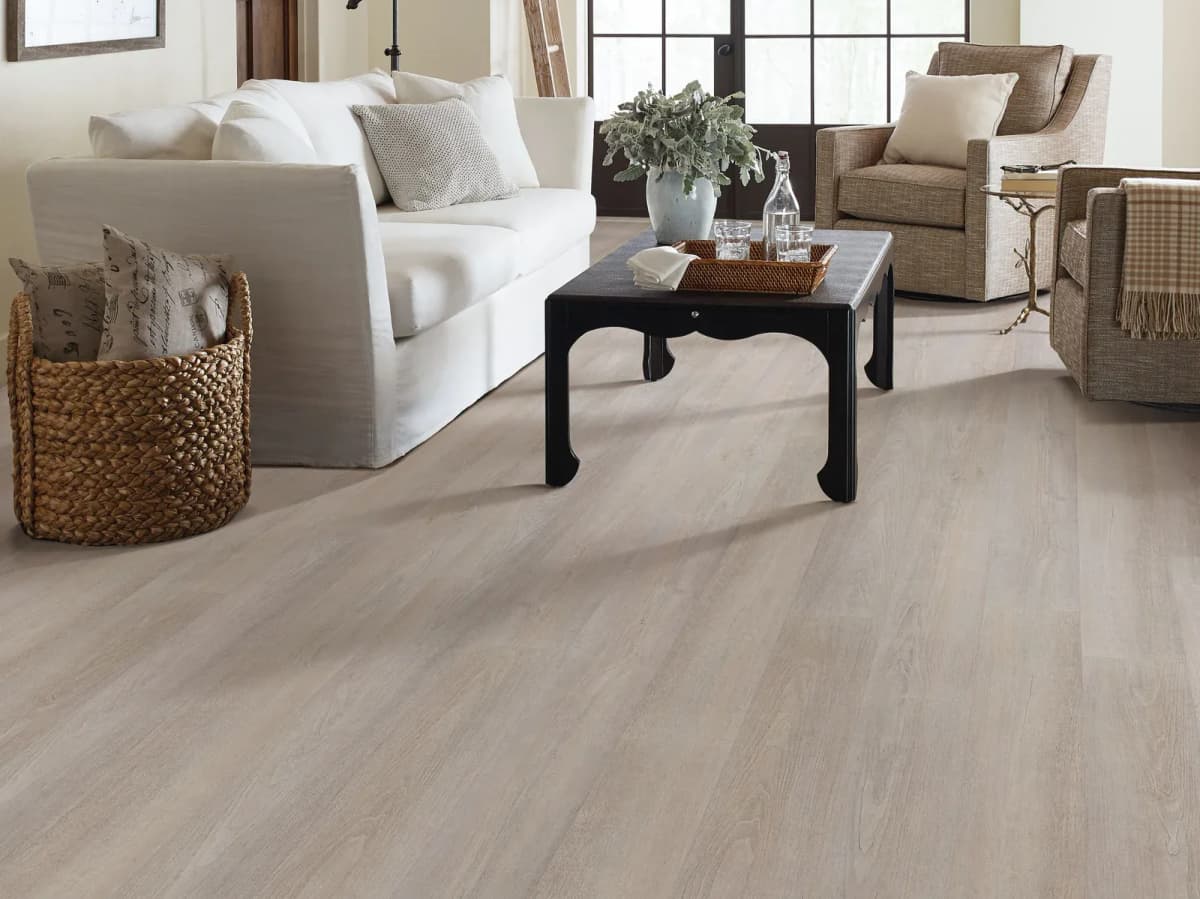
Luxury vinyl plank (LVP) and laminate get cross-shopped constantly, and it's easy to see why. Both are rigid, multi-layer synthetic planks. Both usually click together into a floating floor. Both mimic hardwood with a printed image under a clear wear layer. Side by side — or in a product photo — they can look nearly identical.
Under the surface, they're built on two different materials, and that one difference drives almost everything else. Laminate's core is high-density fiberboard (HDF) — compressed wood fibers and resin. LVP's core is plastic, or a stone-plastic composite. NALFA describes that laminate layer as wood fibers compressed under intense heat and pressure,Source 1 while Shaw describes SPC as a solid polymer core — a more rigid product than WPC.Source 2 Wood core versus plastic core is the whole story: it's why laminate is water-resistant while LVP is waterproof, and it's why the two feel different underfoot.
Full transparency before we go further: FloorFreight is an authorized dealer for Shaw Floors, Anderson Tuftex, and COREtec, and we sell luxury vinyl plank — we don't sell laminate. So we have a commercial interest in the LVP side of this comparison, and we're telling you that up front. We're also going to tell you plainly where laminate is the better fit, and where to go get it, because talking you into the wrong floor helps no one. Let's get into it.
The Short Version: How LVP and Laminate Compare
| Luxury Vinyl Plank (LVP) | Laminate | |
|---|---|---|
| Core material | Plastic or stone-plastic composite (SPC/WPC) | Wood-based high-density fiberboard (HDF) |
| Water performance | Nearly all 100% waterproof ✓ | Water-resistant, not waterproof |
| Wet & below-grade rooms | Bath, kitchen, basement suitable ✓ | Risky — core can swell at seams |
| Feel underfoot | Softer, warmer, quieter ✓ | Harder, can sound hollow without underlayment |
| Surface scratch resistance (dry) | Good — varies by wear layer | Melamine/aluminum-oxide, often harder ✓ |
| Wood-look realism | Very good, improving fast | Crisp printed-and-embossed detail ✓ |
| Install method | Click-lock floating (most) or glue | Click-lock floating |
| Refinishable | No — replace when worn through | No — replace when worn through |
| Entry price | Overlaps heavily with laminate | Can edge lower at the budget tier |
| Sold by FloorFreight | Yes — Shaw, Anderson Tuftex, COREtec ✓ | No — we don't carry laminate |
The one row that decides most kitchens and bathrooms is water performance. A plastic or stone-plastic core doesn't absorb water, so a waterproof LVP plank can sit in standing water without swelling. A wood-based HDF core can — which is why laminate is honestly labeled water-resistant, not waterproof. Almost everything else in this table is a preference; that row is a spec.
What Actually Separates Them
1. Water Behavior — the Core Difference
This is the crux, and it comes straight from the core material. Nearly all LVP is 100% waterproof. The plastic or stone-plastic composite core doesn't absorb moisture, so spills, mopping, pet accidents, and the occasional overflowing tub don't threaten the plank itself. (In our own catalog there's no exception left to warn you about — every active LVP style we carry is flagged waterproof, and the rating is printed on each product page so you can confirm it on the exact style you're considering.)
Laminate is water-resistant, not waterproof, and the vulnerability is at the seams. The melamine wear surface sheds water fine, but if moisture works into the joints or edges and reaches the HDF core, the compressed-wood fibers can swell — producing warping, buckling, and edge "peaking" that generally can't be fixed. You replace the plank. Water-resistant laminate lines are typically built to tolerate surface spills for a limited window if you wipe them promptly, and some products are marketed as "waterproof" via wax-sealed joints and denser HDF — but even those still have a wood-based core and are best understood as highly water-resistant rather than truly waterproof. Exact tolerances vary by brand and line, so don't lean on a specific number.
Edge: LVP. For any room that gets wet, a plastic core outperforms a wood core. It isn't close.
2. Feel and Sound Underfoot
LVP tends to feel softer, warmer, and more forgiving underfoot, and it muffles footstep noise well — especially the WPC (wood-plastic composite) styles like COREtec's Originals line, which are thicker and warmer than denser SPC. Many LVP products also ship with attached underlayment (COREtec includes attached cork on essentially every style), which further quiets the floor.
Laminate is generally harder and stiffer underfoot, and without a quality underlayment it can sound louder and more hollow — the "click-clack" some people notice walking across a laminate floor. A good foam underlayment closes a lot of that gap, but many laminate planks don't come with one attached, so it's a real line item to plan for.
Edge: LVP. Warmer, quieter, softer is the general rule.
3. Surface Hardness and Scratch Resistance
Here laminate earns a fair, genuine point. Laminate's wear surface is typically a melamine and aluminum-oxide coating that tends to be harder than vinyl's wear layer, which often makes it more scratch- and dent-resistant on the surface in dry rooms. Laminate grades this with an AC rating (AC1 to AC5, residential up to commercial) — a useful concept to shop by, though you should confirm the rating on the specific product rather than assume it.
LVP answers with wear-layer thickness measured in mil. Entry LVP might run 6–12 mil, mid-tier lands around 20 mil (COREtec Pro Classics, Shaw Anvil Plus 20 Mil), and commercial-grade styles like Shaw's Titan HD Plus Platinum ($6.79/sq ft) reach 30 mil. A thick vinyl wear layer is very durable — but in a purely dry, high-abrasion setting, laminate's harder surface can hold an edge.
Edge: Laminate. In dry rooms, its surface hardness is a legitimate advantage.
4. The Wood Look
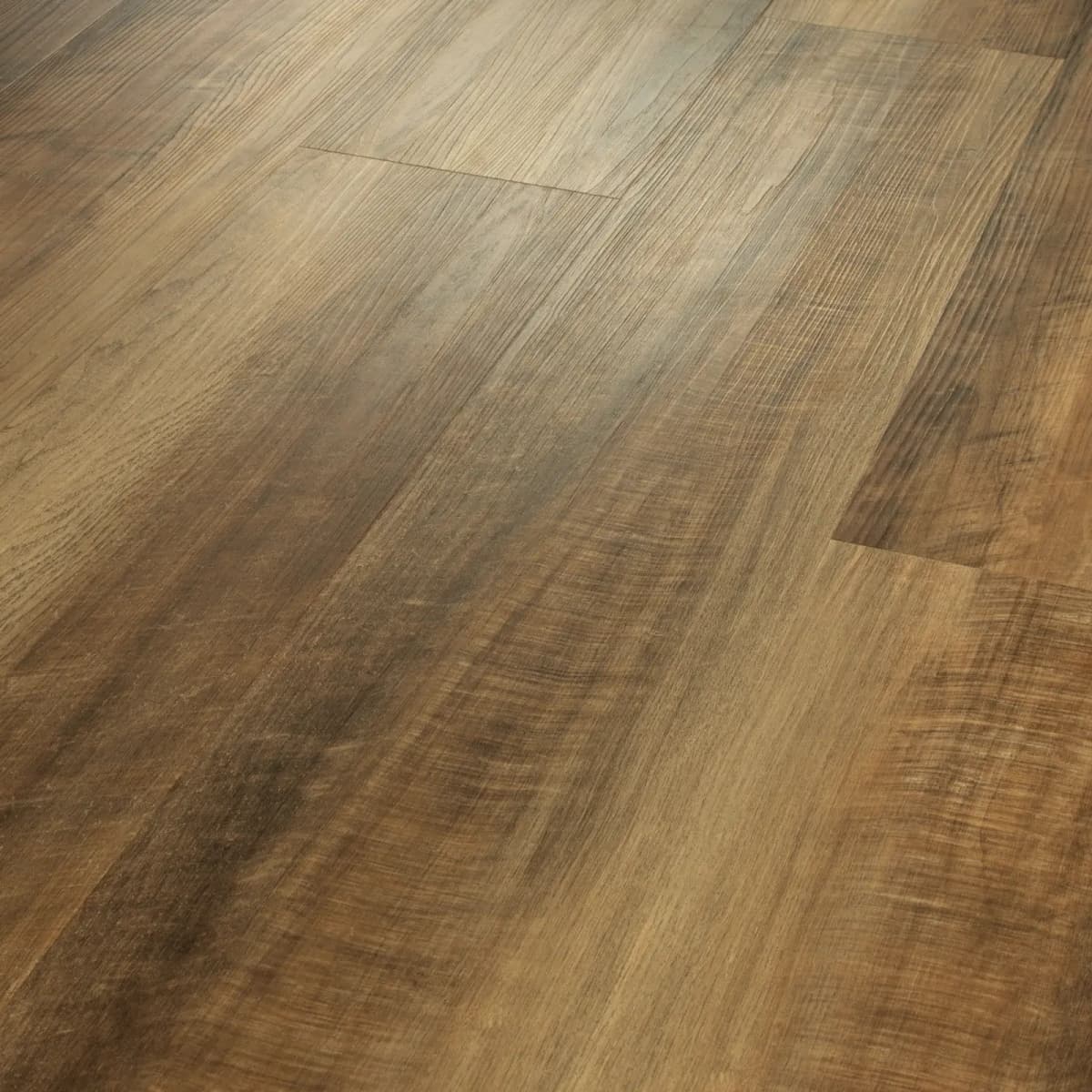
Both categories have gotten remarkably convincing, and this one is close. Laminate's traditional strength is its printed-and-embossed decor layer, which can render very crisp, high-resolution grain with texture that lines up to the print. It's part of why laminate held the "looks most like real wood" reputation for years.
LVP realism has caught up quickly, with embossed-in-register texturing, wider and longer planks, and matte finishes that read as natural wood in most rooms. If a flawless dry-room wood impression is your single priority and moisture is a non-issue, laminate is worth a look. For most homes, the two are close enough that the water question outweighs the look question.
Edge: Laminate, narrowly, and mostly on legacy reputation — LVP has closed the gap.
5. Installation and Subfloor
These two install almost the same way. Most rigid LVP and most laminate are glueless click-lock floating floors that snap plank-to-plank and float over the subfloor, install over most existing hard surfaces, and are genuinely DIY-friendly. Both benefit from an underlayment (attached on some products, separate on many), though what each asks for before install differs — see below.
The differences are at the margins. Laminate almost always needs a moisture barrier or underlayment over concrete, since its wood core is the thing you're protecting. LVP skips the moisture-based acclimation that wood floors need, and the two brands we carry skip acclimation altogether: Shaw states that acclimation is not required for its luxury vinyl as long as the room is climate-controlled,Source 3 and COREtec says the same of its planks and tiles.Source 4 Laminate instructions more often do specify a period in the installation room, so follow whichever guide came in the box. For the full walk-through on the LVP side, see our LVP installation guide.
Edge: Even. Both are approachable floating floors; LVP has slightly fewer moisture caveats, laminate is a hair more forgiving to cut cleanly.
Head-to-Head, Room by Room
For a category comparison, the useful head-to-head isn't price tier — it's the room. Water exposure decides most of these.
Bathrooms, Laundry, Mudrooms
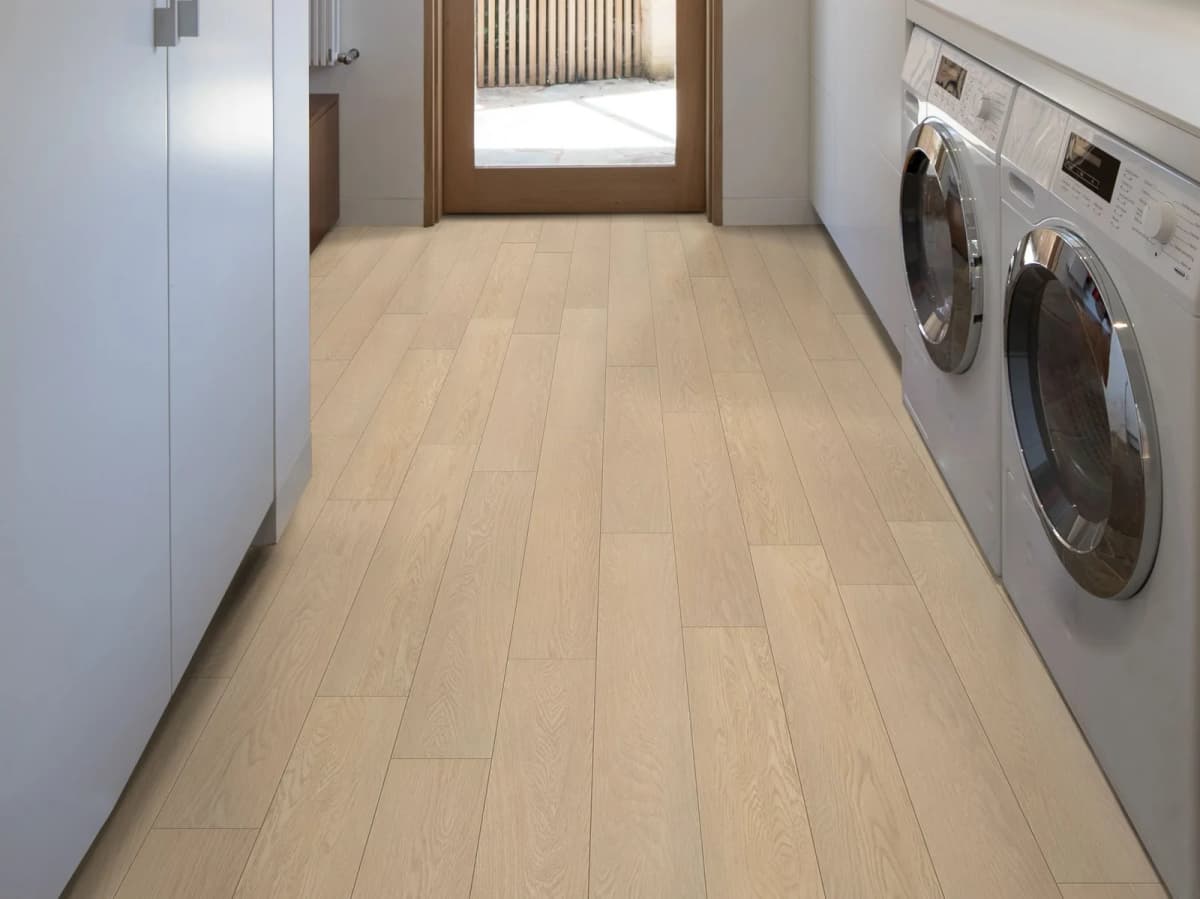
Standing water, splashes, and humidity are constant here, and that's exactly where a wood-based core is a liability. Waterproof LVP handles it; laminate's seams are the weak point.
Best pick: LVP. This is the clearest room in the comparison. Our bathroom flooring guide covers specific waterproof LVP picks.
Kitchens
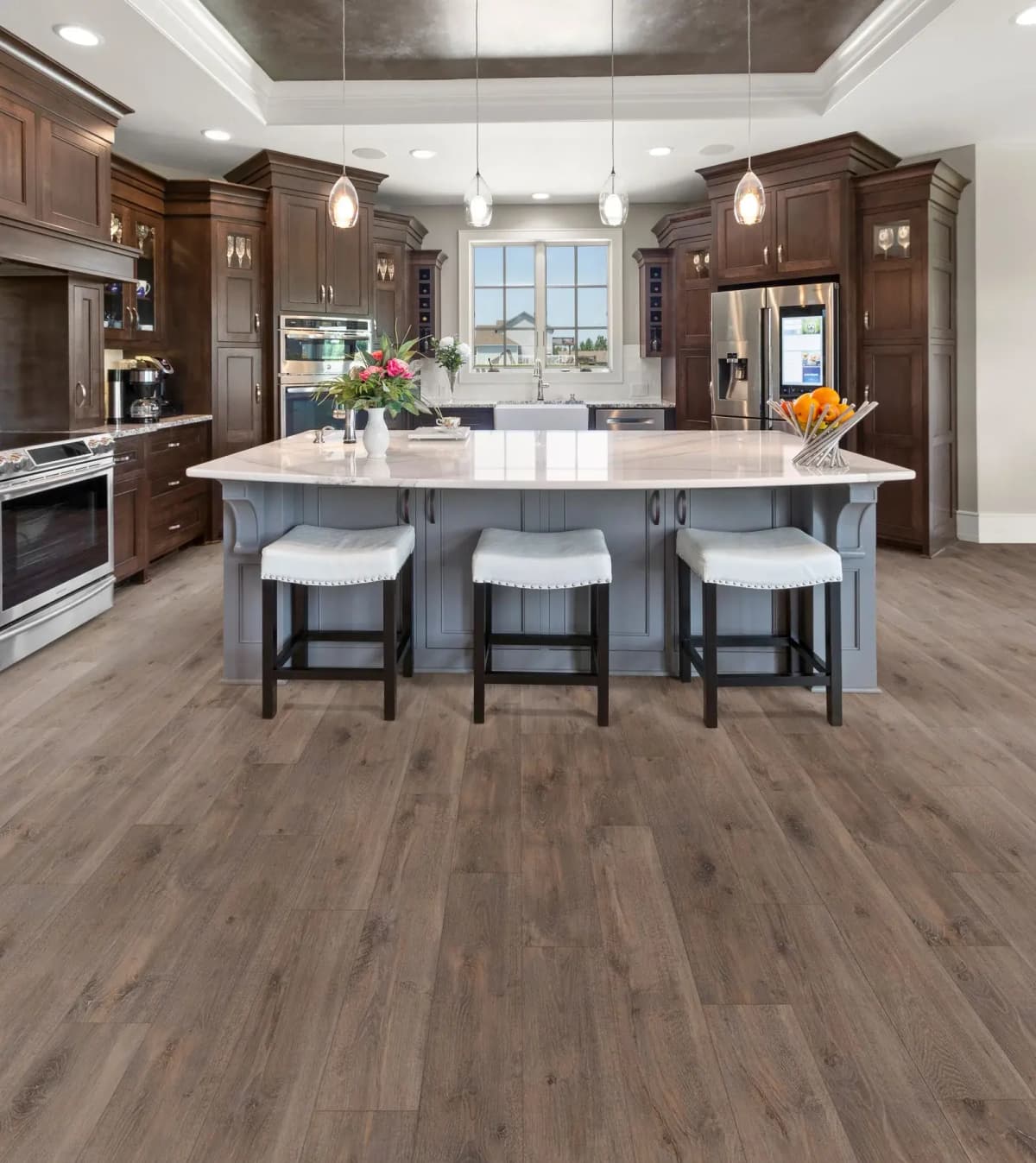
Kitchens are wet rooms in disguise — dishwasher leaks, dropped glasses of water, mopping. LVP's waterproof core is the safer long-term bet. Laminate can work in a diligent, spill-quick household, but the failure mode (a slow leak under the dishwasher swelling the planks) is expensive.
Best pick: LVP, with laminate a distant, higher-diligence second.
Basements and Below-Grade
Below grade means humidity and the risk of moisture from the slab. A wood-core floor doesn't belong there; a waterproof plastic-core floor does.
Best pick: LVP. See the full basement flooring guide for why below-grade rooms rule out wood-based cores.
Living Rooms, Bedrooms, Dining Rooms (Dry, Above-Grade)
This is where laminate is genuinely competitive. In a dry, climate-controlled, above-grade room, laminate's harder surface, crisp wood look, and potentially lower entry price are real advantages, and its water limitation may never come up. LVP still brings warmth and quiet underfoot.
Best pick: Genuinely close. Prioritize surface scratch resistance and look, and laminate makes sense. Prioritize comfort, quiet, and one floor that works everywhere, and LVP.
High-Traffic Entryways and Hallways
High traffic often means tracked-in water, snow, and grit. LVP's waterproof core plus a thick wear layer is the more durable all-around choice; laminate's harder surface resists scratching from grit but not the moisture that comes with it.
Best pick: LVP for the waterproof-plus-durable combination; laminate is defensible if the entry stays dry.
Which Should You Buy
Choose LVP if:
- Any room in the project gets wet — bath, kitchen, laundry, basement, or a busy entry.
- You want one floor that works everywhere in the house without room-by-room caveats.
- Comfort matters: softer, warmer, quieter underfoot, especially with WPC construction and attached underlayment.
- You have pets or kids and want waterproof insurance against accidents and spills.
- You'd rather not think about wiping up spills within a time window.
Consider laminate (from a retailer that carries it) if:
- Every room in the project is dry and above-grade — no moisture exposure to speak of.
- Surface scratch resistance is your single top priority and the floor will stay dry.
- You want the crispest possible printed wood look and are shopping the budget entry tier.
- You understand and accept that a serious water event likely means replacing planks.
The honest middle-ground pick for most households: most homes have at least one wet room, and most people don't want two different floors. That tips the majority of whole-home projects toward waterproof LVP. A strong, sane starting point in our catalog is COREtec Pro Classics VV017 at $4.09/sq ft — an SPC core, a 20 mil wear layer, attached cork underlayment, an explicit pet-stain warranty, and a 15-year heavy commercial warranty at a residential price. It's the kind of floor that works in the kitchen, the hallway, and the bedrooms without asking you to think about which room you're in.
What You're NOT Getting With LVP — and When Laminate Wins
We'd rather you know the limits than find them later.
Neither LVP nor laminate can be refinished. Both wear a printed design layer under a wear layer; once that wears through, the floor gets replaced, not sanded and recoated. If you want a floor you can refinish for decades, that's real wood — and specifically engineered hardwood in most modern homes. We sell that too; here's the honest LVP vs engineered hardwood comparison if refinishability is on your list.
If your whole project is dry and you value surface hardness above all, laminate may genuinely be the better floor — and we don't sell it. Buy it from a retailer that does. That's not a dodge; it's the same posture we take on solid hardwood. Getting the right floor matters more than getting it from us.
"Waterproof" LVP still isn't indestructible. Waterproof refers to the plank not swelling — it doesn't mean water trapped under a floating floor for weeks can't cause subfloor problems, or that a bad install can't fail. And the label is a per-product spec, not a category guarantee — if waterproof performance is the whole reason you're choosing LVP, confirm the specific product is rated 100% waterproof. Our waterproof flooring explainer breaks down what the label actually promises.
A Note on Price
Here's the honest version: LVP and laminate prices overlap heavily, and the historical gap has narrowed. At the budget entry tier, laminate can edge lower; at the mid and premium tiers they're comparable, with LVP often carrying a slight premium for its waterproof core. We won't quote a laminate price we can't stand behind — it swings by brand and line.
What we can be precise about is our own catalog. FloorFreight LVP runs from about $2.99/sq ft (Shaw's entry-tier Impact Plus and Endura Plus) up to $10.69/sq ft (COREtec Originals Premium CR500, a 19mm floor that competes with engineered hardwood), all quoted at the manufacturer's advertised price (MAP). Popular mid-tier waterproof value lands around $3.89/sq ft (Shaw Infinite SPC) to $4.09/sq ft (COREtec Pro Classics). We sell by the carton — each product page shows the full per-carton (box) total next to that per-square-foot figure so you can budget the whole room (a carton covers roughly 18–25 sq ft depending on plank size, so your order rounds up to whole cartons). Lower prices may be available — request a quote by email using the "Email for today's best price" form on any product page.
Final Word
LVP versus laminate isn't a quality contest — both are capable, modern floors. It's a materials question that mostly resolves by room.
The scenarios where the choice is clear:
- Any wet or below-grade room (bath, kitchen, laundry, basement): waterproof LVP, no question.
- A whole-home floor you don't want to think about room by room: LVP.
- A strictly dry, above-grade room where surface scratch resistance and a crisp wood look are the priorities: laminate is legitimately competitive — bought from a retailer that carries it, since we don't.
The scenario where it's genuinely close: dry living rooms and bedrooms in a climate-controlled, above-grade home. There, laminate's harder surface and look go head-to-head with LVP's comfort and quiet, and price can tip it either way. Most people still choose LVP so one floor covers the whole house — but if that room will truly stay dry, either is defensible.
Browse our LVP catalog to compare specs and MAP pricing: all luxury vinyl plank, or by brand at COREtec LVP and Shaw LVP. And before you commit either way, order a $5 sample — every dollar comes back as credit toward your floor when you sign in at checkout with the same email you used for samples, and the credit applies automatically (guests checking out anonymously don't get it, so sign in). The difference between waterproof warmth and a harder, cooler surface is something you feel in your own room, not something a spec sheet settles.
In this article
The floors from this guide

COREtec Floors
COREtec Pro Classics VV017
Chesapeake Oak
Samples are $5 each, credited back at checkout when you sign in.

Shaw Floors
Titan HD Plus Platinum
Imperial Beech
Samples are $5 each, credited back at checkout when you sign in.

Shaw Floors
Anvil Plus 20 mil
Chatter Oak
Samples are $5 each, credited back at checkout when you sign in.
Common questions
Frequently Asked Questions
Is LVP or laminate better for bathrooms and basements?
LVP, in almost every case. Nearly all luxury vinyl plank is 100% waterproof because its core is plastic or a stone-plastic composite that doesn't absorb water. Laminate's core is high-density fiberboard (HDF) — essentially compressed wood — so when water reaches the seams or edges, the fibers can swell, causing warping, buckling, and edge peaking that usually can't be reversed. Laminate is water-resistant, not waterproof: water-resistant lines are generally built to tolerate surface spills for a limited window if you wipe them up promptly, but they aren't rated for standing water or wet rooms. For bathrooms, laundry rooms, and below-grade basements, waterproof LVP is the safer construction — our basement flooring guide covers which floors handle moisture below grade.
Does laminate cost less than LVP?
Not reliably anymore. The two categories overlap heavily, and the old gap where laminate clearly cost less has narrowed. At the budget entry level, laminate can edge out LVP on the per-square-foot price; at the mid and premium tiers the two are comparable, and LVP often carries a slight premium for its waterproof performance. Rather than quote a laminate number we can't stand behind (it varies by brand and line), we'll be straight about our own catalog: FloorFreight's LVP runs from about $2.99/sq ft up to $10.69/sq ft at the manufacturer's advertised price (MAP). Lower prices may be available — request a quote by email using the 'Email for today's best price' form on any product page.
Does FloorFreight sell laminate?
No. FloorFreight is an authorized online dealer for Shaw Floors, Anderson Tuftex, and COREtec, shipping straight from the manufacturer in Dalton, Georgia. We carry luxury vinyl plank and engineered hardwood — not laminate, not solid hardwood, and not house brands like LifeProof. If laminate turns out to be the right floor for your dry, above-grade rooms, buy it from a retailer that carries it; we'd still rather you get the right floor than talk you into ours. This whole comparison is written with that in mind, and with the disclosure that we have a commercial interest in the LVP side of it.
Is laminate more scratch-resistant than LVP?
In dry rooms, often yes. Laminate's wear surface is typically a melamine and aluminum-oxide coating that tends to be harder than vinyl's wear layer, which can make it more scratch- and dent-resistant on the surface — and its printed-and-embossed decor layer can render a very crisp, realistic wood look. Laminate abrasion durability is graded by an AC rating (AC1 through AC5, residential to commercial); confirm the rating on any specific product rather than assuming it. The catch is that this hardness advantage only holds where the floor stays dry. LVP counters with higher wear-layer options (up to 30 mil on commercial-grade styles) and, more importantly, a waterproof core laminate simply doesn't have in kitchens, baths, and basements.
Referenced in this guide
Sources
What is Laminate?
North American Laminate Flooring Association (NALFA) · Accessed 2026-08-03
https://nalfa.com/what-is-laminate/Vinyl Flooring Overview | Durable, Stylish & Waterproof
Shaw Floors (shawfloors.com) · Accessed 2026-08-03
https://shawfloors.com/en-us/vinyl-overviewLuxury Vinyl Installation
Shaw Floors · Accessed 2026-08-03
https://shawfloors.com/en-us/plan-and-install/vinylInstallation & Maintenance
COREtec · Accessed 2026-08-03
https://coretecfloors.com/en-us/installation-maintenance
Related Posts
Keep Reading
COREtec Tile & Stone Looks: The DIY Alternative to Ceramic and Porcelain (2026)
9 min read

LVP Wear Layer Explained: Why 12 Mil and 20 Mil LVP Overlap on Price and Wear Differently
9 min read
Shaw LVP Buyer's Guide: Classic Series vs Pro Series, and Where 5th and Main Fits (2026)
10 min read
Will Heavy Furniture Dent Vinyl Plank Flooring? What Holds Up (2026)
14 min read
Keep browsing