
Shaw Floors vs. LifeProof: Which Is Actually Better?
Floor names link to their product pages in a new tab.
This is one of the most searched flooring comparisons online, and for good reason — both brands show up everywhere and the prices overlap. But there's a fundamental difference most comparison articles gloss over: Shaw manufactures flooring. LifeProof is a retail brand owned by Home Depot. That distinction matters more than you'd think.
Quick Comparison
| Shaw Floors | LifeProof | |
|---|---|---|
| Brand type | Manufacturer (since 1967) ✓ | Home Depot private-label |
| Manufactured by | Shaw Industries ✓ | Halstead + rotating contract manufacturers |
| Sold through | Authorized dealers nationwide | Home Depot exclusively |
| Wear layer range | 6–30 mil | 6–30 mil |
| Warranty handling | Direct with Shaw customer service ✓ | Home Depot → contract manufacturer |
| Average LVP price | $3.00–$6.00/sq ft | $2.50–$4.00/sq ft ✓ |
| Country of origin | USA on 4 of the 23 Shaw LVP styles we carry; Vietnam or Thailand on the rest | Varies by contract manufacturer |
Who Actually Makes the Product?
Shaw Floors manufactures its own product, start to finish. Shaw's own corporate history dates the company to 1967, when it was formed to acquire Philadelphia Carpet Company.Source 1 It's headquartered in Dalton, Georgia — the carpet and flooring capital of the U.S. Shaw operates its own factories, controls its own supply chain, and develops its own proprietary technology. When you buy Shaw, you're buying from the company that made the floor.
LifeProof is a brand name owned exclusively by Home Depot. Home Depot contracts with third-party manufacturers (which vary by product line and aren't publicly disclosed) to produce flooring under the LifeProof label. It's a private-label brand — the same business model as Kirkland at Costco or Great Value at Walmart.
This isn't a criticism. Private-label brands can be perfectly fine products. But it means you're trusting Home Depot's sourcing team rather than a vertically integrated manufacturer with nearly six decades of flooring expertise. The quality control chain is different.
Construction Comparison
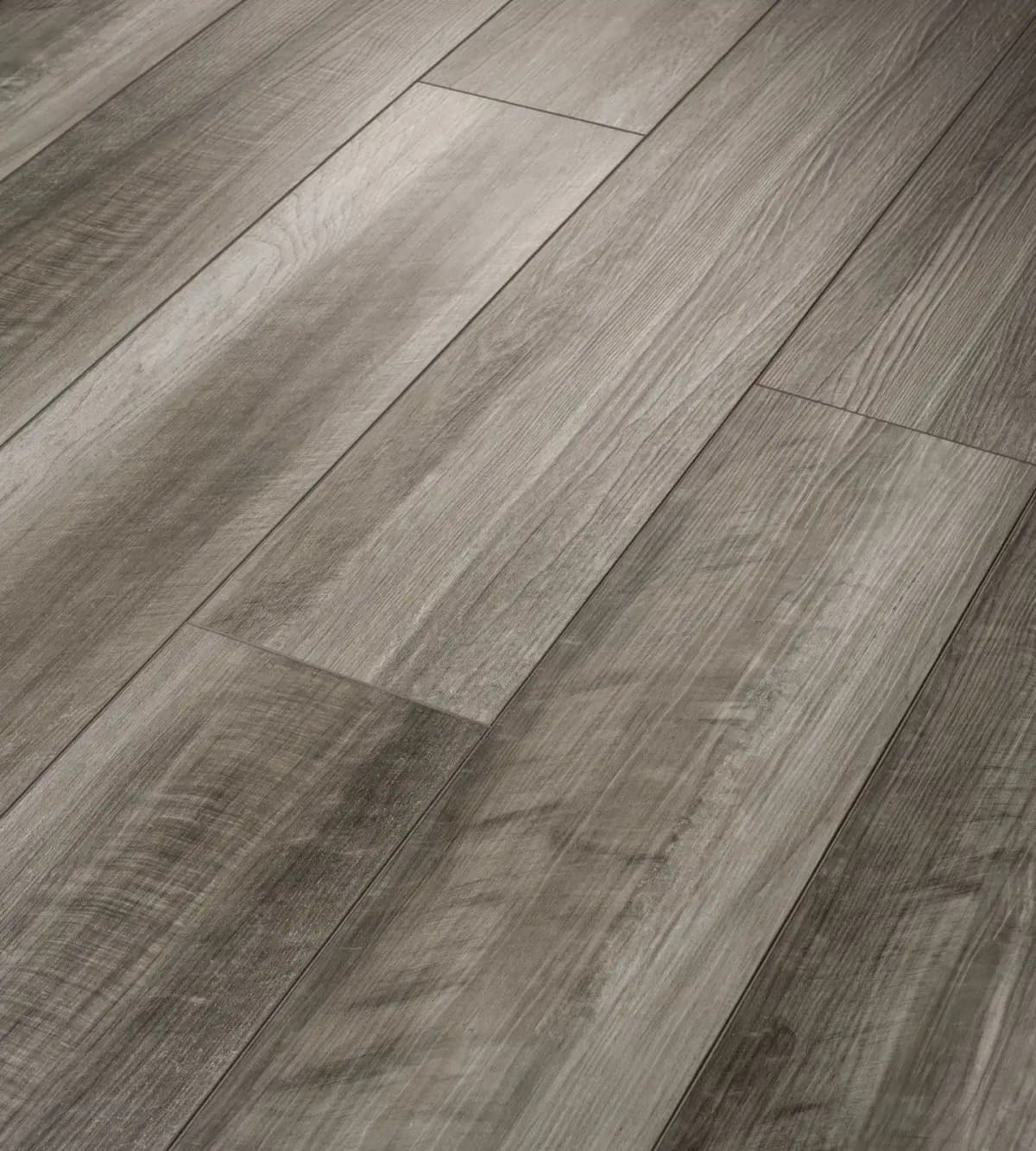
Shaw's rigid-core LVP (the Floorté Plus and Floorté Pro lines) uses a proprietary WPC or SPC core with attached underlayment. Shaw specifies and controls the core composition, the wear layer thickness, and the locking mechanism. The published wear-layer spec runs the full span of the catalog: 6 mil on an entry style like Impact Plus,Source 2 20 mil across the residential-standard tier, and a commercial-grade 30 mil on Titan HD Plus Platinum.Source 3 One certification worth getting right before you shop on it: Shaw's GREENGUARD certification covers its hardwood and laminate flooring, not its vinyl.Source 4 If low-emission certification is what you're after, that's the category to look in — not Floorté.
LifeProof LVP uses SPC (Stone Polymer Composite) cores across most of its lineup. The wear layers range from 6 mil on entry-level products to 30 mil on their top tier. Construction quality is generally decent at the mid-to-upper end, but it varies more from product to product because different contract manufacturers produce different lines. A LifeProof plank from one factory may feel and perform differently than a LifeProof plank from another.
Key difference: Shaw publishes detailed technical specifications for every product — exact core density, precise wear layer mil thickness, UV coating details, and emissions certifications. LifeProof's spec sheets are less granular. If you're the kind of buyer who reads data sheets, you'll notice the gap.
Warranty Comparison
Shaw offers lifetime residential warranties on its Floorté Plus and Pro lines, covering manufacturing defects, wear-through, staining, and waterproof performance. One thing to know before you count that as resale value: Shaw's residential resilient warranty is not transferable. It extends only to the original owner-occupied end-use purchaser, so it covers you for as long as you own the floor and ends when you sell the home.Source 5
LifeProof also offers lifetime residential warranties on most products. On paper, they look similar. In practice, the claims process is different. Shaw warranty claims go through Shaw's own customer service team. LifeProof claims go through Home Depot, which then coordinates with the contract manufacturer. This can add steps and time to the resolution process.
Neither brand has a perfect warranty reputation — flooring warranty claims are notoriously difficult across the industry. But having a direct relationship with the manufacturer (Shaw) versus going through a retail intermediary (Home Depot → unnamed manufacturer) matters when something goes wrong.
Where You Can Buy Them
LifeProof is sold exclusively at Home Depot. You can't buy it anywhere else. That rules out buying it from a specialist retailer who offers better service or advice.
Shaw is sold through a wide network of authorized retailers, specialty flooring stores, and online dealers like FloorFreight. That gives you options for how and where you buy.
Full transparency: FloorFreight is an authorized Shaw dealer. We sell Shaw products. We're writing this comparison because we genuinely believe Shaw offers better long-term value — but we want you to make that judgment based on facts, not just our recommendation.
Price Comparison
This is where LifeProof gets interesting. Because Home Depot controls the brand and the distribution, they can price LifeProof aggressively. Entry-level click-lock LifeProof LVP starts around $2.50/sq ft, and its glue-down planks run lower still. Its 22 mil and 30 mil tiers run roughly $3.00-$4.00/sq ft.
Shaw's Floorté line starts around $3.00/sq ft for the entry tier and runs up to $6.00+/sq ft for the premium Plus and Pro lines. At the low end, LifeProof costs less. Between about $3.00 and $4.00/sq ft, the prices overlap substantially (LifeProof's top tiers against Shaw's entry and mid-range styles), and that's where the construction and quality control differences become worth paying attention to.
Dollar-for-dollar in that $3.00-$4.00 range, LifeProof's 22 and 30 mil tiers can list the thicker wear layer, while Shaw reserves 30 mil for its premium styles. So compare on more than mil alone: Shaw typically offers more consistent construction and quality, fully published specs, and a direct warranty relationship at the same price point.
The Real Question: Long-Term Value
A floor is a 15-to-25-year commitment. The question isn't which one costs less today — it's which one still looks good and performs well a decade from now.
Shaw's vertically integrated manufacturing gives them tighter quality control. Their R&D investment in core technology and wear-layer chemistry is continuous. Their warranty claim process is more direct. And their products are sold through a wide network of authorized dealers, so you choose who you buy from.
LifeProof is a solid choice if you're buying entry-level vinyl for a rental property or a room where budget is the primary concern. For your own home — the living spaces you'll walk on daily for years — the incremental cost of Shaw is, in our experience, worth it.
See Shaw for Yourself
Browse our complete Shaw Floors collection to see every LVP, hardwood, and laminate option with transparent pricing. Order samples to compare them against anything else you're considering — including LifeProof from Home Depot. We're confident in how the comparison turns out.
In this article
The floor from this guide

Shaw Floors
Titan HD Plus Platinum
Imperial Beech
Samples are $5 each, credited back at checkout when you sign in.
Common questions
Frequently Asked Questions
Who actually makes LifeProof flooring?
LifeProof is a private-label brand owned exclusively by Home Depot. Home Depot contracts with third-party manufacturers — which vary by product line and are not publicly disclosed — to produce flooring under the LifeProof name. It is the same business model as Kirkland at Costco or Great Value at Walmart. The specific manufacturers rotate, which means construction quality can vary more from product line to product line than it does with a vertically integrated brand like Shaw.
Is Shaw Floors better than LifeProof?
Where the two brands' prices overlap, roughly $3.00–$4.00 per square foot, LifeProof's 22 and 30 mil tiers give it the thicker wear layer on paper, but Shaw typically offers more consistent construction and quality. Both brands now span 6–30 mil; Shaw publishes detailed specs for every product, while LifeProof's documentation is less granular. Shaw warranty claims go directly through Shaw's own customer service. LifeProof claims route through Home Depot to the contract manufacturer, adding steps to the resolution process. For a forever-home floor in primary living spaces, Shaw's construction consistency gives it the edge.
Where can you buy Shaw Floors?
Shaw is sold through a wide network of authorized retailers, specialty flooring stores, and online dealers. LifeProof, by contrast, is sold exclusively at Home Depot — you cannot buy it anywhere else. Shaw's multi-channel distribution means you choose where you buy it, including specialty retailers who provide installation advice. Shaw products average $3.00–$6.00 per square foot, with entry-tier options starting around $3.00 and premium Floorté Plus and Pro lines running higher.
Is LifeProof flooring really made by Shaw?
No. LifeProof is produced by Halstead and rotating contract manufacturers for Home Depot — it is not a Shaw product. Shaw Industries is a separate company that manufactures its own flooring under the Shaw Floors brand and sells through authorized dealers. The two brands compete at overlapping price points, which is why the question comes up often, but they have no manufacturing relationship. Shaw is headquartered in Dalton, Georgia, and by its own corporate history has operated since 1967 with its own factories and supply chain.
Referenced in this guide
Sources
Our Company — History
Shaw Industries Group, Inc. · Accessed 2026-08-03
https://shawinc.com/Our-Company/HistoryImpact Plus — Weathered Barnboard (Style 2031V-00400) product specifications
Shaw Floors (shawfloors.com) · Accessed 2026-09-13
https://shawfloors.com/en-us/vinyl/impact-plus-weathered-barnb-7-/2031v-00400Titan HD Plus Platinum — Timeless Barnboard (Style 3302V-00194) product specifications
Shaw Floors (shawfloors.com) · Accessed 2026-09-13
https://shawfloors.com/en-us/vinyl/titan-hd-plus-platinum-timeless-barnbo-9-/3302v-00194Sustainability — Product Certifications
Shaw Floors (shawfloors.com) · Accessed 2026-08-03
https://shawfloors.com/en-us/sustainability-ed361c837edb7fb307b06b8b93470ccdResidential Resilient Limited Warranty — Defects, Wear (rev. 06/28/2023)
Shaw Industries, Inc. · Accessed 2026-09-13
https://pdmsview.shawinc.com/viewer/document/doc/28854
Related Posts
Keep Reading
COREtec Tile & Stone Looks: The DIY Alternative to Ceramic and Porcelain (2026)
9 min read

LVP Wear Layer Explained: Why 12 Mil and 20 Mil LVP Overlap on Price and Wear Differently
9 min read
Shaw LVP Buyer's Guide: Classic Series vs Pro Series, and Where 5th and Main Fits (2026)
10 min read
Will Heavy Furniture Dent Vinyl Plank Flooring? What Holds Up (2026)
14 min read
Keep browsing