
Best Engineered Hardwood for Kitchens (2026): What Actually Holds Up
Floor names link to their product pages in a new tab.
Real hardwood in the kitchen used to be a bad idea. It still can be, if you pick the wrong product. But engineered hardwood has changed the math — the right product survives spills and traffic without becoming a project.
The hard part is figuring out what "right" means. Most kitchen-hardwood guides hand-wave it with vague advice about choosing "durable" wood. We're going to be specific. By the end of this post, you'll know exactly which engineered hardwood specs matter for kitchens, which ones don't, and the products from our catalog that actually fit.
Three Things Hardwood Has to Survive in a Kitchen
Before product recommendations, the framework. A kitchen floor faces three things every day:
1. Water and humidity. Spills from the sink, splashes from the dishwasher, and the constant low-level humidity from cooking. Standard hardwood doesn't handle this well — moisture seeps into the seams, the wood swells, and the floor cups or buckles. Engineered hardwood handles humidity better than solid hardwood because the cross-grain construction resists expansion. Water-resistant treatments (like Shaw's Repel) add another layer.
2. Dropped objects. Cast iron pans. Knives. Dishes. The kitchen is the room most likely to dent your floor — and that dent is permanent on a thin wear layer. Wear layer thickness and species hardness both matter here.
3. Traffic. The kitchen sees more foot traffic than any other room in the house. The wear layer takes the brunt of it. Thinner wear layers (1.2mm) wear through faster than thicker ones (4mm or 6mm).
Three pressures. Each one has a different solution. The hardwood that fits your kitchen depends on which pressures matter most in your house.
Wear Layer Thickness Is the Single Most Important Spec
Most kitchen-hardwood comparisons focus on species — hickory vs. oak vs. maple — and skip wear layer entirely. That's backwards.
The wear layer is the actual hardwood veneer on top of the engineered plywood core. It's the part that dents when you drop a pan, the part that scratches when your dog runs across, the part that wears thin under a busy traffic pattern. When the wear layer is gone, the floor is gone.
Three tiers, all of which exist in our catalog:
- 1.2mm wear layer. Most engineered hardwood lives here. Won't survive sanding. In a kitchen, the factory finish is the whole of your protection, and when it wears through the fix is replacement, not refinishing.
- 2-3mm wear layer. Mid-tier. The sanding line runs through this tier: the National Wood Flooring Association's guidelines say a floor with less than 3/32 inch (2.5mm) of wear layer should not be sanded,Source 1 so a 2mm floor gets recoated, while a smooth 3mm floor can be sanded and refinished. On a wire-brushed, scraped or distressed floor that 2.5mm is measured at the lowest point of the texture, and such floors often cannot be sanded.Source 1 In a kitchen, a 3mm floor is the first tier where a worn traffic lane is a sanding job rather than a replacement.
- 4-6mm wear layer. Premium tier, with more wood above the core than any thinner wear layer. A smooth one can be sanded and refinished, but of the 4mm-to-6mm styles we carry only the two Revival Walnut styles are smooth; the rest are wire-brushed or distressed, and textured floors often cannot be sanded, so have a flooring professional assess one first. In a kitchen, this floor outlives the kitchen itself — most cabinets get replaced before this floor needs work.
If your kitchen is the heart of your home and you cook constantly, prioritize wear layer over everything else. A 1.2mm floor has one factory finish and no more. A 4mm floor has real wood under it, so a worn traffic lane in front of the range can be sanded out instead of replaced.
Species Hardness: Helpful, But Don't Overweight It
The Janka hardness scale measures how much force it takes to dent solid wood. Higher number = harder wood. Common species you'll see in engineered hardwood kitchen products:
- Hickory: 1820 (hardest in our catalog)
- Hard maple: 1450
- White oak: 1360
- Red oak: 1290
- American walnut: 1010 (softest in our catalog)
For a kitchen, hickory and maple are the hardest, white oak is the most popular middle ground, and walnut should generally be avoided unless you can't live without the look. Walnut dents easily — fine for bedrooms, risky for kitchens with active cooking.
One caveat that most articles skip: Janka ratings are measured on solid wood, not engineered planks. The wear-layer veneer on engineered hardwood is real wood, so species matters at the surface. But the engineered construction below uses different materials, so the floor's overall durability isn't fully captured by the species' Janka score. Wear layer thickness and finish quality matter just as much.
In other words: a 1.2mm hickory floor (hard species, thin wear layer) will dent less easily than a 4mm walnut floor in the short term, but the 4mm walnut survives more sandings over a longer life. Pick the combination that fits your priorities.
Water Resistance: When It Matters and When It Doesn't
Some engineered hardwood is water-resistant. None of it is truly waterproof. Both facts matter for kitchens.
Water-resistant means a surface treatment that repels spills for a window of time — long enough to clean up a glass of water before it damages the floor. Shaw's Repel is the prime example: an advanced sealant on the top and sides of each plank that is, in Shaw's words, "2X more water resistant than traditional hardwood." For a busy kitchen with active cooking, water-resistant hardwood is a real upgrade.
Truly waterproof means the floor handles standing water for hours without damage. No engineered hardwood does this — the wood will eventually swell. If you need waterproof, you want luxury vinyl plank. We cover the trade-off in our hardwood vs LVP guide.
For most kitchens, water-resistant is enough. Spills get cleaned up within minutes, not hours. Dishwasher leaks are rare. The exception: if your kitchen has a known moisture problem (active leak, slab below grade, no vapor barrier), don't put hardwood there at all. Fix the moisture problem or pick a different floor.
Recommendations by Use Case
Here's how we think about kitchen hardwood for different households.
For the busy family kitchen (highest priority: water resistance)
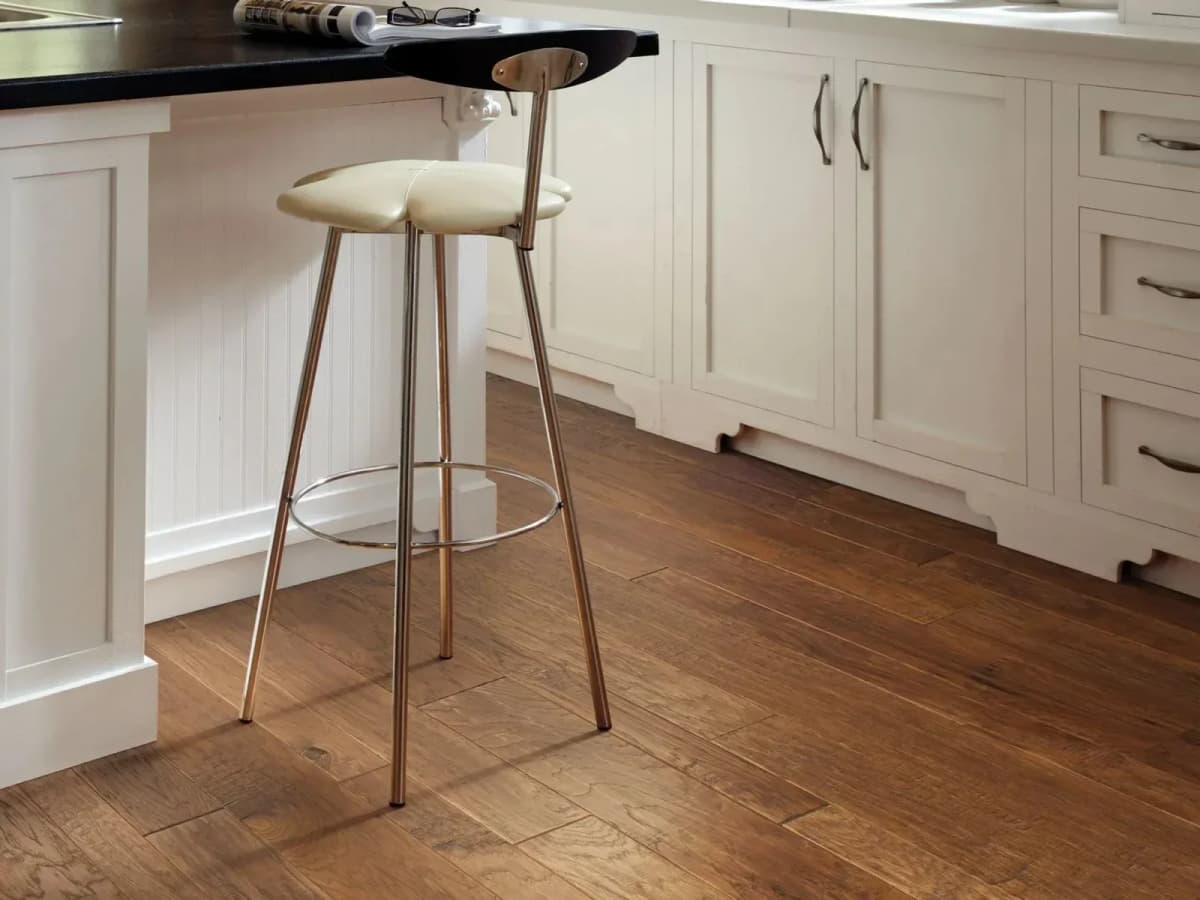
Top pick: Shaw Repel — Sanctuary Oak ($8.29/sq ft) or Pebble Hill Mixed Width ($7.99/sq ft)
Shaw's Repel collection is the most practical engineered hardwood for kitchens that see daily cooking, kid spills, and pet accidents. The water-resistant treatment handles real-life messes. Lifetime residential warranty on the structure. Oak (Sanctuary) or hickory (Pebble Hill) both stand up well to dropped pans.
Wear layer: 1.2mm. You won't refinish this floor; you'll replace it eventually. But for a family kitchen where the likely threat is a spill rather than slow wear, it's the right product. Read more in our Shaw hardwood buying guide.
For the cooking enthusiast (highest priority: wear layer + traffic durability)
Top pick: Anderson Tuftex Grand Estate ($15.09/sq ft) or Provincial Plank ($12.89/sq ft)
Both are 4-6mm wear layer white oak — the kind of floor a serious home cook installs once. Grand Estate is 10.25" wide with a 6mm wear layer; Provincial Plank is 7.5" with 4mm. Either one carries real wood above its core. Both are wire-brushed, though: NWFA measures a textured floor's wear layer at the lowest point of the texture, a sanding takes that texture off, and textured floors often cannot be sanded,Source 1 so have a flooring professional assess the floor before you plan on refinishing it when it shows wear.
These are not water-resistant in the same way Shaw Repel is. The trade-off: thicker wear layer in exchange for less spill protection. For a careful cook who cleans up immediately, the trade-off makes sense.
Browse the full Anderson Tuftex hardwood lineup.
For the value-conscious renovator
Top pick: Shaw Albright Oak ($5.99–$6.19/sq ft) or Anderson Tuftex Confection ($7.79/sq ft)
If your kitchen is part of a broader renovation and floor budget is tight, both options give you a real engineered hardwood floor at the lower end of the market. Albright is red oak, 1.2mm wear layer, classic American look. Confection is white oak, 2mm wear layer, slightly softer modern look.
Neither is water-resistant. Both are good values. For kitchens with light to moderate use, they perform fine.
For the high-design kitchen (highest priority: visual impact)
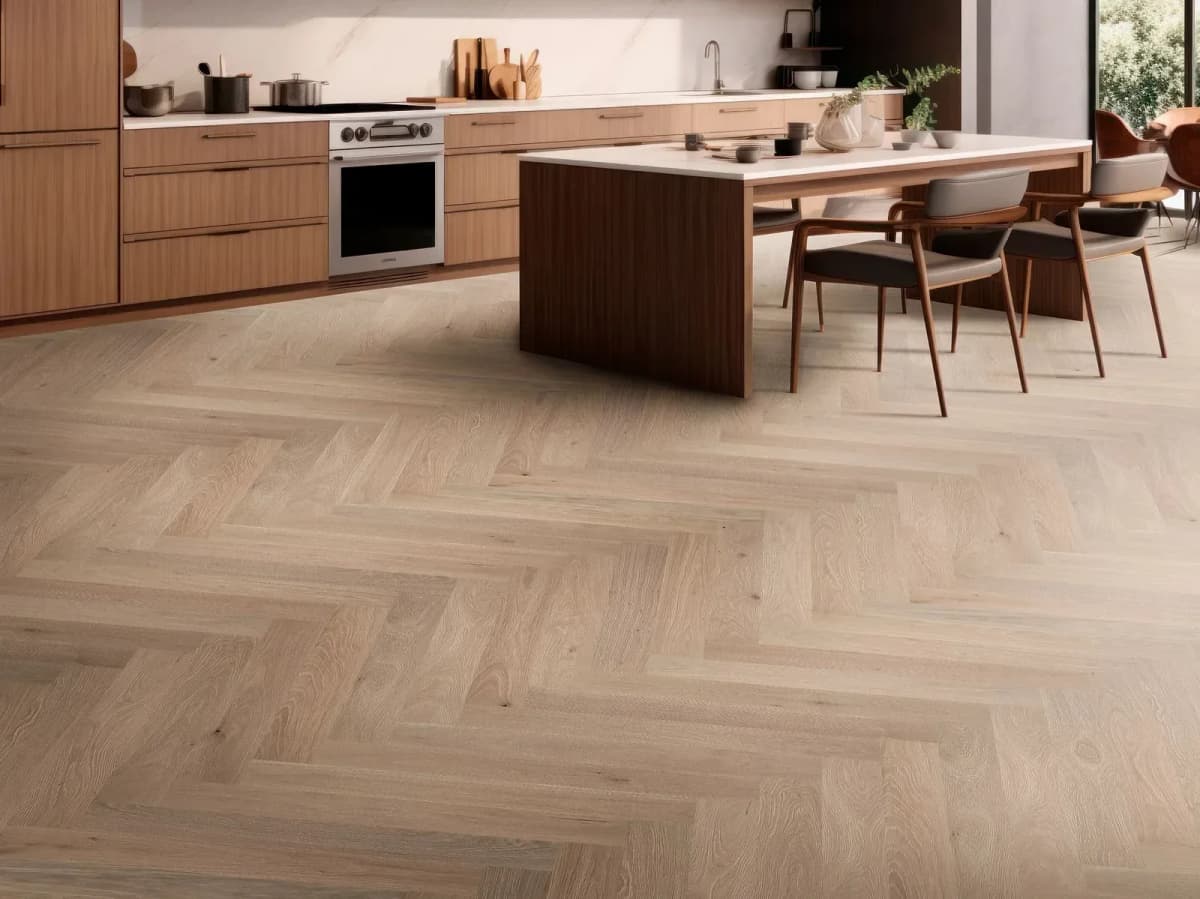
Top pick: Anderson Tuftex Provincial Herringbone ($10.79/sq ft) or Anderson Tuftex European Ash Herringbone ($12.89/sq ft)
For kitchens where the floor is part of the design statement, herringbone-pattern hardwood is striking. Provincial Herringbone is wire-brushed white oak with a 3mm wear layer; European Ash Herringbone is European ash with a 4mm wear layer. Both are glue-down only — installation is more expensive and demands a skilled installer. Every herringbone floor we carry is Anderson Tuftex; no Shaw hardwood style lays in that pattern.
Worth noting: herringbone hardwood is unforgiving of installation mistakes. Hire a contractor who has done it before, not someone learning on your kitchen.
What to Avoid in Kitchens
A few categories we'd steer you away from for kitchen installs:
Solid hardwood. Solid wood expands and contracts more than engineered with humidity. In a kitchen, that means seasonal gapping you'll see all year. We don't sell solid hardwood at FloorFreight; engineered is what you want for kitchens regardless of brand.
Walnut wear layers. Beautiful wood, but the 1010 Janka rating means dents from dropped pans are likely. Save walnut for bedrooms or formal dining rooms.
Hardwood with poor wear layer transparency. Some entry-tier engineered hardwood doesn't disclose wear layer thickness on the spec sheet. If a manufacturer won't tell you the wear layer, the wear layer is probably 0.6mm or less. Skip those products entirely.
Floating installations in kitchens with high humidity. Floating engineered floors work in most rooms, but kitchens with poor ventilation or older homes with humidity issues can cause floating floors to creak or shift. Glue-down or nail-down is more reliable in these conditions.
Installation: The Step Everyone Underestimates
The best engineered hardwood in the world fails if it's installed badly. In kitchens specifically:
Acclimate the wood. Engineered hardwood needs to reach moisture equilibrium with your home before it goes down — the NWFA frames this as matching the wood's moisture content to the conditions it will live in rather than waiting a fixed number of days, and flooring that already coincides with the in-use and subfloor conditions may be installed immediately.Source 2 Skipping the check is the most common cause of cupping and gaps that show up six months later. We cover this in detail in our hardwood acclimation guide.
Test the subfloor for moisture. Concrete subfloors below grade need a moisture barrier. Wood subfloors need to be dry (under 12% moisture content for engineered hardwood). Skipping the moisture test is an installer shortcut that costs the homeowner the floor.
Plan the layout around the kitchen island. Hardwood under a kitchen island is fine, but the seam between island and surrounding floor needs careful planning. Don't let the installer run planks around the island randomly — look for clean lines and minimal short cuts.
Allow expansion gaps near walls and cabinets. Wood expands. The 1/4" gap at every wall (covered by baseboard or transition strips) is what allows the floor to move without buckling. Skipping this gap in tight kitchens is another common failure mode.
Final Word
Engineered hardwood in kitchens works — when you match the product to the way you actually use the room.
For families with kids and pets, water resistance matters more than refinishability: Shaw Repel is the right call.
For serious cooks who'll be in this kitchen for 20+ years, wear layer thickness matters more than water resistance: Anderson Tuftex Grand Estate or Provincial Plank.
For budgets, white oak at 1.2-2mm wear layer (Albright Oak or Confection) gives you a real floor at a fair price.
For design-driven kitchens, herringbone delivers visual impact you don't get anywhere else.
The wrong choice is a 1.2mm walnut floor with no water resistance in a busy family kitchen. The right choice is matching the spec sheet to how the floor will actually live.
Order a $5 sample before you commit. Hardwood reads differently in your home's lighting than it does in a showroom or on a screen.
In this article
The floors from this guide

Shaw Hardwood
Sanctuary Oak
Serenity
Samples are $5 each, credited back at checkout when you sign in.

Anderson Tuftex
Grand Estate
Thorndon Hall
Samples are $5 each, credited back at checkout when you sign in.

Shaw Hardwood
Albright Oak 5
Rustic Natural
Samples are $5 each, credited back at checkout when you sign in.

Anderson Tuftex
Provincial Herringbone
Parchment
Samples are $5 each, credited back at checkout when you sign in.
Common questions
Frequently Asked Questions
Is engineered hardwood OK to use in a kitchen?
Yes, with the right product. Engineered hardwood handles kitchens better than solid hardwood because the cross-grain plywood construction resists humidity-driven expansion. The key specs are wear layer thickness and water resistance. For busy family kitchens, Shaw's Repel collection adds a surface sealant, and Shaw says Repel floors are 2X more water resistant than traditional hardwood. The products to avoid in kitchens are thin (1.2mm) wear layers without water resistance, walnut species (too soft at 1010 Janka), and floating installations in homes with humidity problems.
What wear layer thickness do I need for kitchen hardwood?
For a kitchen used heavily, 4mm or thicker is the best long-term choice — floors like Anderson Tuftex Grand Estate (6mm) or Provincial Plank (4mm) carry far more wood above the core than a 1.2mm floor and will outlast the cabinets installed around them. Both are wire-brushed, so the National Wood Flooring Association measures their wear layer at the lowest point of the texture, a sanding removes the texture, and NWFA says textured floors often cannot be sanded; have a flooring professional assess one before you count on refinishing it. A 1.2mm wear layer (most Shaw Repel styles) is a practical kitchen floor if water resistance is the priority. The 1.2mm floor gets replaced when worn; a thicker floor may be refinished instead, if a professional finds it can be sanded. Match wear layer to how long you plan to stay.
What's the difference between water-resistant and waterproof hardwood for kitchens?
Water-resistant engineered hardwood, like Shaw's Repel collection, has a surface sealant that repels splashes and spills long enough to clean them up without damage. It does not handle standing water for hours. Truly waterproof flooring doesn't exist in engineered hardwood — if your kitchen has an active moisture problem, a known leak risk, or sits on a slab below grade, luxury vinyl plank is the safer material. For typical kitchen spills and cooking splashes, water-resistant hardwood is sufficient.
Should I use solid or engineered hardwood in a kitchen?
Engineered, without exception. Solid hardwood expands and contracts with kitchen humidity — cooking steam, dishwasher splashes, seasonal humidity swings — and produces visible seasonal gapping year-round. Engineered hardwood's cross-ply construction resists this expansion. FloorFreight doesn't sell solid hardwood at all; engineered is the standard recommendation for any kitchen installation regardless of brand or price point.
Referenced in this guide
Sources
Wood Flooring Sand and Finish Guidelines (2016), pp. 19 and 25
National Wood Flooring Association · Accessed 2026-09-15
https://www.oldewoodltd.com/uploads/nwfa-sand-finish-wood-floors-2016.pdfNWFA Installation Guidelines
National Wood Flooring Association · Accessed 2026-08-03
https://nwfa.org/wp-content/uploads/2026/02/NWFA-Installation-Guidelines.pdf
Related Posts
Keep Reading
Shaw Hardwood Buying Guide: Repel, The Gallery and Expressions (2026)
9 min read
What Is the Best Flooring for Stairs? Hardwood, LVP and the Stair Nose (2026)
13 min read
Herringbone Flooring Guide: What Makes the Pattern Premium (2026)
8 min read
Best Hardwood for High-Traffic Homes: Janka, Wear Layer, and What Lasts
9 min read
Keep browsing